 Chef profiles
- Repeat the dishSuccessive test batches expose home-kitchen failure points.
- Specify variablesEgg size, cheese weight, and liquid become reproducible.
- Publish the updateThe latest “ultimate” version replaces an earlier answer.
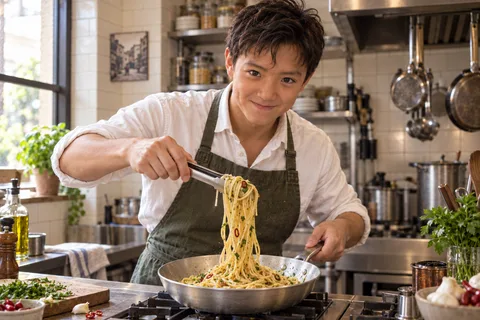
Ryuji treats a recipe as a versioned home experiment.
Over 1,000 test batches, and counting
Ryuji’s school doesn’t take recreating an authentic Italian technique as its starting point. For aglio e olio he says outright that he is “completely ignoring the authentic method,” while the “ultimate” carbonara leans traditional — where he stands differs from dish to dish. It keeps remaking the same dish over years, updating a running “ultimate ___” with the current best result of that testing. The carbonara video’s own title announces “over 1,000 test batches — how to make the ultimate carbonara, the most-played on YouTube,” and on the premise that the recipe has to work on a home stove with supermarket ingredients, the ingredients, heat level, and quantities are all specified down to the number. In the editors’ view, specifying even the egg size is the kind of granularity that sets this school apart from the others.
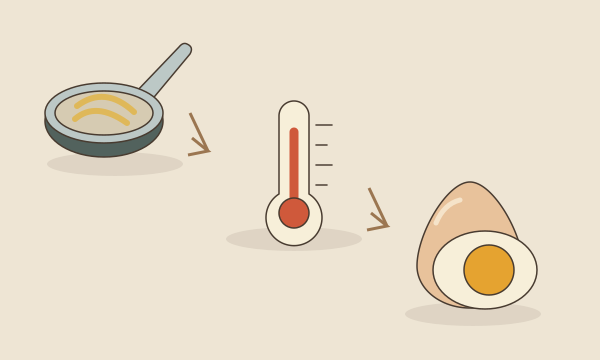
- Sauté aromaticsBacon, garlic, and chili leave the pan very hot.
- Turn heat offCooling resets the pan before egg enters.
- Low heat and stirConstant motion finishes the sauce without sudden setting.
Exact ingredients pair with a deliberate temperature reset.
Egg size is specified; the pan gets cooled first
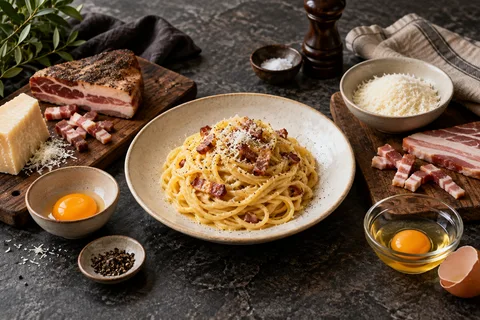
- Quantities are specified down to details like egg size. For carbonara, the recipe calls for “1 whole egg (large) plus 30 g grated cheese,” specifying even the egg size — a design choice that prioritizes repeatability at home (TubeRecipe transcript).
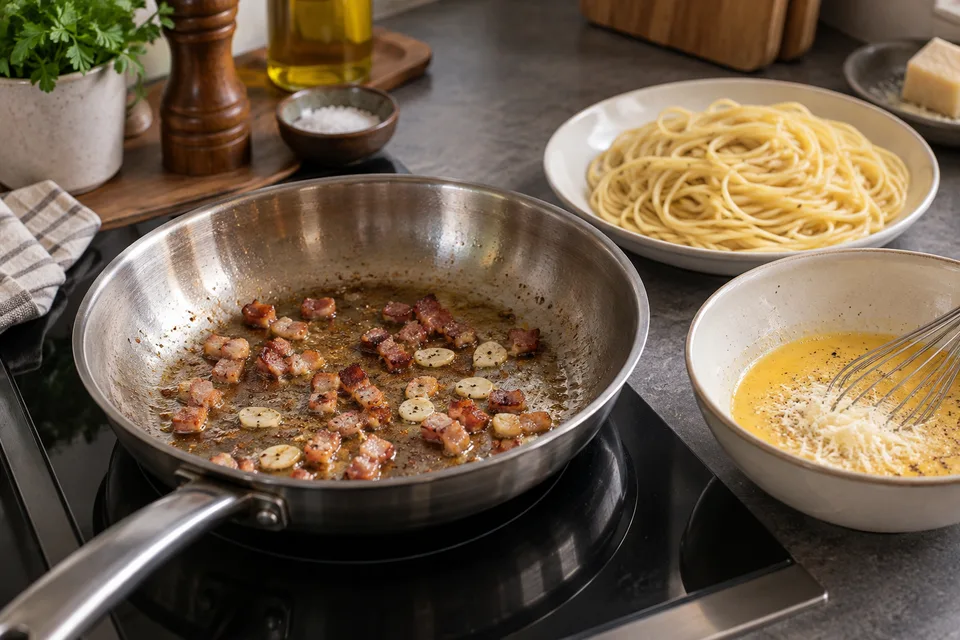
- The pan is cooled once after the aromatics are sautéed. For carbonara, after the bacon, garlic, and dried chili are sautéed, the heat is turned off and the pan is left to cool, then about 2 tbsp of pasta water and the pasta go in before it returns to low heat and the egg mixture is poured in and stirred constantly with a rubber spatula. Adding the egg mixture right after sautéing, while the pan is still hot, makes it set too quickly, so this “cooling” step resets the temperature before the egg goes in (TubeRecipe transcript).
- Some dishes sidestep the emulsification technique altogether. Aglio e olio skips boiling the pasta separately: the pasta cooks directly in 350 cc of water plus bouillon granules, a one-pot method. There’s no dedicated emulsifying step — the sauce naturally thickens as the water cooks off — and Ryuji himself describes it as “completely ignoring the authentic method,” calling it “heretical, yet the ultimate version” (Buzz Recipe official site).
- Napolitan gets pan-fried for extra fragrance. The seasoning centers on ketchup alone, though the official site’s instructions add “if the flavor is thin, add bouillon granules” (Buzz Recipe official site). Draining the pasta lightly and then thoroughly stir-frying it in the pan — the transcript notes that “frying it brings out more fragrance” — is what gets it close to the toasty aroma of kissaten (Japanese coffee shop) Napolitan.
Pressing play loads YouTube’s embedded player.Open on YouTube

- CarbonaraCool once, then stir egg over low direct heat.
- Aglio e olioSimmer pasta in one pan until the liquid thickens.
- NapolitanReduce ketchup, then fry noodles for toasted aroma.
Each “ultimate” dish solves heat in a different place.
Where carbonara, aglio e olio, and Napolitan diverge on heat
Even under the same “ultimate” banner, the heat and temperature design differs pasta by pasta.
Read the full explanation
- Carbonara: One whole egg, stirred constantly over low direct heat. The two-stage approach of cooling the aromatics before adding the egg mixture is what makes it distinctive. The same person also has other carbonara variants using a different method (not covered in this article) — this piece covers the more traditional “ultimate” line.
- Aglio e olio: A one-pan method that simmers dried pasta directly. The garlic goes into cold oil before the heat is turned up, and once it starts to sizzle, a pool of oil is formed and the garlic is colored slowly over low heat; the chili is always added later because it burns easily, as he explains. (The Buzz Recipe official page lists only ingredients and a video link, with no written steps; the written source for these steps is a third-party transcript.) Skipping a dedicated emulsifying step — letting the sauce thicken naturally as it reduces — is what sets this furthest apart from schools that build a whole step around emulsifying pasta water with oil.
- Napolitan: The sausages are cut on a diagonal — the transcript’s notes add that “a wider cut surface brings out more umami” — and the two-stage heat cooks off the ketchup’s acidity over low heat before the noodles get pan-fried. Some steps don’t spell out a salt percentage or boil time — in those cases, this isn’t a “presumably” hedge, it’s simply information that isn’t given.

- Restaurant axisPreserve the established process and ingredient logic.
- Ryuji axisPrioritize one-pan repeatability and supermarket access.
The optimization target is reliable home execution.
Not copying the authentic method — optimizing for home
Building flavor around umami seasonings (MSG/Ajinomoto, shiro-dashi, and the like) and cream-free variations that cut cost and effort are consistent threads throughout. This isn’t a simplification of the authentic technique — it’s better understood as a different optimization axis, one that maximizes repeatability within the constraints of a home stove, a single skillet, and supermarket ingredients. The one-pan approach is also collected in the book “Serious One-Pan Pasta” (Fusosha, March 2024).
Because this is a school built on precise measurements, eyeballing the cheese quantity tends to throw off the result. Weigh the 30 g of grated cheese on a kitchen scale and use a large egg as the transcript specifies, and the outcome becomes far more consistent.
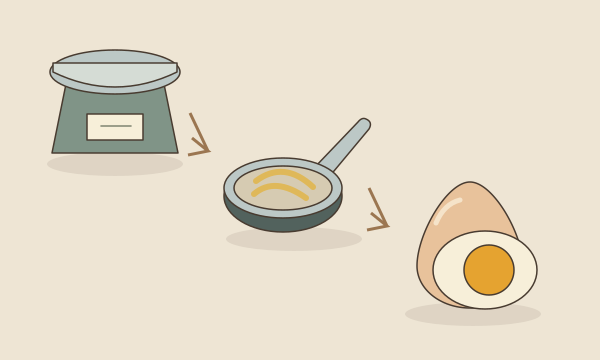
- Measure the setupUse the specified egg and cheese amounts.
- Reset pan heatCool the sautéed pan before adding wet ingredients.
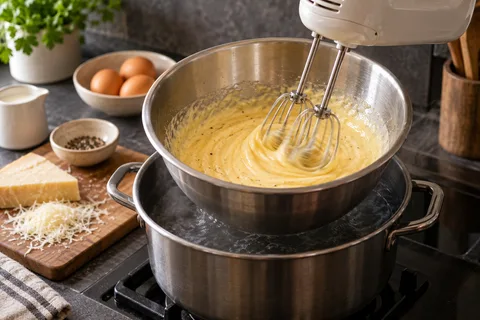
- Emulsify on lowReturn gently and keep the mixture moving.
Carbonara repeatability starts with the cooldown.
Summary: cool it down, then emulsify
Ryuji’s school isn’t organized around “how do you recreate the authentic dish” — it starts from “how do you raise repeatability at home,” and it’s a test-driven design. Carbonara uses a direct-heat method with a cooling step before the egg goes in, aglio e olio is a one-pan method that leaves out any dedicated emulsifying step and lets the sauce thicken naturally as it reduces, and Napolitan gets pan-fried for extra fragrance — the way heat is built differs from pasta to pasta. Start by making one of these exactly as the transcript describes, then compare it against other schools on the carbonara comparison page to see just how unusual Ryuji’s “cool it down, then emulsify” choice really is. If you want to rearrange the steps yourself, the recipe builder guide is also worth a look.