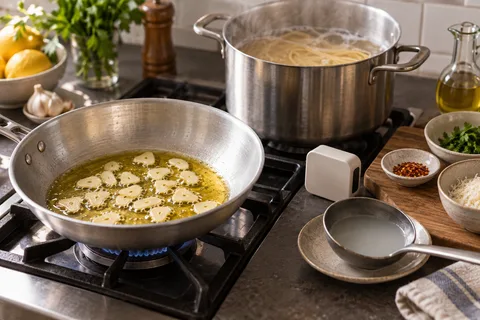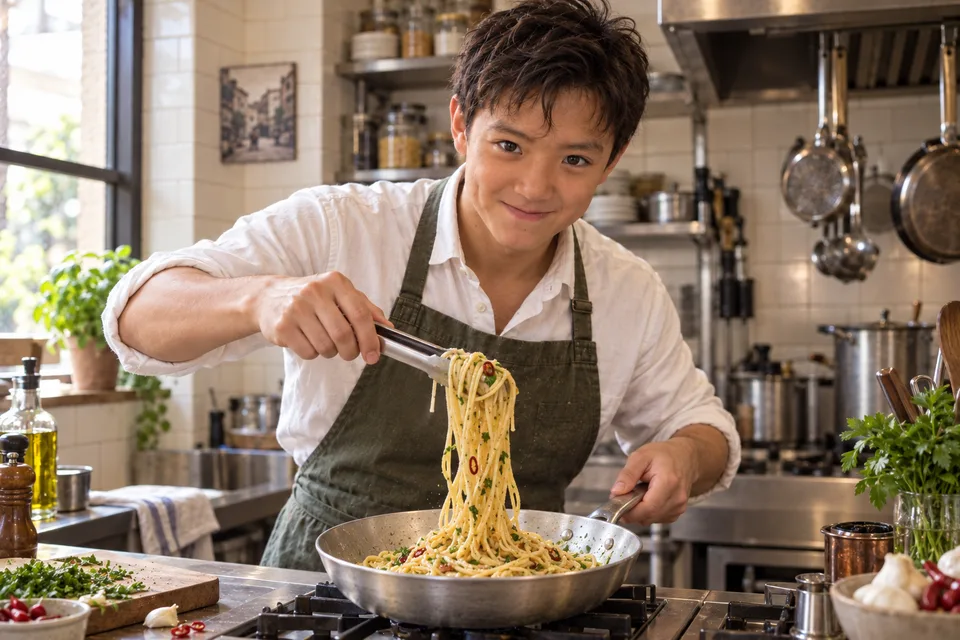
Left alone, oil and water separate. What turns them into one sauce isn’t muscle or stubbornness — it’s three conditions lining up: starch, temperature, and agitation. In the editors’ reading, every school’s technique really comes down to which of the three it trusts the most.

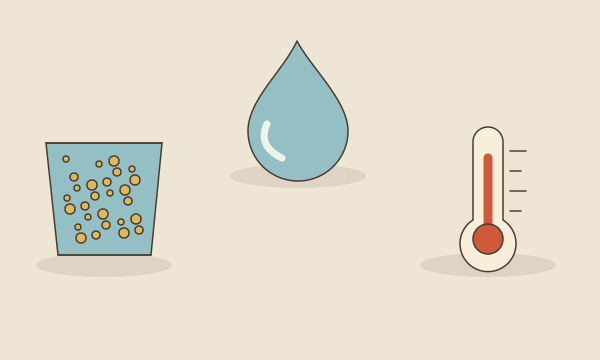
- Tiny oil dropletsAgitation breaks fat into droplets dispersed through water.
- Continuous water phaseThe surrounding liquid carries starch and seasoning.
- Starch in the waterThicker water helps slow oil droplets from rejoining.
A sauce holds when droplets stay distributed in water.
What’s actually holding the oil and water together
Left alone, oil and water separate. When starch from the pasta water gets involved, the water side thickens and the oil droplets have a harder time moving, which slows down how fast the finely broken-up oil regroups and separates again. That’s the practical reality of what cooks call “emulsification” in the kitchen. In French sauces, egg yolk and butter play the role that pasta water’s starch and cheese split between them here — though they don’t work the same way: egg yolk and cheese proteins coat the surface of oil droplets to stabilize them, while starch thickens the water side to slow separation.
When emulsification fails, clear oil pools at the bottom of the pan and the sauce turns watery. Go the other way — over-emulsify, or let the cheese or egg proteins seize up under too much heat — and the sauce breaks into clumps or splits. In other words, emulsification isn’t something that “just happens if you stir.” It only holds together within a narrow range defined by starch concentration and temperature.

- StarchAdds viscosity and slows droplet separation.
- TemperatureControls fluidity without overheating cheese or egg.
- AgitationBreaks oil into smaller droplets and distributes them.
Starch and motion support dispersion; heat control also protects egg and cheese.
Starch, temperature, agitation — each one does a different job
Starch concentration is set by how concentrated your pasta water is. The less water you boil the pasta in, the more starch leaches out of the noodles relative to volume, so even a small amount of pasta water works as a stronger emulsifier. Use more water, and the pasta water is more dilute, so it does less work helping the emulsion along.
Read the full explanation
Temperature mainly concerns egg and cheese. Egg white starts to set at around 58°C, egg yolk at around 65°C. The figures for full setting — yolk at 65–70°C, white near 80°C — come from the Chemical Society of Japan’s Kagaku Daisuki Club; the roughly 58°C figure for when egg white begins to set is a widely circulated rule of thumb for which this site has not confirmed a primary source. All of these shift somewhat with the individual egg, how fast it’s heated, and dilution. Cross that threshold and the sauce stops being a smooth emulsion and turns into something closer to scrambled eggs. Steps like pulling the pan off the heat in carbonara, or raising the temperature gradually with a bain-marie, are both ways of stopping the sauce just short of that coagulation point.
Agitation breaks the oil into finer droplets so the starch can coat them more easily. Even with identical ingredients at an identical temperature, oil and water will separate again if you don’t stir fast enough or long enough.
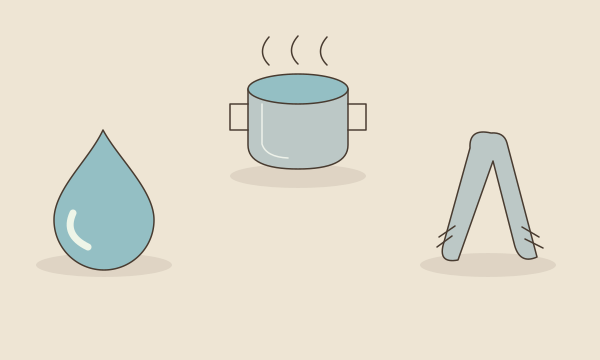
- Concentrated starchKenji changes boiling geometry to strengthen pasta water.
- Buffered heatFabio and Vincenzo soften heat through a bain-marie.
- Strong agitationOther schools toss or stir hard to disperse the fat.
Water and agitation shape dispersion; a bain-marie controls heating of egg mixtures.
Same emulsion, different condition each chef leans on
Carbonara is where the differences in how schools weight these three conditions show up most clearly. According to the site’s write-up of the video, Fabio sets a bowl with 3 egg yolks over a bain-marie and slowly brings it up to around 65°C while stirring constantly with a hand blender (the source is a third-party recipe article built from the video rather than a word-for-word transcript, and hasn’t been cross-checked against the full video; howtocook.jp). That’s a combination of managing temperature by the number and guaranteeing agitation with a machine.
Read the full explanation
Pressing play loads YouTube’s embedded player.Open on YouTube
Ryuji describes pouring an egg mixture made from 1 whole egg and grated cheese into a pan he’s already let cool after sautéing the other ingredients, over low direct heat, stirring constantly with a rubber spatula to emulsify it. It’s a way of compensating for the unpredictability of direct heat by cooling the pan first and never stopping the stirring (TubeRecipe).
In “Fava Bean Carbonara” (Italian Pro Training Course vol. 26), Tomomi Ogura is described as mixing 1 egg yolk, an equal amount of Parmigiano Reggiano, a little cream, and water in a bowl first, then combining it with the pasta after taking the pan off the heat. This takes heat out of the leading role in emulsification, building the consistency instead from cheese, the pasta water’s starch, and agitation (a plain version is published as vol. 8, but this fava-bean version is the only one whose figures can be confirmed from a transcript; TubeRecipe).
Aglio e olio uses neither egg nor cheese in the sauce (some schools do offer an optional dusting of Parmigiano at the finish), so emulsification rests almost entirely on the pasta water’s starch and on agitation. Where schools diverge is the timing — when, and how much, pasta water to add. According to the transcript site, Tomomi Ogura adds pasta water with 10 seconds left on the boil, pinning the start of emulsification to a specific point in time (the source is a third-party transcript and hasn’t been cross-checked against the full video; TubeRecipe). Tsutomu Ochiai adds 3 to 4 tablespoons of pasta water and swirls the pan, explaining that “once you can no longer see the sauce at the bottom of the pan, that’s your sign the pasta is well coated” (based on a published article; Cuisine Kingdom). Vincenzo’s Plate adds pasta water gradually while tossing with tongs, and the 1–2 drops of water added during cooking are there mainly to keep the garlic from scorching (Vincenzo’s Plate). Some schools skip active emulsification altogether — Ryuji’s one-pan method, for example, simmers dried pasta in a small amount of water and lets the starch thicken naturally as it cooks (bazurecipe.com). With so few ingredients in the dish, whether it emulsifies shows up directly in the flavor.
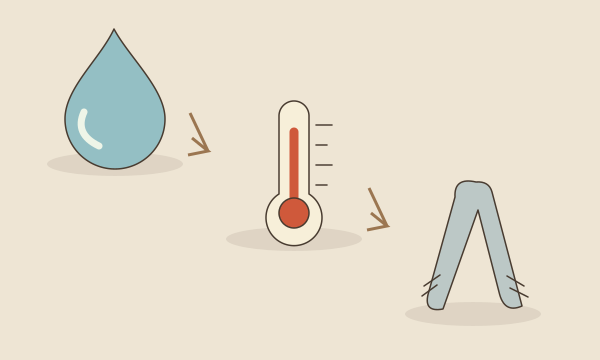
- Reserve cloudy waterCapture starch before draining the pasta.
- Lower the heatProtect cheese or egg from tightening too fast.
- Agitate graduallyAdd liquid in stages while tossing or stirring.
Starchy water, gentle heat, and motion form the safety net.
Three steps for stabilizing it at home
Start by using less water than usual so the pasta water’s starch concentration stays high enough to matter. Fixing the salt level as a percentage of your pot’s water ahead of time lets you manage emulsification and seasoning as two separate decisions.
Read the full explanation
Next, for sauces built on egg or cheese, decide in advance how you’ll keep from pushing much past the roughly 65°C point where egg yolk starts to set — taking the pan off the heat, dropping to a lower flame, whatever fits your method (schools like Fabio’s deliberately target around 65°C in a bain-marie; the usual explanation is that an egg mixture diluted with fat, cheese, and pasta water sets at a higher temperature, but this site has not confirmed a primary source for that). A cooking thermometer lets you check the egg mixture’s actual temperature instead of relying on guesswork for when to pull it off the heat.
Finally, add pasta water a little at a time and never stop stirring. Adding too much at once drops the temperature suddenly, which can break the emulsion rather than help it. Swirling the pan, or keeping tongs or a rubber spatula moving without pause — that continuous agitation is the last piece of the three conditions.
- Disperse the oilMotion breaks the oil into droplets throughout the water.
- Thicken the waterStarch helps slow the droplets from coming back together.
- Protect egg or cheeseWhen present, proteins need separate care against overheating.
Oil dispersion and protein coagulation are related cooking concerns, but different mechanisms.
Summary: it’s distribution, not magic
Emulsification isn’t a trick for force-mixing oil and water — it’s a phenomenon that only happens when three conditions line up: enough starch concentration in the pasta water, a temperature band where egg and cheese don’t seize up, and agitation that never stops. The differences between schools of technique are easiest to understand as differences in which of these three conditions gets managed with numbers and tools, and which gets left to instinct and experience. Compare the carbonara page and the aglio e olio page to see how each school actually builds its emulsion. For more on using the tools mentioned here, see how to use the recipe builder.



 Ingredients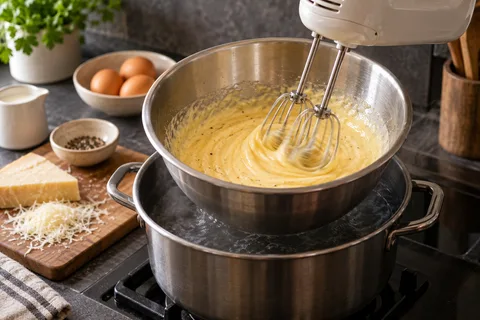
 Chef profiles