
- Tradition priorityProtect the dish’s established ingredient and process identity.
- Home priorityProtect repeatability, access, cost, or cleanup in one kitchen.
The schools optimize different constraints on the same plate.
The split isn’t about correctness, it’s about which variable wins
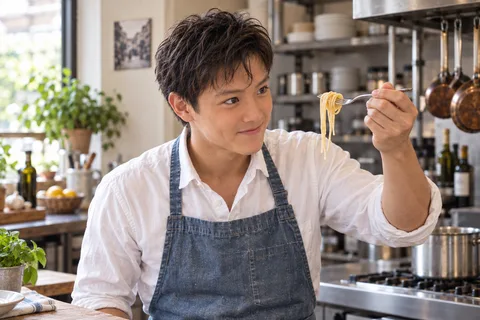
People sometimes say “Ryuji’s carbonara isn’t the real thing.” But laid side by side, the split isn’t about correctness at all — it comes down to three design decisions: ingredients, heat, and emulsion. As the editors read it, home cooks optimize for repeatability and low effort, while tradition-minded cooks optimize for ratios and where a technique comes from. Below, four schools of carbonara and aglio e olio are lined up to see exactly where those fault lines run.

- Traditional no creamEgg, cheese, and pork fat define the Roman structure.
- Home no creamSome home recipes also omit it for cost and simplicity.
- Cream variationOther versions use dairy as a stability or richness aid.
The same omission can serve different goals.
Fault line 1: skipping cream isn’t a tradition-only move
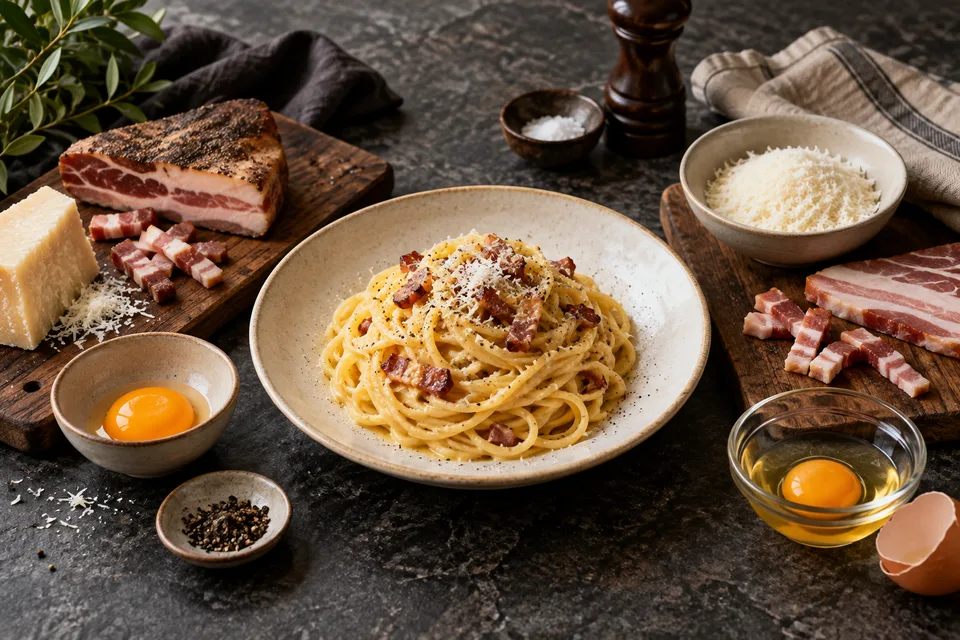
The clearest fault line is heavy cream. Ryuji’s carbonara uses one whole egg and 30 g of grated cheese, with no heavy cream at all (source). Vincenzo’s Plate, meanwhile, uses 3 egg yolks, 1 whole egg, and 90 g of Pecorino Romano — and its ingredient list contains no cream either (in the comments the author replies “no cream… ever!”) (source). In other words, “no heavy cream” is common ground between Ryuji and Vincenzo’s Plate, so it doesn’t cleanly separate a Japanese home-cook line from a traditional-Italian one.
Read the full explanation
Converted to a per-100g-of-pasta basis, Ryuji’s 30 g of grated cheese and Vincenzo’s Plate’s Pecorino Romano (90 g across 300 g of pasta) land at nearly the same amount, while Pasta Grammar comes in lightest at roughly 16 g (55 g across 340 g) (source, source). What actually diverges isn’t the absolute amount of cheese — it’s whether the egg is carried lightly with a whole egg or richly with just yolks. In his fava bean carbonara episode, Tomomi Ogura matches Parmigiano Reggiano to the egg yolk by weight and adds a small amount of heavy cream (whether this ratio holds for a plain carbonara hasn’t been confirmed — his standalone explanation of a plain version is unverified, source). That’s a third answer, distinct from the “tradition means no cream, period” line.
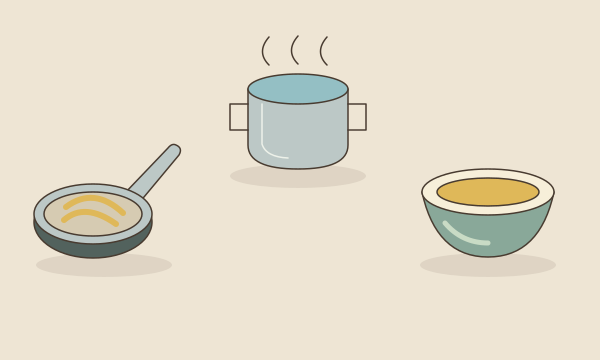
- Direct low heatStir constantly while the burner stays low.
- Bain-marie or steamWater buffers heat before it reaches the egg.
- Residual heatHot pasta cooks the mixture away from flame.
Egg choice matters less than the route heat takes.
Fault line 2: the same egg, set four different ways
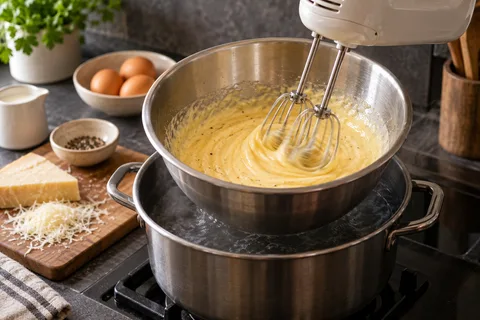
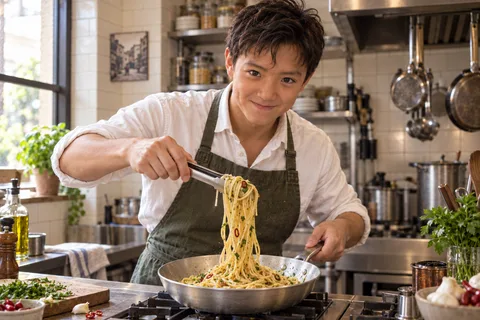
The second fault line is how heat reaches the egg mixture. Ryuji lets the pan he cooked the ingredients in cool down, then returns it to low direct heat and pours in the egg mixture while stirring constantly — a “direct heat, fixed low flame” method (source). Tomomi Ogura does the opposite: he takes the pan off the heat entirely, then folds in the egg mixture and pasta together — an “off-the-heat toss” method (source).
Read the full explanation
The two Western cooks land on yet different answers. Vincenzo’s Plate holds the pan directly over a pot of simmering water, so the steam’s indirect heat cooks the cheese-and-egg cream — a technique he describes as something he “picked up while living in Rome” (source). Pasta Grammar uses no heat source at all: the al dente pasta goes straight into a bowl of egg mixture, and the pasta’s own residual heat does the cooking. The same page also mentions “an old Italian belief that the hot pasta pasteurizes the egg” — presented there as an unverified piece of lore (source) — and offers a bain-marie as a fallback for anyone uneasy about skipping heat altogether. Direct flame, residual pan heat, steam, and pasta heat aren’t four competing claims to authenticity so much as four different answers to the same underlying problem: finding a temperature band where the egg won’t scramble.
Pressing play loads YouTube’s embedded player.Open on YouTube

- Salt the waterPlain sauces may need seasoning carried by the pasta.
- Reduce the saltGuanciale and hard cheese can supply much of it.
- Use no saltSome cacio e pepe methods rely entirely on Pecorino.
Salt concentration follows the other salty ingredients.
Fault line 3: salt gets adjusted dish by dish
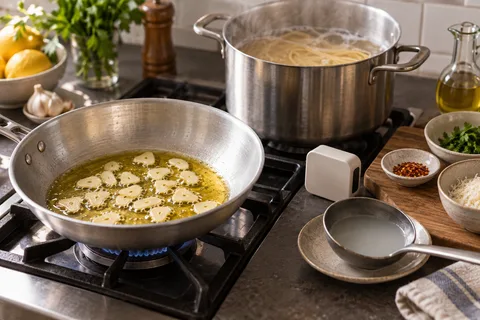
The third fault line shows up most clearly in aglio e olio, because schools disagree on how to think about salt. For aglio, olio e peperoncino, Pasta Grammar’s boiling-water instructions just say “generously,” with no specific amount given (source). But its carbonara instructions say to go lighter on the boiling salt “since the guanciale and Pecorino already carry plenty of salt” (source) — the site adjusts its salt guidance dish by dish. Ryuji’s aglio e olio takes an even more different direction: rather than boiling the pasta in a pot of water and tossing it after, he cooks it directly in the frying pan with 350 cc of water added straight in — a “one-pan method” — building flavor with two pinches of salt and 1 tsp of bouillon granules (source). He himself writes in the recipe post that he “completely ignored the traditional method” and calls it “heretical yet supreme” (source) — he isn’t hiding that this departs from the traditional standard.
Read the full explanation
For a 300–500 g batch serving four, Vincenzo’s Plate uses a large pot with about 5 L of water, sautés the garlic over low heat for roughly 5 minutes, and stops it from browning further by dropping in 1–2 drops of water when it starts to color; the emulsion is finished by adding pasta water gradually while tossing with tongs (source). Tomomi Ogura cooks his garlic longer, over medium-low heat for about 7 minutes, and adds pasta water 10 seconds before the pasta would finish boiling (source) — both cooks favor “gentler, somewhat longer” heat over “short and hot.” Ogura, at least, manages the start of emulsification by time — “10 seconds before the pasta is done” — which suggests he treats the exact moment the pasta water goes in as a design variable in its own right, more than the total boiling time.

- Scrambled eggLower, buffer, or remove heat before the sauce sets.
- Clumped cheeseCool the vessel and add finely grated cheese gradually.
- Flat or salty plateJudge seasoning across water, pork, and cheese together.
Different schools prevent the same failures by different means.
Common mistakes and how each school handles them
- The egg scrambles. Ryuji lets the sautéed pan cool before adding the egg mixture, which keeps it from setting even over direct heat (source). Tomomi Ogura’s “off-the-heat toss” never lets the egg mixture near direct flame in the first place (source).
- The emulsion breaks. Vincenzo’s Plate holds the pan over a pot’s steam — indirect heat that keeps the cheese-and-egg cream from overheating (source). Pasta Grammar uses no heat at all, and loosens a sauce that’s gone too thick by adding more hot pasta water (source).
- The dish turns out too salty. Pasta Grammar accounts for the salt already in the guanciale and Pecorino Romano and dials back the carbonara’s boiling salt accordingly (source). For a dish like aglio e olio, where the other ingredients bring little salt of their own, the pattern reverses — go generous rather than light (source).

- Choose the goalDecide whether tradition or home constraints lead.
- Choose the heat pathMatch technique to the margin your equipment gives.
- Rebalance seasoningAdjust salt only after pork and cheese are fixed.
A coherent plate starts with one optimization priority.
Summary
Lined up across ingredients, heat, and emulsion, the difference between home cooks and tradition-minded cooks isn’t “correct recipe versus a shortcut version” — it’s that each one optimizes for a different variable. Ryuji optimizes for repeatability and low effort, Tomomi Ogura for ratio logic, Vincenzo’s Plate for strict egg-and-cheese discipline, and Pasta Grammar for dish-by-dish salt balance. Start by cooking one school’s version exactly as written, then swap in steps from another school using the carbonara comparison page and the aglio e olio comparison page to see exactly which fault line you’ve crossed. The Ryuji chef page and the Vincenzo’s Plate chef page round up how each cook handles other pasta dishes too.


 Chef profiles