 Chef profiles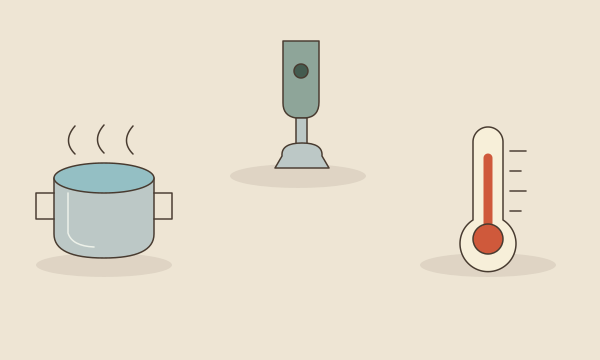
- Bain-marieSteam softens the heat reaching the egg bowl.
- Hand blenderContinuous blending spreads heat through the mixture.
- Temperature cueThe stated target makes doneness observable.
Fabio converts flame control into a measured process.
Turning the stovetop into a temperature you can actually read
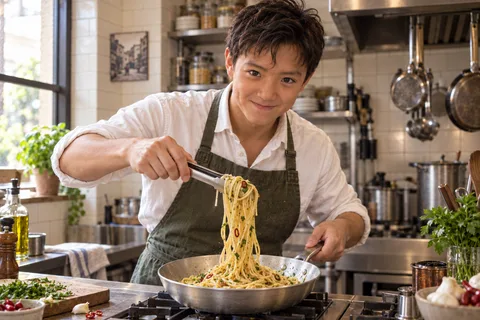
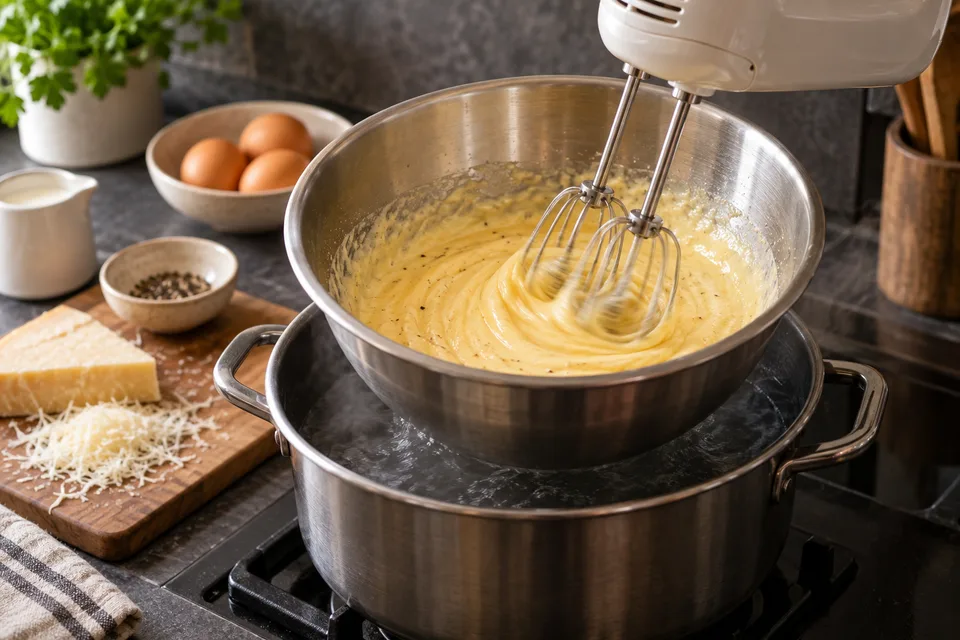
Fabio is a freelance chef with a background as an Italian cook, and his school is defined by translating technique learned in fine dining into forms a home cook can use. He’s known for episodes that make the same dish several different ways and taste them side by side (a 3-way carbonara comparison), and for episodes that hold every ingredient constant and isolate only the failure factor (why carbonara fails, tested). Across both formats he’s consistent about explaining why a given step is necessary, not just what to do. His carbonara skips cream entirely, in the authentic style that emulsifies with egg and cheese alone — and the biggest difference from schools that finish over direct heat is that he manages temperature with a bain-marie and a hand mixer.
Pressing play loads YouTube’s embedded player.Open on YouTube
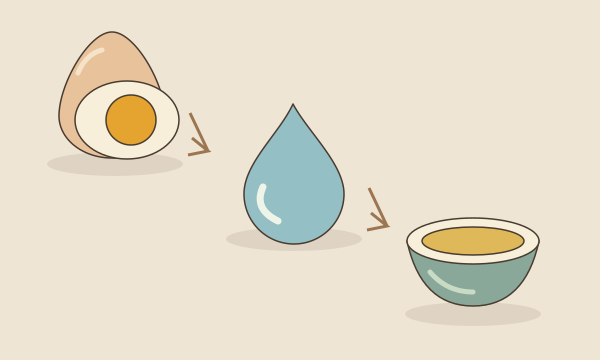
- Mix egg and cheeseBuild the base before adding hot liquid.
- Blend in hot waterDilution and motion spread the incoming heat.
- Warm over steamGentle heating thickens the sauce without curds.
Hot water is managed by dilution, motion, and buffered heat.
Pour in boiling water and the eggs still won’t set
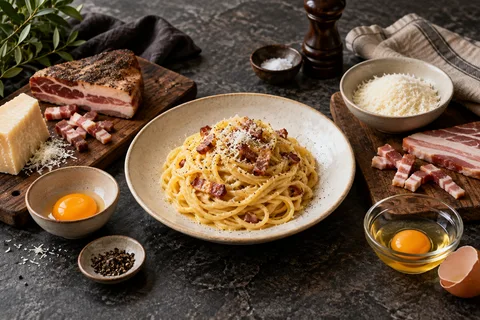
Per the transcript, the egg mixture for carbonara is built from 3 egg yolks, 10 g of Grana Padano, and 5 g of Pecorino, plus guanciale fat and 30–40 cc of pasta water cut with plain water. Three yolks against a combined 15 g of cheese is already a lighter cheese ratio than several other schools use — and that’s before Fabio’s signature move even starts.
Read the full explanation
- Set the whole bowl over a bain-marie and run a hand mixer continuously while slowly bringing the mixture up to about 65°C. In the editors’ view, a bain-marie can’t exceed the temperature of the water it sits in, which makes the temperature easier to read than over direct heat. The tip line inside the recipe steps reads, “even if you pour in boiling water, the eggs won’t set.” The line “working in a bowl over a bain-marie makes it hard to fail and lets you enjoy the authentic flavor,” by contrast, is the host site’s own editorial blurb, not Fabio’s words. The transcript doesn’t compare this directly to direct-heat safety, and cross-checking against the full video hasn’t been completed
- When the mixer starts to feel heavy, that’s the cue that the mixture has thickened — a hands-on way to judge the endpoint without a thermometer
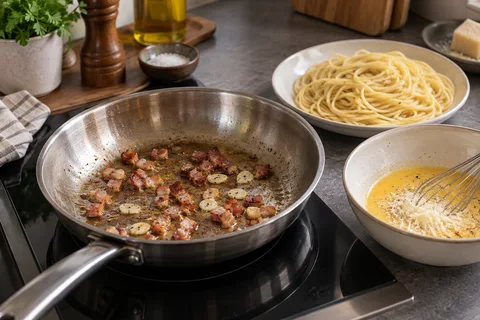
- Cut 45 g of guanciale into large cubes and render it slowly until crisp. The tip box says the rendered fat is “never thrown away” and goes straight into the sauce, and the framing that “rendering it until crisp is what makes it Roman pasta” comes from that same tip box
- Toss the drained pasta and guanciale together in the bowl, then set it back over the bain-marie for just a moment to bring it to final thickness. Finish with Pecorino Romano and black pepper, loosening with pasta water if it’s too thick
- The pasta is 70 g of 2.2 mm noodles, and the salt level is 1.5% of the boiling water — a design that appears built to let a thick noodle carry a rich sauce
- The source is a third-party site that rewrites the video into a recipe article (howtocook.jp) rather than transcribing it word for word, and cross-checking against the video itself hasn’t been completed. The host site’s blurb (written by its editors) describes the dish as a reproduction of “Chef Luciano, known in Italy as the ‘King of Carbonara’” — no surname is given there, and it hasn’t been confirmed against the video either
If the branch into bain-marie plus hand mixer is the part you’re curious about, the hand blender gear card below is a useful reference. The transcript’s own wording is just “hand mixer,” with no specific product identified (the products listed on the card haven’t been confirmed as Fabio’s actual pick). If you’d rather track temperature by the numbers instead of by feel, pair it with a thermometer — that lets you follow the roughly 65°C target as a hard number.
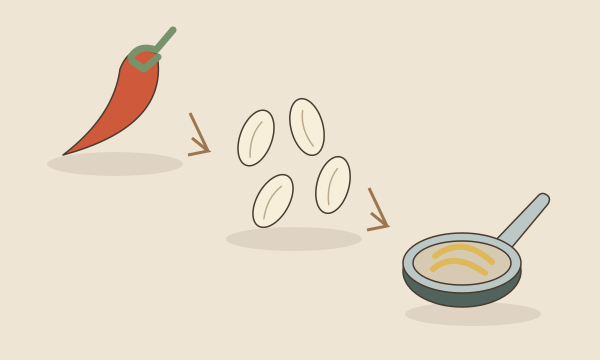
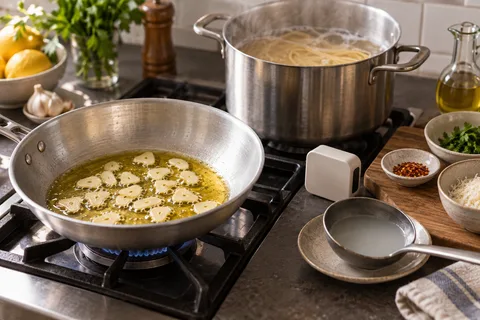
- Chili starts firstHeat the oil and whole chili first, per the recipe write-up.
- Garlic joinsAdd garlic when the chili begins to sizzle; swirl the pan.
- Different endpointsGarlic turns golden; the chili is deliberately blackened.
The write-up describes chili first, then garlic; the full video remains unchecked.
Garlic goes golden, chili goes black
The same attitude shows up in how Fabio dials in heat for aglio e olio. Per the transcript, 2 tablespoons of olive oil and 1 whole dried chili go into the pan over high heat; once the chili starts to sizzle, 1 clove of garlic is added and the pan is swirled to make chips. The garlic is cooked to golden, the chili to black — a char-forward design meant to push the aroma hard (the split between golden garlic and blackened chili is read off those two stated endpoints; the transcript never says outright that the garlic must not blacken).
Read the full explanation
- The salt for the pasta water is stated numerically as “30 g of salt in 2 L (about 2 quarts) of water” (1.5%), making this one of the more reproducible recipes referenced on this site so far. The source is the same third-party transcript site as the carbonara entry, and cross-checking against the full video hasn’t been completed
- The emulsion is built with Italian parsley, off the heat, using pasta water — the pasta itself only goes in afterward. In contrast to carbonara’s slow bain-marie ramp, aglio e olio here goes hard on high heat to build aroma fast, and the heat comes off only for the emulsion step
- After plating, a separately reduced tomato sauce is spooned on the side, giving one plate two distinct flavors
The pasta is 70 g of 1.7 mm spaghettini, boiled per the package time. That 1.5% works out to 15 g of salt per liter, so it translates directly to whatever volume your pot holds.

- Measured egg heatUse steam and blending to approach the target gradually.
- Aromatic sequenceChili receives the first strong heat; garlic joins later and stops at golden.
Fabio makes timing and temperature visible controls.
Summary
Fabio’s school treats carbonara and aglio e olio as two different problems solved the same way: define an endpoint in numbers and hit it with a tool — about 65°C via bain-marie and hand mixer for carbonara, and a chili charred fully black for aglio e olio’s aroma. Because he explains things by logic rather than by feel, the safest path the first time through is to reproduce the transcript’s amounts and temperatures exactly, then adjust for your own pot and stove afterward. The carbonara comparison page lines this school up against others so you can see just how unusual the bain-marie method is. If you want to mix and match individual steps, the recipe builder guide is also worth a look.