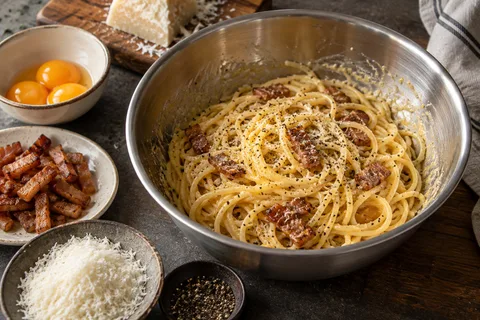
Carbonara alone — one dish — has real recipes salted at 1%, 1.5%, and 2%. The most commonly cited number for pasta salt is “10 g of salt per liter of water” (1%) — seawater runs about 3.5% salinity, so 1% is under a third of that. Within what this article could verify, real recipes range from no salt at all to roughly 2%. Numbers outside that range do turn up online, but none traced back to a sourceable recipe. Nobody here is wrong — the spread exists because different schools use salt to solve different problems.

- Season the noodleSalt enters pasta during boiling rather than only at the end.
- Season the sauceTransferred cooking water carries dissolved salt into the pan.
- Reboil and textureSalt also has a secondary effect on boiling and noodle texture.
Salt seasons noodle and sauce while also affecting the boil.
Salt concentration does three jobs at once
Salt in the boiling water serves three broad purposes: seasoning the noodle itself, functioning as an ingredient once the pasta water gets folded into a sauce, and a secondary effect on time-to-reboil and texture. Which of these a recipe prioritizes is what moves the number.
Read the full explanation
Ryuji specifies 1% salt in the water and pulls the pasta 1 minute under the package time (transcript). That’s arguably the standard-value approach — it balances “seasoning the noodle itself” against “keeping the pasta water flexible enough to loosen a sauce,” which matters for a home carbonara. Tsutomu Ochiai, by contrast, uses 2.5 tablespoons of salt in 3 liters of water (1.5%), a slightly stronger specification (recipe). Tomomi Ogura also specifies 1.5% for a fava-bean variation, though the video doesn’t state the water volume and whether the number applies to the plain version is unverified (transcript). Ogura’s book Hitotsuboshi Italian no Minimal Saiko Pasta (“Minimal Ultimate Pasta from a One-Star Italian Restaurant,” KADOKAWA) is organized around “5 major elements, sub-elements, and aroma elements” (book info), though the chapter contents are unverified, so whether salt concentration falls under that framework is unknown. Chef Ropia’s YouTube carbonara, meanwhile, specifies roughly 2% salt to water (transcript) — the strongest figure among the Japanese chefs’ carbonaras checked here. The same Chef Ropia specifies 1% salt for cacio e pepe (transcript), so the concentration moves by dish, not by chef. Even within a single dish — carbonara — three real recipes land at 1%, 1.5%, and 2%.

- Unsalted waterPecorino can supply all seasoning in a cheese-led sauce.
- Lightly salted waterCured pork and cheese leave only a small gap.
- Stronger brineSimple sauces may rely more on seasoning inside the pasta.
Zero is a dish-specific choice, not a missing step.
“Zero salt” has a rationale too
The spread isn’t only toward stronger salt; there are schools with grounded reasons for going lighter, even to zero. Vincenzo’s Plate’s 2026 revision of cacio e pepe drops the tablespoon of rock salt carried on the same page as the original method (labeled “OPTIONAL (Original Method Only)”), relying instead on the saltiness of the Pecorino alone. The 2026 revision also reduces the water volume to concentrate the starch (recipe). He states his reasoning explicitly, on two counts: the Pecorino Romano provides all the seasoning the dish needs, so the salt is unnecessary; and, more importantly, using less water concentrates the starch in the cooking liquid, which makes the sauce bind more smoothly (he cites research published in 2025 on the physics of cacio e pepe in support). Dropping the salt isn’t only about avoiding doubled-up seasoning — it’s part of a design change that puts starch concentration first.
Read the full explanation
The Serious Eats recipe credited to J. Kenji López-Alt (a separate cacio e pepe video also exists under his name, and whether it follows the same method as this recipe is unverified) pushes the reduced-water approach even further, cooking the pasta in just enough water to submerge it in a 12-inch pan. This is a starch-concentration method, and the salt is given only as “Kosher salt, to taste” in the ingredient list and “a small pinch of salt” in the steps — no number either way (recipe). Since neither the salt amount nor the water volume is given a number, a percentage can’t be calculated here. With less water, the starch in the pasta water gets more concentrated, and the volume of pasta water actually used in the sauce changes too — a detail that lining up percentages alone against other recipes can’t show.
The editors’ view is that much of the wide spread of numbers seen online comes from ignoring water volume, cheese saltiness, and whether a finishing salt is used, and simply lining up percentages side by side. A percentage is only the ratio of salt to water — without also matching the amount of pasta, the amount of cheese, and whether a finishing salt is added, a straight comparison doesn’t hold.

- Fix water volumeMeasure the actual amount in the pot.
- Count salty ingredientsInclude cured pork, cheese, and concentrated sauce.
- Choose and record saltWeigh the dose so the next plate can be adjusted.
Set salt after the dish and water volume are known.
How to think about it when cooking at home
At home, deciding what job the salt is doing in a given dish first — before picking a concentration — keeps you from getting pulled around by conflicting sources.
Read the full explanation
- Even for dishes heavy on salty ingredients like cheese or anchovy, the specifications verified in this article center on 1–1.5% (cacio e pepe: Tomomi Ogura 1.5%, Chef Ropia 1%; vongole: Tsutomu Ochiai just over 1%, Tomomi Ogura 1.5%). Dropping to zero salt is limited to designs with a heavy finishing cheese load, like Vincenzo’s Plate’s 2026 revision — so start at 1%, and dial it down next time if the saltiness comes out too strong
- For dishes with little fat or cheese salt to lean on, where the noodle’s own seasoning does the work (aglio e olio, for example), use 1–1.5% as the baseline
- If you plan to use a large amount of pasta water in the sauce, salt the water lighter to start (it concentrates further and gets stronger later)
Pressing play loads YouTube’s embedded player.Open on YouTube
“Rock salt,” which turns up in Western recipes, refers to coarse-crystal salt. An inexpensive coarse salt is plenty for pasta water, so if you want to keep one on hand for that, this kind of rock salt works fine.

- No universal percentageThe right number changes with sauce and finishing ingredients.
- Use one laneDo not combine a salty brine with a low-salt school blindly.
- Taste the whole systemJudge pasta water, pork, cheese, and reduction together.
Salt concentration is part of the recipe architecture.
Summary
There’s no single correct salt concentration for pasta water — real recipes span from zero salt to roughly 2%, a genuinely wide range. The spread exists because salt plays a different role from school to school: seasoning the noodle, functioning as a sauce ingredient, or standing in for a finishing salt. Rather than taking any single number at face value, look at what job salt is doing in the dish you’re making, and pick a concentration from there — that keeps the disagreement between sources from being a problem. A good place to start is the carbonara chef comparison, where you can compare how different chefs handle the boil side by side.