The box time appears to assume pasta eaten straight from the pot, though we could not find a manufacturer stating that outright. Skip the subtraction before a pan toss, and it turns soft.
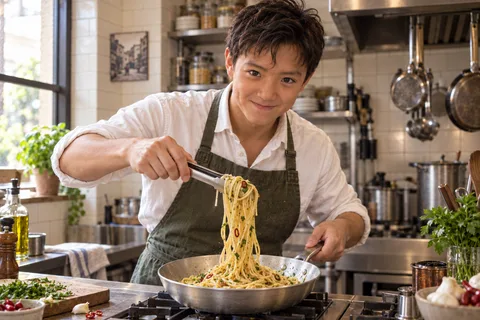
Japanese chef
Tsutomu Ochiai
Tsutomu Ochiai
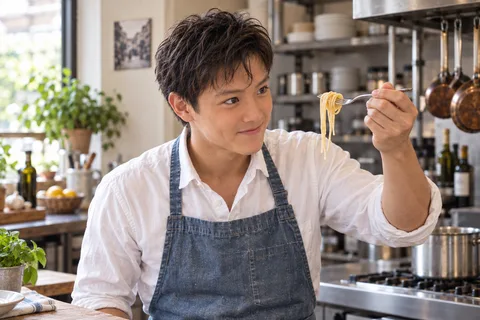
Heat control and residual-heat finishing Narrows the cause of failure down to a single point — heat control — finishing the dish just short of fully thickened and letting residual heat carry it the rest of the way while plating. Has no personal YouTube channel; his recipes are sourced from NHK's Kyo no Ryori and his books.
LA BETTOLA da Ochiai (official site)
What defines this chef’s technique
- Heats the egg mixture over medium heat, scraping the pan with a heatproof rubber spatula as it cooks
- When it starts to set, pulls it off the heat to stir, then returns it to the heat, repeating as needed
- Removes from the heat just short of fully thickened, finishing with residual heat
- Once the bacon is crisp, deglazes the pan's fond with water (or pasta water)
- Uses 2 whole eggs plus 2 egg yolks for 2 servings
Cook from this chef’s recipes
6 dishes


Gear and ingredients referenced by Tsutomu Ochiai
Add them all to your shopping list
No gear confirmed from sources yet. We add items as they show up in videos.
Articles about Tsutomu Ochiai
Emulsifying pasta sauce isn't about mixing harder. It happens only when starch, a safe temperature, and nonstop agitation all line up. Four schools split the work differently.
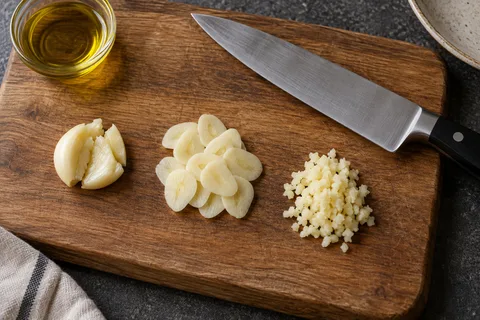
How you cut garlic trades off aroma against burn risk. Mincing should burn fastest, yet Ryuji starts it in cold oil — reading that as burn-proofing is the editors' inference, not his source's.
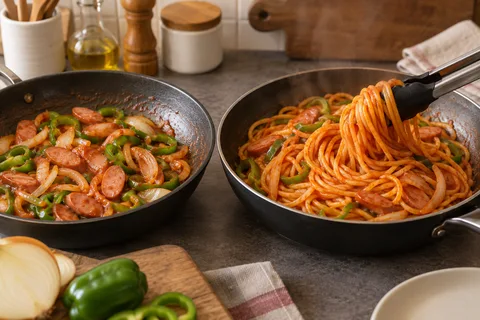
Fabio fries the noodles themselves in the pan and Ryuji fries them too, but Ochiai takes the pan off the heat and only tosses. Five schools compared on noodle, ketchup, and frying.
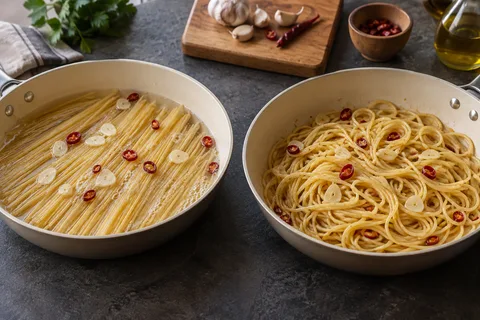
Ryuji calls his own aglio e olio "heretical, yet supreme." We trace how it swaps emulsification and water-ratio math for one-pan cooking and umami seasoning, across his 2020 and 2023 recipes.
Ryuji's ultimate aglio e olio lists olive oil on two separate lines — one tablespoon each, the same oil. The split appears to come down to whether the oil hits heat.
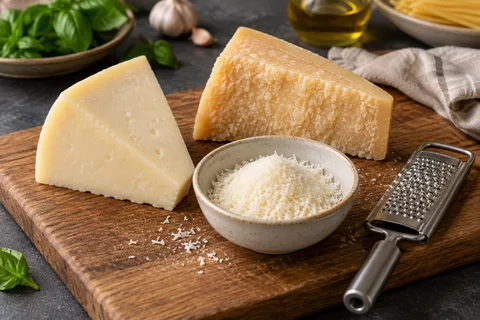
Pecorino is salty sheep's-milk cheese; Parmigiano is milder cow's-milk. Some recipes leave the water unsalted so Pecorino carries the salt; others salt it heavily instead. Pick the cheese first.
Ryuji's peperoncino skips emulsification: he simmers dried pasta directly in water and bouillon. Tomomi Ogura adds pasta water with ten seconds left on the boil. Six chefs compared.
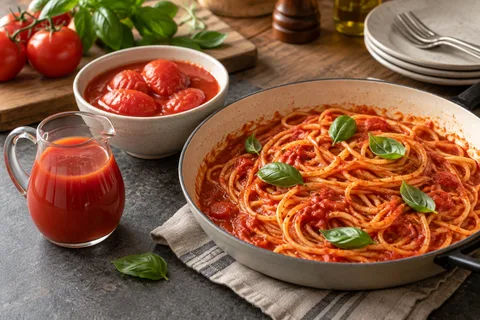
In this recipe Ochiai skips the can and reduces unsalted tomato juice instead, reasoning it's the same tomato at the source. Once pasta hits his sauce, he never turns the flame back on.
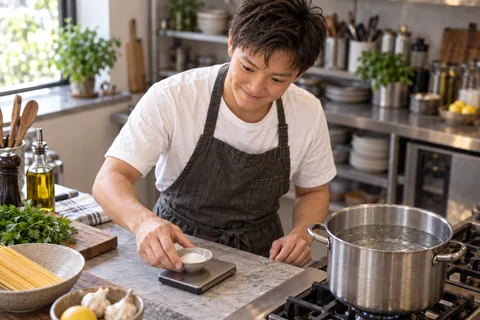
The standard line is 10g salt per liter (1%), but real carbonara recipes split into 1%, 1.5%, and 2%. Cacio e pepe has a school that uses none at all — the number moves with the job salt is doing.
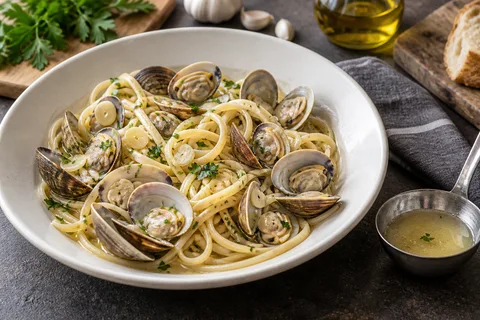
Ryuji's vongole bianco includes a half-teaspoon of kombu tea. Seven takes split on one real question — does the pasta drink clam liquor straight, or get tossed with a pasta-water emulsion?