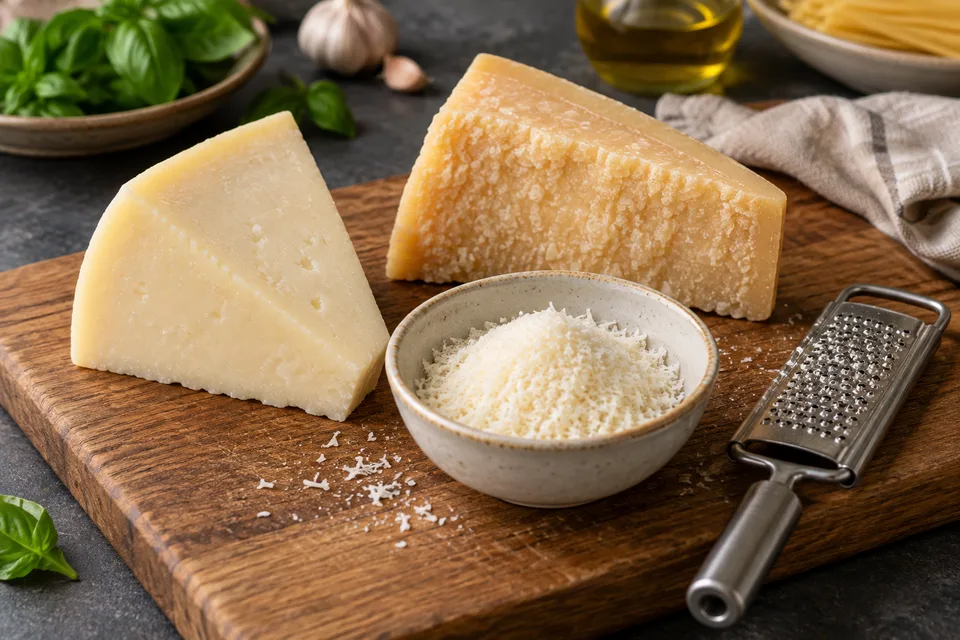

- Pecorino RomanoSheep’s milk gives a salty, forceful Roman profile.
- Parmigiano ReggianoCow’s milk gives a milder, fruitier dairy profile.
- Generic grated cheeseAn unspecified blend prioritizes access over provenance.
Changing cheese changes milk source as well as salt.
Pecorino and Parmigiano come from different milks
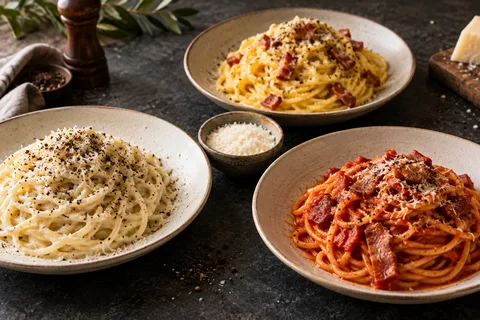
Compare carbonara and cacio e pepe recipes and the cheese called for varies: “Pecorino Romano,” “Parmigiano Reggiano,” or simply “grated cheese.” This isn’t just a preference in wording — the cheeses are made from different raw milk entirely. Pecorino is a family name for sheep’s-milk cheeses, and Pecorino Romano, the one called for in Roman recipes, carries DOP (Protected Designation of Origin) status and delivers a strong, salty, savory hit. Parmigiano is a DOP cow’s-milk cheese with milder salt than Pecorino and a somewhat different quality of umami. Rome’s four classic pastas (carbonara, cacio e pepe, amatriciana, and gricia) technically call for Pecorino, but in practice many Japanese recipes swap in Parmigiano or generic grated cheese instead.

- Pecorino-ledRoman-focused schools make the sheep cheese the reference.
- Mixed cheeseSome recipes soften Pecorino with Parmigiano.
- Home substitutionJapanese recipes often use Parmigiano or generic grated cheese.
Authenticity and accessibility pull cheese choice differently.
Authenticity-minded chefs lean toward Pecorino
Chefs leaning toward authentic Roman style clearly favor Pecorino. Vincenzo’s Plate whisks 90g of Pecorino into the egg mixture for carbonara and states a personal rule of at least 30g per 100g of pasta. For cacio e pepe the channel is just as consistent, making a “Pecorino paste” and melting it with steam. J. Kenji López-Alt (Chief Culinary Advisor at Serious Eats, with videos on his own channel) uses 55g of Pecorino alone plus 30g of unsalted butter for cacio e pepe (per the ingredient list in the official Serious Eats recipe; the direct link is currently bot-blocked, so this was confirmed on the Wayback Machine copy). Pasta Grammar uses equal parts Pecorino and Parmigiano, 30g each, taking the pan off the heat and letting it cool for three minutes before adding the cheese gradually.
Read the full explanation
Recipes commonly referenced in Japan, by contrast, lean toward Parmigiano or generic grated cheese. This tendency shows up even among restaurant chefs (Tomomi Ogura, Tsutomu Ochiai), though some, like Fabio, use a small amount of Pecorino alongside it. The editors’ read is that availability of Pecorino Romano DOP may be part of what recipes built for home reproduction are taking into account. Tomomi Ogura’s “Fava Bean Carbonara” uses Parmigiano in an amount equal to the egg yolks (a source for a plain, standalone carbonara has not been identified). Tsutomu Ochiai’s cheese and amounts differ by source: the NHK version calls for 25g of grated cheese (two servings, 140g of pasta), the Kodansha version for 30g of Parmigiano (two servings, 160g of pasta). Ryuji’s carbonara and cacio e pepe recipes both just say “grated cheese,” and the specific brand can’t be pinned down from the transcript (unverified).
Serious Eats’s carbonara (by Daniel Gritzer), along with Pasta Grammar’s and Italian chef Max Mariola’s cacio e pepe, take a “mixed” approach, using both Pecorino and Parmigiano. Serious Eats whisks 25g of Pecorino and 25g of Parmigiano in equal parts into an egg mixture of 2 whole eggs and 6 yolks for four servings (per the official Serious Eats recipe’s ingredient list: 450g of pasta for four servings, 2 whole eggs plus 6 yolks, 25g Pecorino and 25g Parmigiano. That works out to about 5.6g each of Pecorino and Parmigiano per 100g of pasta). Serious Eats explicitly spells out its reasoning for the 50:50 split: Pecorino on its own comes across as too assertive. The same article also spells out Parmigiano’s role: cutting Pecorino’s assertiveness with the “sweeter, fruitier” Parmigiano keeps the dish from tasting excessively salty or sharp. Max Mariola adds whole black peppercorns and a tablespoon of Parmigiano to a Pecorino cream (per the recipe text published by Sky TG24).
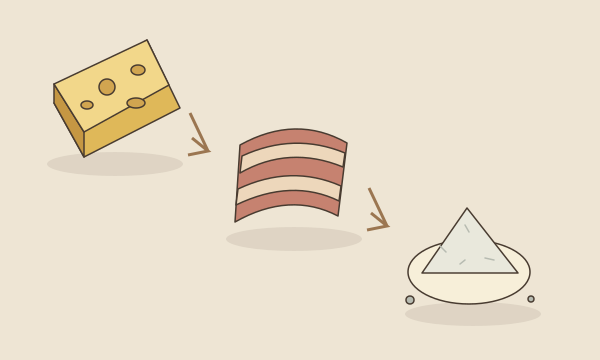
- Choose the cheeseTaste the actual wedge or grated product first.
- Count salty partnersInclude guanciale and any other cured ingredient.
- Set pasta-water saltAdjust the pot only after the cheese is fixed.
Seasoning begins with the cheese, not a universal brine.
Saltiness is the first thing that changes
Because Pecorino carries strong salt, it can easily stack with the salt concentration of your pasta water or other salty elements in the dish — worth watching closely. In a dish like cacio e pepe, where the only components are cheese and pepper, schools of thought split on how to handle the pasta water’s salt. Vincenzo’s Plate, in its 2026 version, leaves the boiling water unsalted and lets the Pecorino carry all the salt; Kenji López-Alt likewise keeps salt to a pinch. Pasta Grammar goes the opposite direction, calling for “plenty of salt.” Deciding on the cheese brand first, then adjusting the salt-per-water-volume ratio to match its saltiness, keeps the overall flavor design from drifting. Parmigiano and generic grated cheese carry milder salt, so in many cases a standard salt concentration in the boiling water works fine.
Pressing play loads YouTube’s embedded player.Open on YouTube
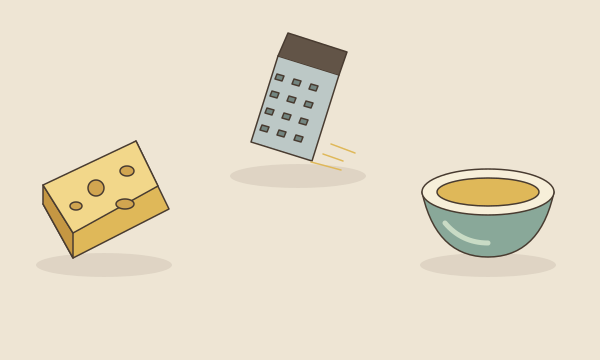
- Coarse particlesLarge pieces need more heat and clump more easily.
- Microplane-fineSmall particles disperse faster in warm pasta water.
- Off-heat mixingLower heat limits protein tightening during melting.
Fineness and heat jointly determine whether cheese disperses.
Melt behavior and how finely the cheese is grated
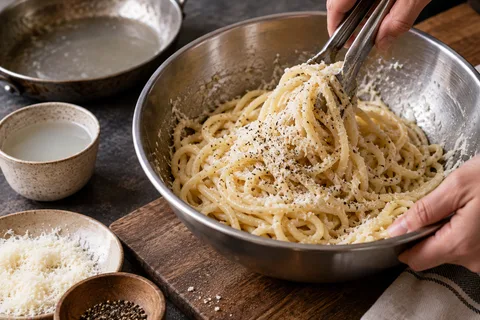
Both Pecorino and Parmigiano are hard cheeses, and their proteins tend to clump when heated (Pasta Grammar and Serious Eats both describe the failure mode as clumping). That’s why so many schools of cacio e pepe take the pan off the heat before mixing in cheese: Italia Squisita’s featured recipe from Claudio Gargioli (of Rome’s Armando al Pantheon) explains the original method as mantecare done “sempre a fuoco spento” — always with the heat off. Another factor at play is how finely the cheese is grated. Kenji López-Alt is reported to grate Pecorino with a microplane (a fine-toothed grater); compared to a coarser grater, this increases surface area and helps the cheese dissolve more readily into the pasta water. We cover grating tools in more depth in Cheese Graters vs. Microplanes.
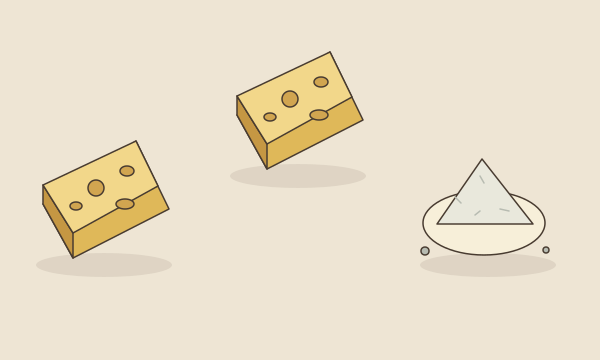
- PecorinoChoose sheep’s milk for stronger salt and Roman identity.
- ParmigianoChoose cow’s milk for a gentler dairy balance.
- Then adjust saltMatch the pasta water to the cheese actually used.
Cheese identity sets both flavor and salt strategy.
Summary
It helps to think of this in three layers: Pecorino for sheep’s milk, strong saltiness, and an authentic Roman style; Parmigiano for cow’s milk, milder saltiness, and Japan’s home-style recipes; and generic grated cheese for a brand left unspecified more often than not. Because the saltiness differs so much between them, the safer approach is to settle on the cheese brand first, then adjust the boiling water’s salt concentration to match. Some schools mix both cheeses together, so start by reading through the Carbonara or Cacio e Pepe comparison pages and compare how each chef specifies cheese and saltiness. Our thinking on salting the pasta water is laid out in There Is No Single Right Salt Concentration for Pasta.



 Ingredients