Tellicherry Is a Size Grade, Not a Variety
 Ingredients
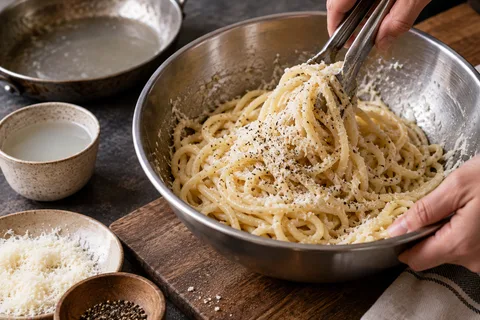
Cacio e pepe has just two elements asserting themselves — Pecorino's salt and pepper's bite — so grind coarseness alone changes the plate. Tellicherry is a size grade, not a variety.
Japanese chef
Chef Ropia (Akifumi Kobayashi)
Authentic-first (no cream) Builds his approach around the position that "true carbonara doesn't use cream," translating restaurant technique for home cooks. Also runs comparison episodes with veteran Italian chefs as guests.
Chef Ropia料理人の世界 · ~583K subscribers (as of 2026-09-05)
Plays through the official embed
Ragù alla bolognese累計560万再生!【極上ボロネーゼ】シェフが辿り着いた家庭で作る極みのレシピ
Cacio e pepe材料3つで極上パスタ【カチョエ・ペペ】深夜に作ったら最高です
Carbonaraプロが教える カルボナーラの作り方 【生クリームを使わない】
Napolitanナポリタン(Chef Ropia料理人の世界・書き起こし)
Spaghetti alla puttanescaプロが教える【娼婦風パスタ】 プッタネスカ Puttanesca
CarbonaraA Pro's Carbonara [Without Cream]
5 dishes


Add them all to your shopping list
Each link is based on the source note on the card and on the chef’s own videos and posts. Items marked “unverified” include editorial guesses. None of this is an endorsement or partnership.
Cacio e pepe has just two elements asserting themselves — Pecorino's salt and pepper's bite — so grind coarseness alone changes the plate. Tellicherry is a size grade, not a variety.
The box time appears to assume pasta eaten straight from the pot, though we could not find a manufacturer stating that outright. Skip the subtraction before a pan toss, and it turns soft.
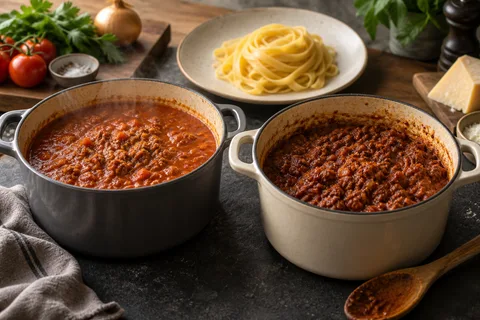
Seared or pale, red wine or white, milk or none — eight chefs disagree on nearly everything, and simmer time alone splits by a full order of magnitude, 30-60 minutes against 3-5 hours.
Cacio e pepe comes down to cheese and black pepper, yet almost every failure has one cause — a pan that's too hot when the cheese goes in. Eight chefs split into three schools for that moment.
Carbonara splits over one question — where the egg comes up to temperature. Direct heat, bain-marie, or residual heat: five chefs, plus the tip line in Fabio's transcript about hot water and eggs.
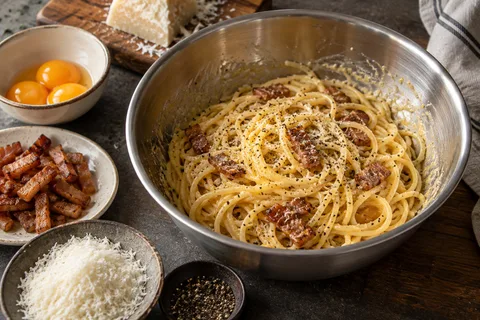
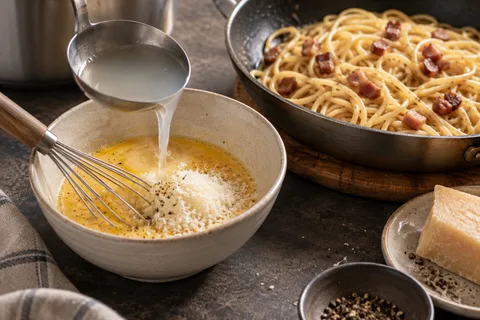
Chef Ropia's carbonara never touches cream — egg and cheese alone create the emulsion. In his book, he thins the egg mixture with cooled pasta water first, which he says keeps it from going lumpy.
Fabio fries the noodles themselves in the pan and Ryuji fries them too, but Ochiai takes the pan off the heat and only tosses. Five schools compared on noodle, ketchup, and frying.
Ogura's fava bean carbonara, Fabio's rich carbonara and Gritzer's carbonara all pull the egg off direct heat.
Ryuji scatters raw cracked peppercorns at the finish; Pasta Grammar roasts them 4 minutes, then pounds them in a mortar. Grind and heat alone split cacio e pepe pepper into at least four schools.
The standard line is 10g salt per liter (1%), but real carbonara recipes split into 1%, 1.5%, and 2%. Cacio e pepe has a school that uses none at all — the number moves with the job salt is doing.
Moving pasta from pot to pan comes down to two tools. That how much pasta water rides along changes the finish is the editors' read, not a relationship our sources tested.
 Chef profiles