 Chef profiles
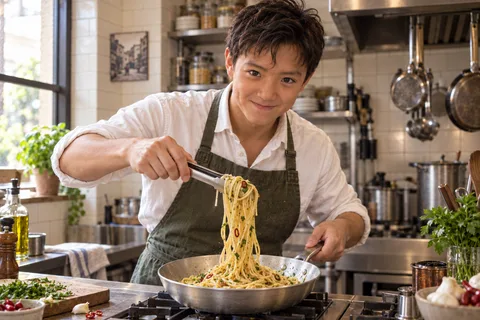
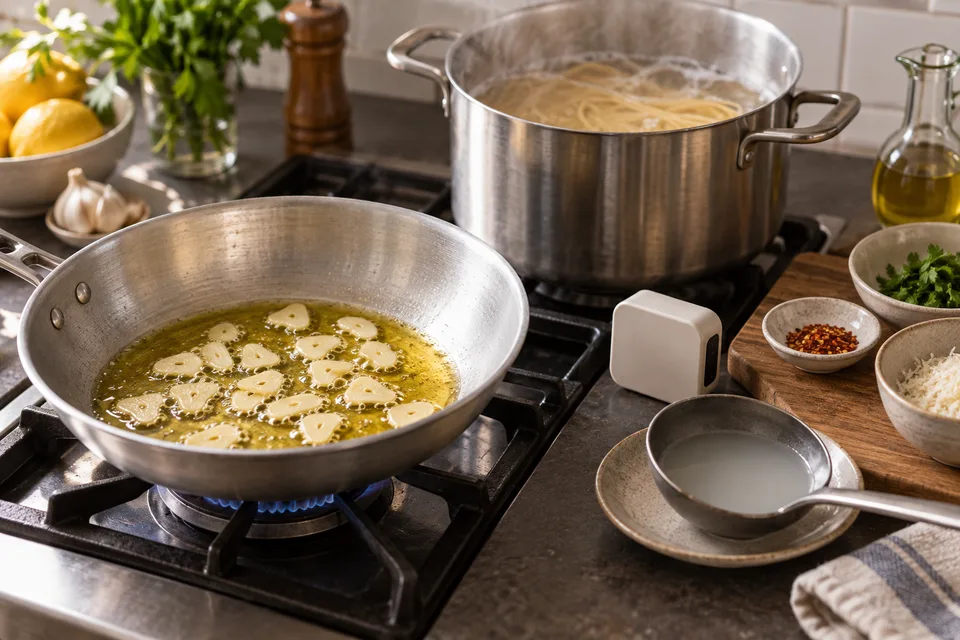
Tomomi Ogura calls for heating the garlic “over medium-low to low heat for about 7 minutes,” and starts his emulsion at the 10-second mark before the pasta finishes boiling — both given as numbers on the clock. The owner-chef of Regalo in Sangubashi doesn’t lean on feel-based words, giving the main steps as numbers instead: 1.5% salt, Parmigiano Reggiano matched to egg yolk by weight, 7 minutes for the garlic (though some things, such as water volume and boiling salt, are left unnumbered).

- Egg yolk weightThe yolk supplies the reference amount for the sauce.
- Equal cheese weightParmigiano matches that yolk weight rather than a fixed spoonful.
Ogura scales the cheese from the yolk, one to one.
Egg yolk and Parmigiano set at an equal ratio
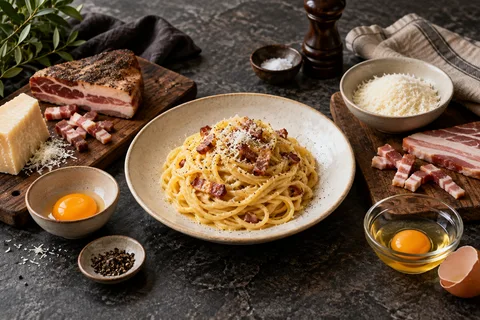
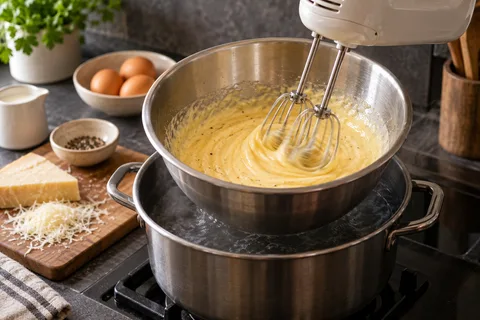
The video referenced here is a fava bean variation. (A plain version exists as vol.8, but we could not find a transcript of that episode, so this is the one used here.) Ogura’s carbonara turns on one clear ratio: Parmigiano Reggiano matched to egg yolk, weight for weight. He mixes the egg yolk, an equal weight of Parmigiano, a little cream, and a little water in a bowl first. Then, once the guanciale is cooked in the pan, he adds 30–45 ml of pasta water, takes the pan off the heat, and only then adds the pasta and egg mixture to toss. Because the egg mixture never touches direct heat, this method is less prone to the classic failure of the eggs setting into scramble.
Read the full explanation
The pasta is 1.9 mm, 60 g, boiled 10 minutes in water salted to 1.5%. That’s higher than schools running closer to 1% and lower than Chef Ropia, who runs about 2% (see the carbonara comparison page for the full lineup) — a middle-to-slightly-high setting, likely aimed at holding its own against the saltiness of the Parmigiano and guanciale. The salt figure comes from step 1 of the transcript (we haven’t independently reconfirmed it against the video itself). Because this video is a seasonal fava bean variation, treat the data pulled from it as partial confidence.
Pressing play loads YouTube’s embedded player.Open on YouTube
The guanciale is sliced thin and laid out in the pan to render, balancing fat and lean for how the fat comes out. The transcript also notes a practical tip: if not enough fat renders on its own, add a little olive oil — a hands-on adjustment worth having. If the mixture seizes up while tossing, he says to loosen it with water, a fine-tuning move that’s only possible because there’s no direct heat involved.
- Noodle and boil: 1.9 mm, 60 g, 1.5% salt, 10 minutes
- Base: Guanciale sliced thin, fat and lean balanced
- Sauce and emulsion: Egg yolk plus an equal weight of Parmigiano plus a little cream, mixed first, then combined off the heat
- Finish: Black pepper. Loosen with water if it seizes up
Since the amount of salt needed shifts with how much water is in your pot, read 1.5% as 15 g of salt per liter and scale it to your own pot. To try this combination as-is, the carbonara comparison page lines it up next to other chefs’ approaches.
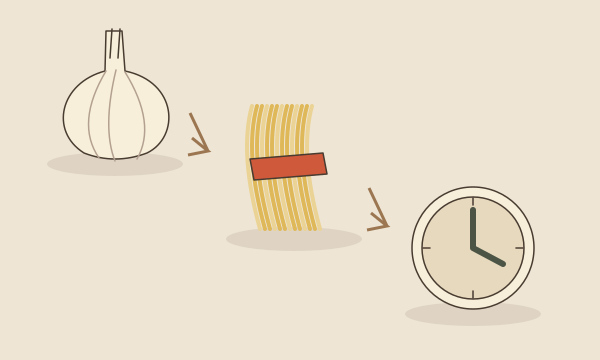
- Slow garlic stageCold oil and low heat develop aroma over several minutes.
- Pasta joins panNoodles finish while oil and water start combining.
- Final ten secondsThe emulsion is timed at the very end of cooking.
A long aroma build ends in a tightly timed emulsion.
Aglio e olio: garlic for about 7 minutes, emulsion timed to “10 seconds left”
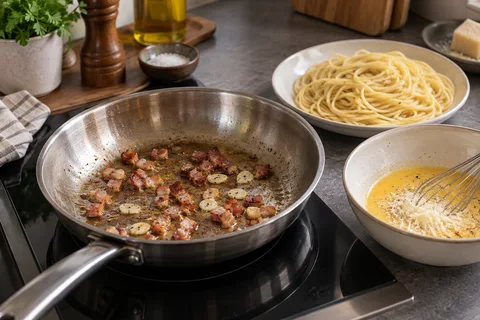
In aglio e olio too, Ogura states his timing in hard numbers. One clove of thinly sliced garlic, olive oil, and two dried chilies go into the pan, and the transcript’s “Point” notes read: “It’s best to heat the garlic over medium-low to low heat for about 7 minutes.” That’s a long, gentle, clear-oil approach — the opposite of schools that build aroma fast over high heat.
Read the full explanation
The other distinctive feature is that he pins the start of the emulsion to a specific moment: “when the pasta has 10 seconds left to boil.” Rather than eyeballing when to add the pasta water, he’s turned it into something you can manage with a timer — a good illustration of how this school is built. The pasta is 1.5 mm, 70 g, boiled 5 minutes. Once drained, it’s tossed quickly with the sauce, finished with Italian parsley and a final drizzle of oil. The transcript doesn’t specify the boiling salt or water volume, so this article leaves those unconfirmed as well.
- Noodle and boil: 1.5 mm, 70 g, 5 minutes
- Base: One clove garlic thinly sliced, 2 dried chilies, olive oil, over medium-low to low heat for 7 minutes
- Sauce and emulsion: Add pasta water when the boil has 10 seconds left
- Finish: Italian parsley, a final drizzle of oil
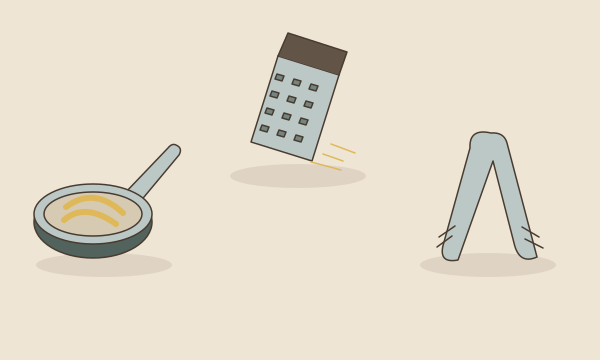
- Aluminum panFast temperature response supports quick heat correction.
- MicroplaneA fine grate lets cheese disperse with less heat.
- TongsA lifting tool supports transfer and vigorous tossing.
The listed tools support heat, texture, and movement.
The tools he’s shared publicly: an aluminum pan and a Microplane
Among the tools Ogura has shared on his own note page, here are the ones tied directly to these two dishes. For pasta he lists an aluminum pan (24 cm) — he lists an iron pan for meat and vegetables as well — and its fast heat conduction seems well suited to the temperature control this method depends on — taking the pan off the heat before tossing, or holding a steady 7 minutes for the garlic.
The only grater the note ties to cheese is the box grater — it’s the one he points to “when you want to grate cheese coarsely”; he also lists a Microplane large shaver and a Microplane zester, but the note doesn’t say whether he uses them for cheese. In general, the finer Parmigiano is grated, the more easily it melts, which helps it avoid clumping even with an off-heat tossing method (per the gear data).

- Ratio for carbonaraMatch cheese weight to yolk instead of eyeballing.
- Timing for aglio e olioBuild garlic slowly, then finish the emulsion quickly.
Ogura turns restaurant judgment into ratios and timing.
Summary
Ogura’s school is defined by putting nearly every step into a number: 1.5% salt, egg and cheese matched by weight, 7 minutes for garlic, emulsion timed to the last 10 seconds. Because it doesn’t rely on feel, it reproduces reliably — and that makes it a useful baseline when you’re mixing his steps with another chef’s in the recipe builder. Try either the carbonara or the aglio e olio exactly to the video’s numbers first, then use the recipe builder guide to swap in other steps from there.