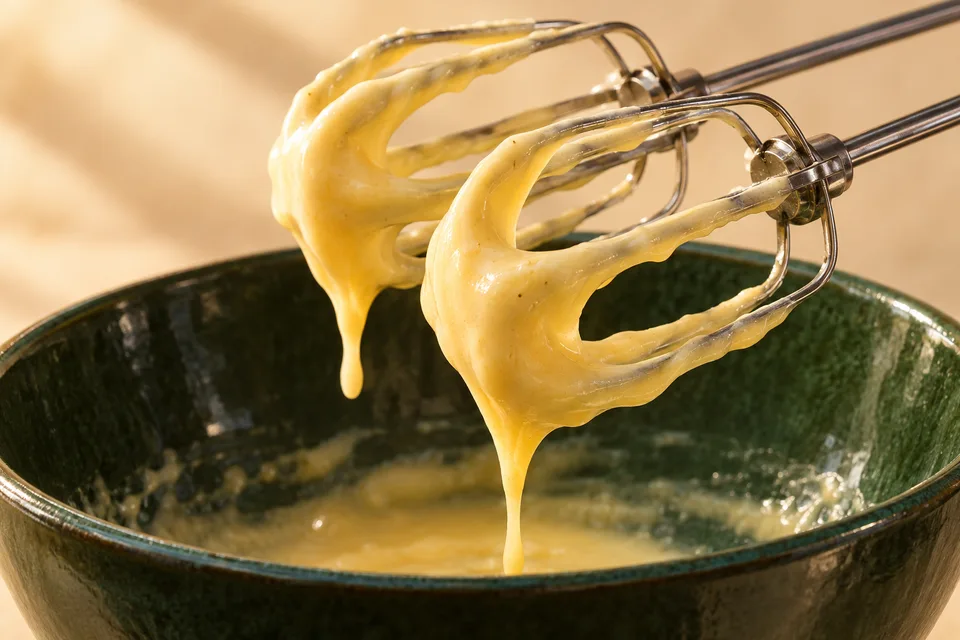
Pressing play loads YouTube’s embedded player.Open on YouTube
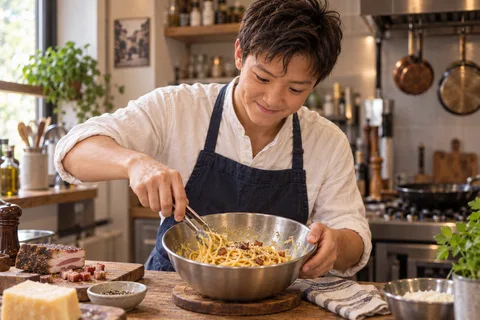
No thermometer appears in the steps of Fabio’s “Rich Carbonara.” The cue is the weight of the hand blender: stir the egg mixture over a bain-marie up to around 65°C, and the transcript says the blender turning heavy is the sign the mixture has thickened enough (cross-checking against the full video hasn’t been done). Schools of carbonara split mainly on how they bring heat into the egg mixture — direct heat, a bain-marie, residual heat, steam — and this article covers the tools behind the bain-marie-plus-machine-agitation approach. Fabio’s version, introduced as a re-creation of the technique of “Chef Luciano,” known as the carbonara king (neither the transcript nor the video description gives a surname; identifying him as Luciano Monosilio is the editors’ inference), solves for one thing only: never letting agitation lapse in the temperature range just short of where the egg starts to set.

- Hand whiskSpeed can fade while the mixture passes through hot zones.
- Hand blenderMechanical agitation stays fast and continuous as heat rises.
The machine removes variation from the agitation rate.
Why a hand blender beats stirring by hand
Binding egg yolk and fat (the rendered fat from guanciale) into a uniform mixture takes both temperature and agitation. You can emulsify by hand with a whisk, but if agitation slackens off even for a moment while passing through the higher-temperature zone, the egg can set and the mixture can split. A hand blender hands off the speed and consistency of stirring to a machine, so agitation never has to stop while the temperature is climbing over the bain-marie — that’s its advantage here.
The transcript describes combining egg yolk, cheese, guanciale fat, and pasta water cut with plain water into an egg mixture, then setting the bowl over a bain-marie and raising the temperature while stirring with the hand blender (unverified). For the full quantities, see the carbonara comparison page. One note on terminology: the transcript uses “hand mixer” in Japanese, but since “Bamix” refers to a specific brand’s product line, this article uses the generic term “hand blender (immersion blender)” throughout.
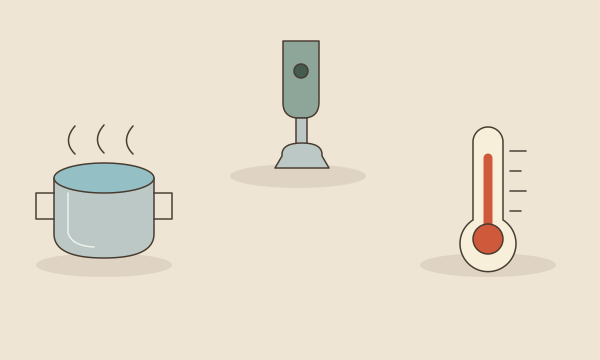
- Warm over waterA bain-marie raises temperature gradually.
- Blend continuouslyMotion distributes heat and rendered fat.
- Stop as it thickensThe stated target sits near the yolk-setting boundary.
The method approaches thickening without lingering past it.
65°C is aimed at exactly where egg yolk sets
Egg yolk is generally said to start setting at around 65°C, egg white from around 58°C (the Chemical Society of Japan’s Kagaku Daisuki Club gives 65–70°C as the range in which the yolk sets fully; treating around 65°C as where it begins to set is this site’s own framing. The roughly 58°C figure is a widely circulated rule of thumb for which we have not confirmed a primary source — see the article on egg coagulation temperatures). The editors’ reading is that Fabio’s “up to about 65°C” instruction is aimed squarely at the point where egg yolk begins to coagulate — stopping right there, once the mixture has thickened, to avoid overshooting it. According to the transcript, the hand blender getting harder to move is the cue that the mixture has thickened enough.
Read the full explanation
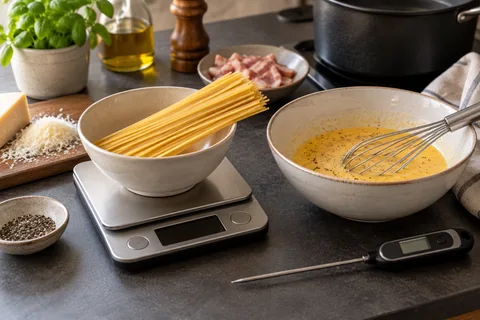
A thermometer doesn’t appear in this transcript’s steps. A cooking thermometer is one option if you want to confirm the temperature numerically instead (there’s a record of Fabio listing a thermometer among his tools elsewhere, but its use in this particular recipe is unverified).
On the moment when 30-40cc of pasta water cut with plain water gets added to the egg mixture, the transcript passes along a tip: “adding hot water won’t set the eggs” (unverified). Read literally, this suggests that even added straight in once cut with plain water, the pasta water never brings the egg mixture as a whole to the coagulation point (the transcript gives no instruction to add it in stages). On the safety of the bain-marie method itself, the transcript sums it up as producing “an authentic result that’s hard to mess up, since you make it over a bain-marie in a bowl.” That said, the source is a third-party transcript site, cross-checking against the full video hasn’t been done, and the finer points of the method should be read at the “described as… (unverified)” level of confidence.
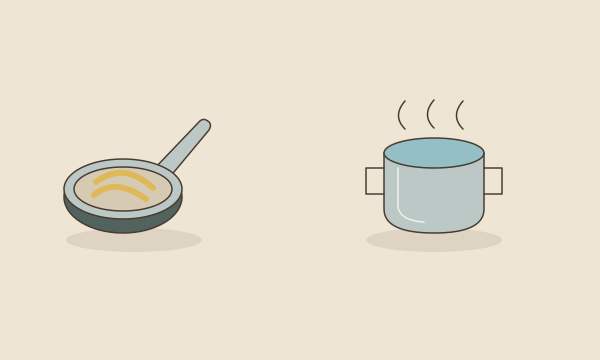
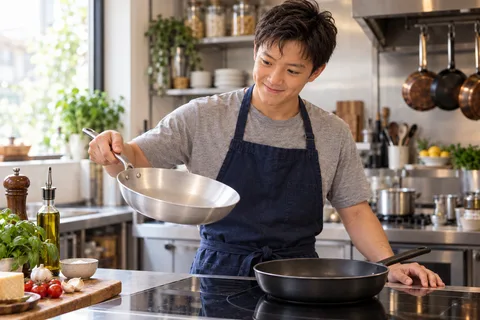
- Direct pan heatFast response needs close flame control and constant stirring.
- Bain-marie heatWater buffers hot spots and slows the temperature rise.
Extra equipment buys a gentler, more repeatable climb.
Direct heat vs. bain-marie: how gently the temperature climbs
Making carbonara over direct heat, tossing the egg mixture right in the pan (some schools hold it at a fixed low flame while stirring continuously, others cycle the pan on and off the heat to control temperature), doesn’t require any extra equipment, but success hinges on judging heat by feel. The bain-marie-plus-hand-blender method adds one more tool to the counter, but one way to look at it is that a gentler temperature climb makes the result easier to reproduce. In the editors’ view, if you’re not yet used to how egg sets, the bain-marie-plus-hand-blender method narrows the margin for error; direct heat is worth trying once you’ve built up a feel for temperature.
Read the full explanation
A hand blender is useful beyond emulsifying egg, too — a common use is adjusting the texture of a sauce. When choosing one, the three things to weigh are shaft length, a head diameter that turns freely inside your bowl, and how long it can run continuously. Check pricing on the individual product pages linked from the gear card. If you’d rather try the method before buying one, whisking by hand is a substitute — as long as you never stop stirring through the temperature-rising stage, which asks more of your stamina and focus.
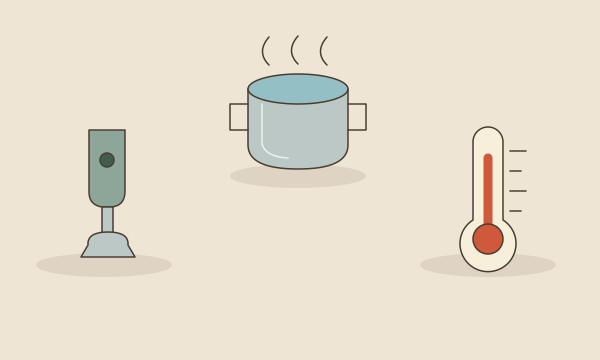
- Continuous motionKeep fat and egg dispersed throughout warming.
- Buffered heatUse the water bath to reduce sudden hot spots.
- Optional readingAdd a probe when you want numerical confirmation.
The blender and bain-marie control different risks.
Summary
In Fabio’s carbonara, the hand blender exists to keep agitation going right up to the edge of where the egg starts to set. Paired with a bain-marie, it lets the temperature climb gently — and lets you track it numerically if you add a thermometer — which is the main difference from the direct-heat method. If you want to track temperature numerically, pairing it with a thermometer is worth doing. For the full method, see Fabio’s chef page; to compare it against other emulsification methods, see the carbonara comparison page; and if you want to combine the steps yourself, see how to use the recipe builder. For more on the underlying science of emulsification temperature, see the emulsification science article as well.


 Ingredients