 Reads
ReadsPressing play loads YouTube’s embedded player.Open on YouTube

- Hotel New GrandIts account describes a fresh tomato-based sauce.
- Later coffee shopsKetchup became the familiar mass-market version.
The origin story and the standard modern sauce diverge.
The hotel credited with it didn’t use ketchup
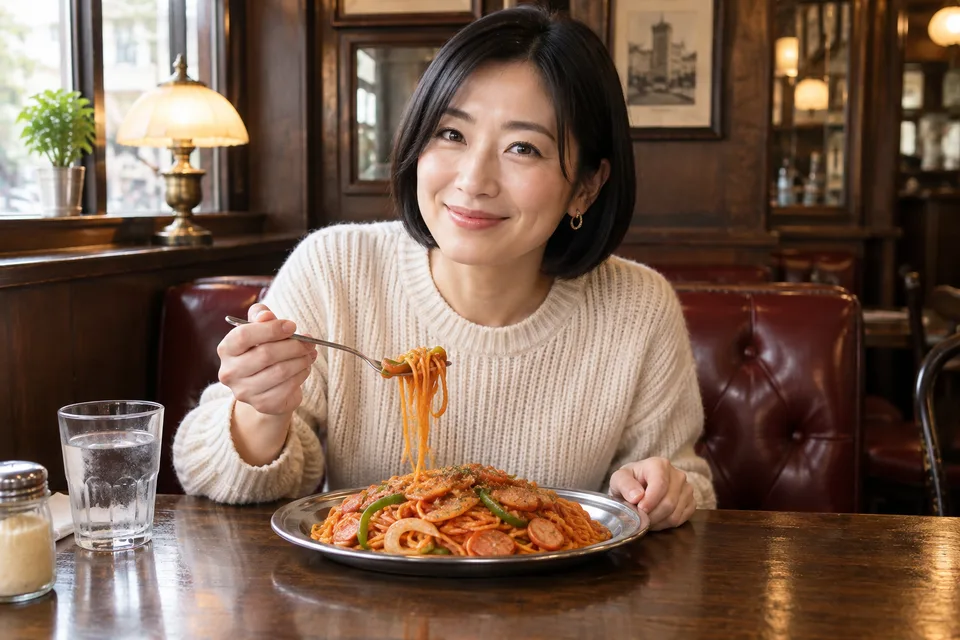
To state the conclusion up front: the Napolitan eaten across Japan today is generally held to be a Japanese-born dish, not a regional Italian one. The dish most widely credited as the origin of the name is said to have been created at the Hotel New Grand in Yokohama (Tabelog Magazine hedges this as “a persistent theory”), while the ketchup-based version found in coffee shops today spread through a separate line, via Center Grill, covered below. The hotel’s own site lists “Doria, Napolitan, and Pudding à la Mode — three dishes still widely known today” as its own creations. The dish is credited to Shigetada Irie, the hotel’s second head chef, and the official account describes it as a dish he created during the Occupation years, after seeing American soldiers eating boiled spaghetti tossed with salt, pepper, and ketchup, and reworking it into something of his own.
Read the full explanation
In other words, the prototype was an improvised dish American soldiers were eating, and a professional chef in a hotel kitchen turned it into a proper menu item — that is Napolitan’s starting point. According to the Government of Japan Public Relations Online article, the hotel is believed to have begun formally serving Napolitan in the 1950s, after roughly seven years under Occupation requisition ended following World War II — worth remembering that this was after the requisition was lifted, not immediately after the war.

- Domestic pasta spreadsAccessible dried spaghetti reaches more kitchens.
- Coffee shops adopt itKissaten turn the dish into a repeatable menu item.
- Ketchup style growsA convenient sauce becomes the recognizable form.
Availability helped transform a hotel dish into a staple.
Domestic dried spaghetti pushed it into coffee shops
The turning point that took a hotel dish and made it a coffee-shop (kissaten) staple nationwide was the spread of domestically produced dried spaghetti. According to the Tabelog Magazine article, the 1955 launch of domestic spaghetti sales was a major catalyst, and pasta stir-fried with ketchup — the prototype of Japanese-style Napolitan — was heavily promoted to popularize that product (accounts of the exact year vary). The same article notes that Saboru, a long-running kissaten in Tokyo’s Jimbocho neighborhood, also opened in 1955, and speculates that the timing, which overlapped with the popularity of jazz kissaten and utagoe (singalong) kissaten, helped the dish get picked up as a novel menu item at coffee shops.
Read the full explanation
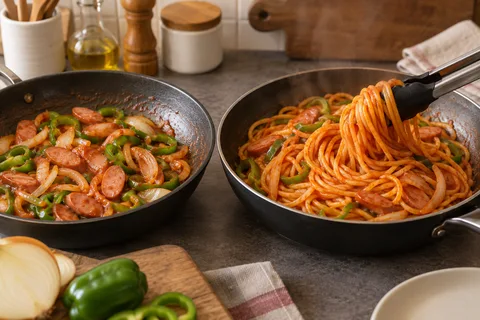
According to Government of Japan Public Relations Online, after the hotel’s dish became popular, the Yokohama restaurant Center Grill developed a ketchup-based Napolitan, and the ketchup-forward version made with bacon and green peppers spread nationwide from there. In the editors’ assessment, this route substantially changed the character of the dish. As it shifted from a dish plated one order at a time in a hotel kitchen to one served in minutes from a coffee-shop kitchen, “kissaten-ness” — turnaround measured in a few minutes, a finish of grated cheese and black pepper — appears to have accumulated afterward (boiling the noodles ahead of time itself is described in the hotel’s own account, though). The finer points of ratios and heat from here on are down to individual shops, and there is not much sourced material to point to a single correct answer.

- Documented hotel dishThe account centers on tomato sauce, not kissaten technique.
- Modern conventionsThick noodles and reduced ketchup develop elsewhere later.
Do not project later coffee-shop traits onto the origin.
Neither thick noodles nor reduced ketchup appear in the hotel’s account
Reading the hotel’s official account, what Irie made was not simply the American soldiers’ ketchup-tossed spaghetti itself. It’s described explicitly as a tomato-sauce dish: garlic and onion caramelized, then combined with fresh tomato, canned tomato, and tomato paste along with bay leaf and olive oil, tossed with the spaghetti. In other words, the hotel’s version and the ketchup dish served in coffee shops today differ in their sauce from the very starting point. Boiling the noodles ahead of time to get a chewy (mochi-mochi) texture is also described in the hotel’s own account — the Government of Japan Public Relations Online reporting describes boiling the noodles, chilling them in ice water, and letting each portion rest overnight. Noodle thickness, on the other hand, is not addressed in either the hotel’s official materials or the government reporting, so it’s reasonable to view thick noodles as an element that took hold on the coffee-shop side. Reducing the ketchup to cook off its sharpness isn’t found in the hotel’s account either, and is reasonably viewed as something that accumulated later in coffee-shop kitchens. Tabelog Magazine reports that Kissa Yuki in Nagoya began serving Napolitan on a heated iron plate in 1961 to keep it from cooling — but that’s a matter of the serving vessel, and it doesn’t appear in the hotel’s account either.
Read the full explanation
Our Napolitan comparison page lines up multiple documented approaches — drawn from videos and transcripts of chefs’ own recipes — step by step, along axes including noodle thickness, whether the noodles are boiled ahead, how the ketchup is reduced, and the grated-cheese finish. If you’re curious which combination of steps adds up to the “that flavor” of memory, our article comparing Napolitan by chef is worth reading alongside this history to connect the story to the actual technique.
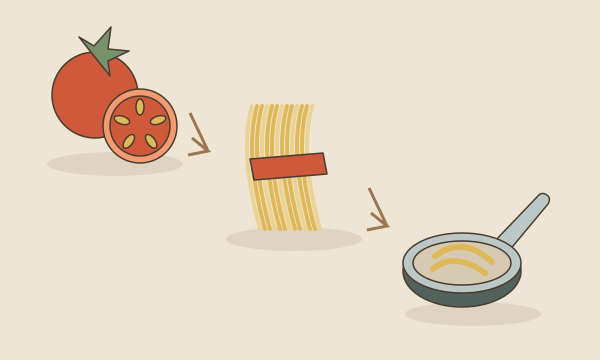
- Hotel tomato dishThe credited starting point does not use ketchup.
- Domestic pasta eraWider availability supports coffee-shop adoption.
- Kissaten NapolitanLater practice establishes ketchup and chewy noodles.
Napolitan’s familiar form emerges after its credited origin.
Summary
The received account starts with Napolitan at the Hotel New Grand in Yokohama, reworking the ketchup-tossed spaghetti eaten by American soldiers into a tomato-sauce dish, and after that dish caught on, a ketchup-based Napolitan spread nationwide to coffee shops via Center Grill and others (no source we could find dates Center Grill’s version to a specific year). Boiling the noodles ahead for a chewy texture is described in the hotel’s own account, but “kissaten-ness” — thick noodles, reducing the ketchup to cook off its sharpness, serving on a hot iron plate — isn’t part of the hotel-origin account itself, and is reasonably viewed as something that built up later in coffee-shop kitchens. If you want to see how today’s methods differ once you know the history, head to the Napolitan comparison page.

 Chef profiles