Pressing play loads YouTube’s embedded player.Open on YouTube
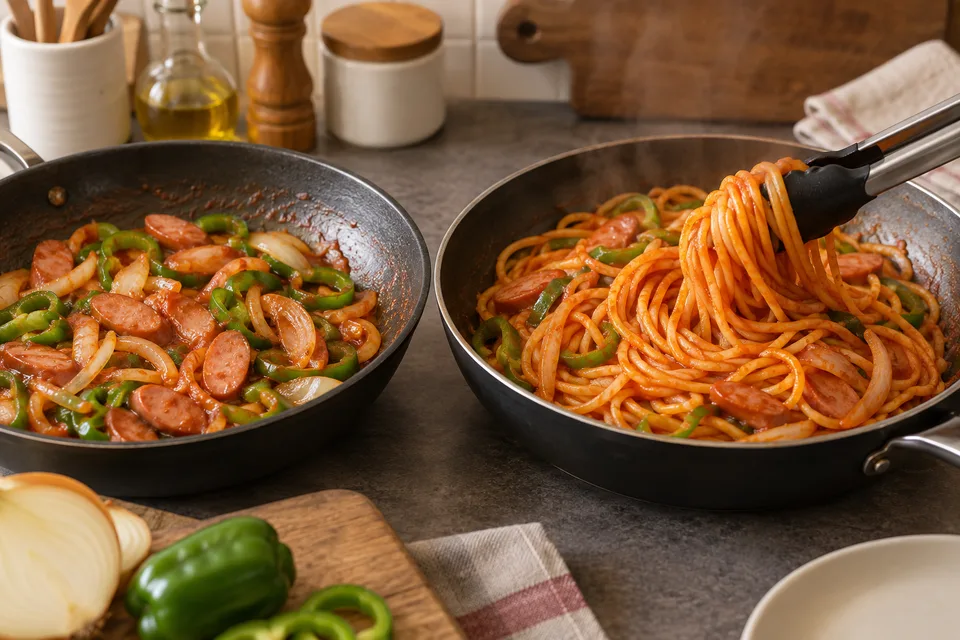
“In Ochiai’s method, only the ingredients get fried” — that’s how the NHK Kyo no Ryori recipe blurb puts it. Where Fabio fries the noodles themselves in the pan and Ryuji fries his too, Ochiai takes the pan off the heat and simply tosses the just-boiled pasta in. That split tracks with noodle thickness, and with whether you reduce the ketchup into something thick or thin it out with pasta water. This article lines up five schools of Napolitan on three points: the noodle, the ketchup, and the frying technique.
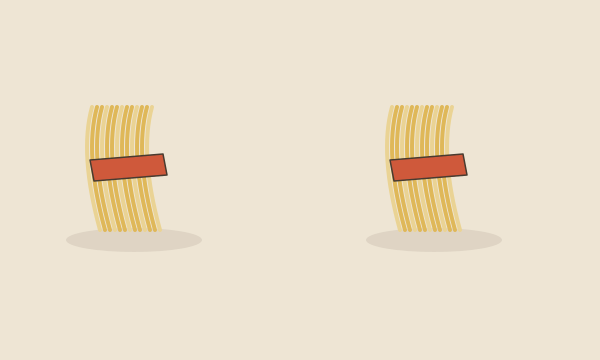
- Thick noodlesFabio and Ryuji favor a chewy kissaten-style presence.
- Thin noodlesOchiai uses a lighter strand with a different sauce balance.
Noodle thickness is a school choice, not a fixed rule.
Thick noodles from Fabio, thick recommended by Ryuji — Ochiai goes thin
Fabio uses 90g of 2.2mm thick spaghetti, boiled for 12.5 minutes — longer than usual — chasing a chewy, mochi-like bite. Ryuji never specifies a thickness: his official recipe notes “even thicker pasta works too,” and the transcript’s tip section says “thicker pasta is recommended for Napolitan” — a recommendation, not a stated choice. He drains the noodles lightly, not fully dry. Tsutomu Ochiai, on the other hand, uses 1.4mm thin noodles at 80g per serving (160g for two). That is thinner and lighter than Ryuji’s 100g or Fabio’s 90g — the opposite choice from the thick-noodle camp. Boil time and salt concentration appear on the same page as shared basics — salt the water at 1% (10g per liter) and set the timer 1-2 minutes shorter than the package time. No reason is given for choosing thin noodles. But since he never fries the pasta itself, the choice reads as one made on the assumption that no moisture will cook off in a pan.
Tomomi Ogura swaps out spaghetti entirely for 60g of fusilli, boiled in water salted to 1.5%. Chef Ropia skips pre-boiling altogether: he simmers 80g of dry noodles directly in the pan with 400ml of tomato juice.

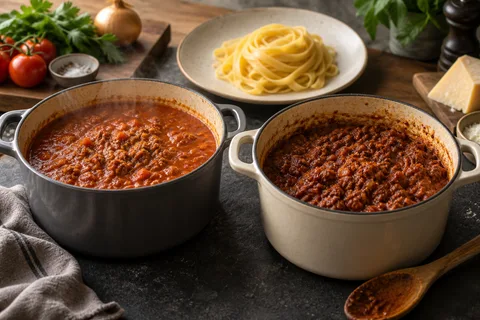
- Reduce ketchupCook off water and acidity for a darker concentrated base.
- Thin ketchupAdd liquid to keep the sauce looser around the noodles.
Ketchup handling sets concentration before pasta enters.
The ketchup splits into reducers and thinners
Ryuji’s signature move is “seasoning with nothing but ketchup” — 4 tablespoons cooked with the other ingredients over low heat until the acidity cooks off and it clings to everything, at which point he takes it off the heat. (His official recipe adds a note: “if the flavor needs more depth, add bouillon granules.”) Fabio uses 150cc of homemade ketchup, tosses the drained noodles in with black pepper and butter, then fries everything together at the end. The transcript site’s own editors summarize the method as “frying it like yakisoba to concentrate the umami,” but that is the site’s wording, not the chef’s.
Read the full explanation
Ochiai goes the other direction, thinning things out. He adds 2 tablespoons of pasta water to 2 tablespoons of ketchup and takes the pan off the heat (holding it on the barest flame if the pasta is not yet boiled). Chef Ropia lets his tomato juice “sit until it starts to reduce and catch on the pan,” then flips it with a spatula, works in the ketchup, and adds water gradually to hit his preferred thickness. Tomomi Ogura skips ketchup altogether, building his sauce from 80g of pre-cooked tomato sauce and 1 tablespoon of oil-marinated paprika.
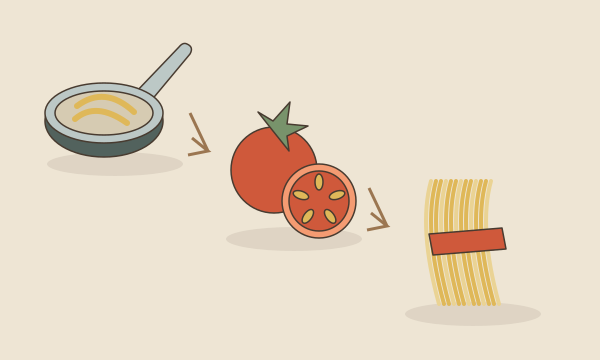
- Fry the ingredientsVegetables and meat develop flavor in the pan.
- Build the sauceKetchup joins the fried vegetables and meat as the sauce base.
- Fold in noodlesPasta combines without a second hard fry.
Ochiai protects the noodles from a final frying stage.
“Only the ingredients get fried” — Ochiai never re-heats the noodles
“In Ochiai’s method, only the ingredients get fried” — that’s how the NHK Kyo no Ryori recipe blurb puts it. He cooks 100g onion, a 120g block of boneless ham, 5 mushrooms, and 2 bell peppers, then takes the pan off the heat before tossing in the just-boiled pasta with 30g of grated Parmesan, adding 10g of butter last of all, aiming for what he calls a “silky, coating” texture.
Read the full explanation
Fabio, by contrast, fries the noodles themselves in the pan, and Ryuji’s transcript has him adding the lightly drained noodles to the pan and “frying and mixing thoroughly” — his recipe’s tip section adds, “once the pasta is in the pan, it’s better to fry it until you get that toasted aroma.” For Chef Ropia, the reduce-until-it-catches step is the whole point. Tomomi Ogura takes the Italian route: he simmers the tomato sauce over low heat for 2 minutes, then adds the fusilli, thinning with pasta water only if it has tightened too far, and finally takes the pan off the heat and pours olive oil over to finish — the sauce is built first, and the pasta joins it.
The proteins split by school too: sausage links for Ryuji and Chef Ropia (labeled “wiener” in Japan), sausage for Fabio, ham for Ochiai, and bacon for Ogura. Ryuji even specifies the cut: “slice on a diagonal — more surface area means more umami comes through.”
- Raw ketchup edgeReducers cook acidity before adding noodles.
- Dry sticky sauceThinners add liquid before the pan tightens too far.
- Soft noodlesControl boil and final pan time as one total.
Each school manages a different concentration risk.
Common failure points and how each school handles them
Ketchup that tastes sour and raw means it was not reduced enough. Ryuji cooks his over low heat until it clings to the ingredients; Fabio cooks his until it’s properly fried in.
Noodles that turn gummy usually mean too much liquid. Ochiai thins with 2 tablespoons of pasta water, then has you taste and adjust the saltiness: a little more pasta water if it is under-seasoned, a little plain water if it is too strong — an adjustment of seasoning strength, not of moisture (his recipe says nothing about adjusting the liquid). Chef Ropia works the opposite way, reducing all the liquid out before adding water back in.
Cheese that clumps means it hit too much heat. Ochiai takes the pan off the heat before folding in the Parmesan and butter.
- Choose noodle weightThick gives chew; thin keeps the plate lighter.
- Choose ketchup pathReduce for concentration or thin for looseness.
- Choose final heatFry noodles or only fold them into the sauce.
Three decisions explain most Napolitan differences.
Summary
Want thick, chewy noodles? Follow Fabio’s 12.5-minute boil. Want a sauce built on nothing but reduced ketchup? Take Ryuji’s low-and-slow approach. Want Parmigiano richness without scorching the noodles? Go with Ochiai’s “only fry the ingredients” method. All five schools are broken down step by step on the Napolitan comparison page, and if you want to mix and match techniques by step, start with the recipe builder guide.

 Reads
Reads
 Chef profiles
 Ingredients