Pressing play loads YouTube’s embedded player.Open on YouTube
Tsutomu Ochiai skips the can in this recipe. He reduces unsalted tomato juice instead — “it’s the same tomato at the source,” he reasons — and once pasta goes into the sauce, his rule is: never turn the flame back on. Ryuji mellows the acidity with onion, then rounds the flavor out with sugar and granulated bouillon; Pasta Grammar simmers it away by subtraction instead. This article lines up six schools across four axes: tomato form, acidity, garlic, and finishing.

- Canned tomatoStarts cooked and consistent, with adjustable texture.
- Tomato juiceAdds more liquid and needs reduction or absorption.
- Fresh tomatoBrings seasonal water, acidity, and intact flesh.
The starting tomato sets the sauce’s water problem.
Canned, juiced, or fresh
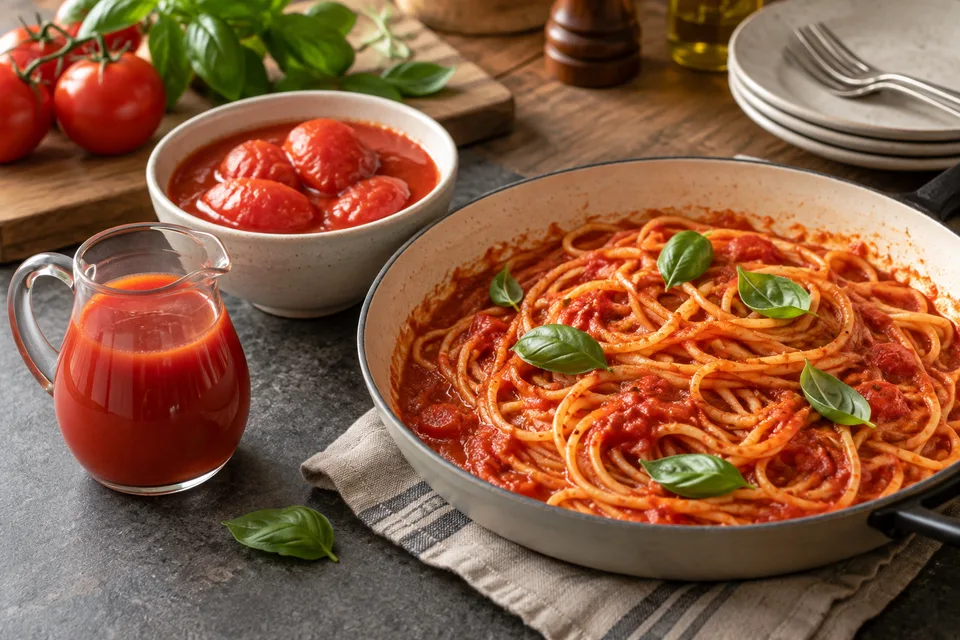
Even under the same name, “tomato sauce,” these six schools start from three tomato forms — canned, fresh, and juice — which sort into five approaches. Ryuji and Fabio crush whole canned tomatoes by hand. Yoshimi Hidaka simmers whole canned tomatoes in a batch sized for ten servings, meant to be made ahead and kept on hand. Vincenzo’s Plate uses 400 g of fresh cherry tomatoes (or canned, as an alternative). Tsutomu Ochiai uses 400 ml of unsalted tomato juice instead of a can. Ochiai explains his reasoning: “it’s the same tomato at the source, so I thought — why not reduce unsalted tomato juice myself? — and it came out amazingly good,” citing the convenience too: “with juice, if there’s extra you can just drink it, and if you’re short you can add as much as you like — it’s flexible.”
The fifth, Pasta Grammar, uses an 800 g can of whole tomatoes with no additives, starting from how to pick the can itself: “check the ingredient label — you want tomatoes and nothing else.”
- Add sweetness or fatSugar, onion, or dairy rounds sharp acidity.
- Reduce the sauceLonger cooking concentrates sweetness along with flavor.
- Choose ripe tomatoStarting fruit can reduce the need for correction.
Acidity can be balanced in the ingredient or the process.
Correcting acidity by addition, or reducing it away
Ryuji adds 50 g of onion along with 1 tsp sugar and granulated bouillon to balance both acidity and umami. His own explanation: “adding onion mellows out the tomato’s acidity” — a home-style approach that adds umami at the same time. Fabio appears to work salt and sugar (two pinches to 4 g, the amount varies by source) into a 400 g can of whole tomatoes before reducing it, and the j7p.jp transcript explains: “adding sugar softens the acidity of the whole tomatoes.”
The Italian-school cooks add no sugar. Pasta Grammar simmers with the lid half on for 25 to 30 minutes, and Hidaka simmers over low heat for 30 minutes after bringing it to a boil — in both cases the stated purpose is consistency (any effect on acidity is the editors’ read; the sources don’t mention it). Vincenzo’s Plate holds that “the skin is the secret to creaminess,” and only gently presses halved cherry tomatoes with a spoon to release their liquid. For the basil, the same recipe calls for tearing it by hand rather than cutting it on a board, “since chopping on a board loses the aroma.”
- Leave pieces inGarlic remains an edible part of the final sauce.
- Remove after infusionOil keeps the aroma while the clove leaves the plate.
- Use no garlicTomato and finishing fat remain the entire focus.
Garlic can act as ingredient, infusion, or omission.
Leave the garlic in, or take it out
Garlic falls into three approaches. Ryuji uses two cloves for sautéing plus two more cloves, grated and microwaved at 600 W for 40 seconds, added to the sauce and left in (“this reduces the raw smell and sharpness while keeping the fragrance”). Hidaka minces four cloves and sautés them into the soffritto without ever removing them.
Read the full explanation
Fabio infuses the oil with crushed garlic and basil stems, then removes the stems. Ochiai infuses 50 to 60 ml of extra virgin olive oil with two cloves of garlic cut into quarters, then turns off the heat and removes the garlic. Pasta Grammar drops one whole peeled clove into the pot from the start and removes it only after the 25-to-30-minute simmer finishes.
How each school avoids burning the garlic differs too. Ryuji pushes the garlic right to the edge of scorching before adding the onion (the sources give no anti-scorching rationale for this; the reading is the editors’). Ochiai turns off the heat the moment the aroma comes through and removes the garlic immediately. Vincenzo’s Plate manages it by time: “crushed garlic gets just 30 seconds — add a little water if it looks like it’s about to burn.”

- Fresh olive oilAdds green aroma and gloss at the end.
- ButterAdds dairy richness and softens sharp tomato notes.
- No added fatLeaves reduced tomato as the final texture and flavor.
The finishing fat decides the sauce’s last impression.
Finishing with oil, butter, or off the heat entirely
Ochiai is the most thorough about finishing off the heat: his rule is “once the pasta goes into the sauce, do not turn the flame back on” — he mixes in 20 g of grated Parmigiano and 10 g of unsalted butter all at once. Fabio, depending on the version, also turns off the heat and mixes in 15 g of grated Parmesan, while another version finishes with 10 g of butter and torn basil. Ryuji and Vincenzo’s Plate both toss over the heat: Ryuji adjusts consistency with 1 tbsp extra virgin olive oil and pasta water, while Vincenzo’s Plate drizzles EVOO and finishes with basil, adding Pecorino to taste (the ingredient list marks it optional).
- Watery sauceReduce longer or begin with a less liquid tomato format.
- Harsh acidityCook it down or balance with the school’s chosen addition.
- Burned garlicStart gently and remove the clove once infused.
Diagnose water, acidity, and garlic separately.
Common mistakes and how each school fixes them
If the acidity stands out too much, it’s either underripe tomatoes or under-reduction. Lean into one fix or the other: correct it with sugar (Fabio, and Ryuji, who also names onion as what mellows the acidity), or simmer it down for 25 to 30 minutes (Pasta Grammar, Hidaka).
If the sauce turns watery and separates, you’ve added too much pasta water. Vincenzo’s Plate adds it “a little at a time”; Ochiai emulsifies with butter instead.
If the garlic burns and turns bitter, it sat over high heat too long. Vincenzo’s Plate’s 30-second rule and Ochiai’s “turn off the heat and remove it” are both useful benchmarks.
- Choose tomato formSet the starting texture and water level.
- Choose garlic roleKeep, remove, or omit the aromatic.
- Choose the finishEnd with olive oil, butter, or reduced tomato alone.
Pomodoro style emerges from three independent switches.
Summary
If you want to take a whole can quickly to a home-style flavor with sugar and granulated bouillon, look to Ryuji. If you want extra richness from butter and cheese, look to Fabio. If you want something fast made from tomato juice, look to Ochiai. If you want to keep the thickness of the skin and the aroma of fresh basil while smoothing the texture with a blender, look to Vincenzo’s Plate. If you want to simmer it down for 25 to 30 minutes and subtract the acidity instead, look to Pasta Grammar; if you want a 30-minute simmer meant to be made ahead, look to Hidaka. All six schools are broken down step by step on the pomodoro comparison page. Setting the boiling salt as a percentage of your pot’s water keeps the taste consistent from pot to pot.

 Ingredients