Pressing play loads YouTube’s embedded player.Open on YouTube
Amatriciana splits on one question: does onion and garlic go in at all? The traditional Roman and Amatrice schools say no. Of the six chefs compared here, only Ryuji and Yoshimi Hidaka add them — Fabio, Vincenzo’s Plate, Pasta Grammar, and Italia Squisita all skip both, building the dish on pork fat, tomato, and cheese, with white wine or chili alongside.

- Roman coreGuanciale, tomato, Pecorino, and pasta carry the sauce.
- Optional chili or wineSome schools add heat or deglaze without adding aromatics.
Four schools build depth without onion or garlic.
The four who need no onion at all
Fabio’s video is titled “Don’t Put Onion In!,” and its description reads: “The classic version from Lazio and Rome uses no onion and no olive oil. All you need is guanciale, Pecorino Romano, tomato, and pasta.” His ingredient list has only four items: 70 g of bucatini, 45 g of guanciale, 160 g of passata (strained tomato), and about 10 g of Pecorino Romano. Skipping oil is a traditional touch, but the description doesn’t specify heat level, so that detail is unverified.
Read the full explanation
Vincenzo’s Plate slow-renders 150 g of guanciale over low-to-medium heat, and once it starts to color, adds a glass of white wine, then 400 g of peeled tomatoes, simmering for 10-15 minutes before adding five tablespoons of pasta water to bind the sauce to the noodles. “This amatriciana recipe starts with the guanciale!” sets guanciale as the anchor of the dish, and the recipe is explicit that acceptable substitutes are “pancetta or salami — bacon is not.”
The original version featured on Italia Squisita, from Gabriele Perilli of La Conca, the old-guard restaurant in Amatrice, sears 150 g of guanciale without oil over high heat until deeply browned, adds just one tablespoon of white wine, then simmers with 400 g of whole peeled tomatoes and one whole dried chili. The pan comes off the heat before 100 g of Pecorino goes in, and the sauce is mantecato’d (emulsified by tossing off the heat) for a few minutes. Searing over high heat stands in contrast to Vincenzo’s Plate, which renders the fat slowly over low-to-medium heat.
Pasta Grammar skips onion and adds red chili flakes instead. Using chili is a point shared with Italia Squisita, though the difference is flakes scattered through the sauce rather than one whole dried chili. Their 100 g of guanciale is cut into chunks and cooked over medium heat for 5-6 minutes, then 60 ml of white wine and 400 g of whole peeled tomatoes go in. “White wine is traditional, but feel free to experiment!”, written in a reply in the comments section, leaves room for the wine choice to vary. The dish finishes “off the heat with a generous amount of Pecorino.”
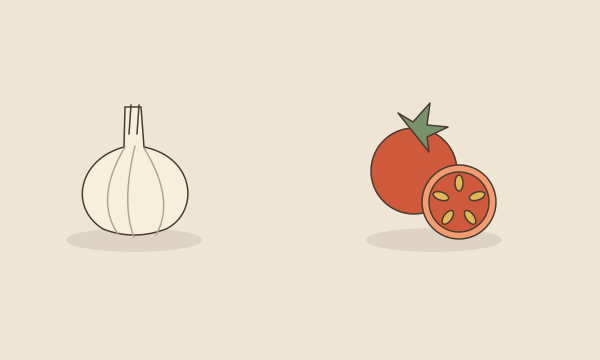
- HidakaGarlic and onion are optional additions around pancetta.
- RyujiGarlic and onion cook into tomato before bacon is fried.
The Japanese versions add aromatics by different routes.
Onion and garlic, added in a Japanese kitchen
Yoshimi Hidaka puts one clove of minced garlic into the olive oil and adds 70-80 g of pancetta cold, pushing the garlic to the edge of the pan so it doesn’t burn; once it colors and turns fragrant, he combines it with the pancetta and crisps it up, then adds a thinly sliced third of an onion, deglazes with white wine, and simmers with 400 g of canned chopped tomatoes. The dish finishes off the heat with olive oil and a tablespoon of Pecorino. The transcript notes a specific caution, in the English-language version of the page: “Don’t burn the garlic; once it’s colored and fragrant, combine it with the pancetta.” This particular video uses both garlic and onion, but Hidaka himself says on camera that both are optional, added by preference — less a fixed school than a home cook’s range of choice.
Read the full explanation
Ryuji cooks two cloves of garlic “slowly, until deeply golden-brown,” then half a small onion until it takes on a little char, and simmers them with a third of a can of tomatoes and chicken bouillon. He empties the tomato sauce into a bowl, washes the pan, and only then cooks 40 g of block bacon in olive oil, over low heat until lightly charred — a two-step structure (see the official recipe). The recipe gives no reason for washing the pan; keeping the browned-on fond from carrying over is the editors’ read. No matching video has been confirmed.
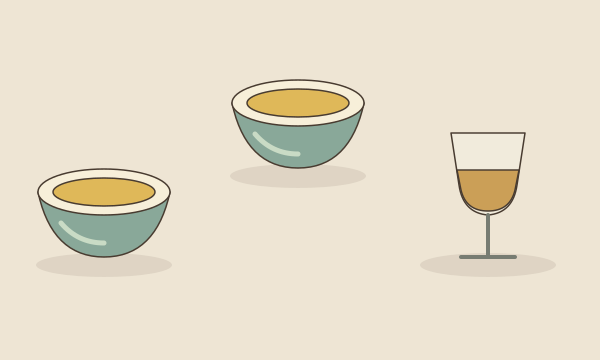
- One tablespoonItalia Squisita uses wine mainly to deglaze the pan.
- 60ml or a glassOther traditional schools use visibly larger wine amounts.
- No listed wineFabio keeps the published ingredient list to the core four.
Traditional intent does not predict wine volume.
The traditionalists don’t necessarily pour less wine
Five of the six schools render the pork fat before adding tomato (Yoshimi Hidaka uses pancetta); Ryuji alone runs it in reverse, making the tomato sauce first and then washing the pan to cook his bacon in olive oil. Among those five, the splits are how hard the pork is cooked and how much white wine goes in.
Read the full explanation
For white wine: Italia Squisita uses one tablespoon (to deglaze), Pasta Grammar uses 60 ml, Vincenzo’s Plate uses a full glass, Yoshimi Hidaka says “to taste,” and Fabio’s ingredient list has no wine at all. Measured against pasta weight, Pasta Grammar’s 60 ml serves 160 g of pasta and Vincenzo’s Plate’s full glass serves 250 g — the traditional schools aren’t necessarily using less.
Pecorino goes in “off the heat” for Italia Squisita, Pasta Grammar, and Yoshimi Hidaka, while Vincenzo’s Plate adds it “generously” after plating. Normalized to cheese per 100 g of pasta, Italia Squisita uses 100 g of cheese for 500 g of pasta (20 g per 100 g), and Fabio uses about 10 g for 70 g of pasta (about 14 g per 100 g). Vincenzo’s Plate and Pasta Grammar only specify “generous,” so they can’t be compared on a like-for-like basis.

- Burned pork fatShorten high heat or begin from a cooler pan.
- Seized cheeseAdd Pecorino only after direct heat is removed.
- Stacked saltBalance guanciale, cheese, and salted pasta water together.
Each failure traces to a different control point.
Why it burns, splits, or turns too salty
The causes below are the editors’ read; the sources themselves give only the steps.
Burning the guanciale fat comes from leaving it over high heat too long. Vincenzo’s Plate uses low-to-medium heat, and Yoshimi Hidaka starts the pork from cold. Italia Squisita sears over high heat but deglazes with white wine as soon as it colors.
Cheese seizing the moment it hits the pan comes from adding it while the pan is still over direct heat. Italia Squisita, Pasta Grammar, and Yoshimi Hidaka all add Pecorino only after taking the pan off the heat.
Oversalting comes from guanciale, Pecorino, and the pasta-water salt stacking up. Decide the Pecorino amount per 100 g of pasta, and set the boiling-water salt as a percentage of your pot’s water (10 g of salt per liter is 1%).

- Traditional laneSkip aromatics and let guanciale anchor the tomato sauce.
- Japanese laneAdd onion or garlic as an explicit flavor preference.
Aromatics, pork heat, and cheese timing define the school.
Summary
Whether onion and garlic go in, whether the pork is seared hard or rendered gently, and whether the Pecorino goes in off the heat — these three points sort nearly all six schools. The full breakdown of each chef’s steps is collected on the amatriciana comparison page. If you want to mix and match the schools you like step by step, start with how to use the recipe builder.

 Ingredients