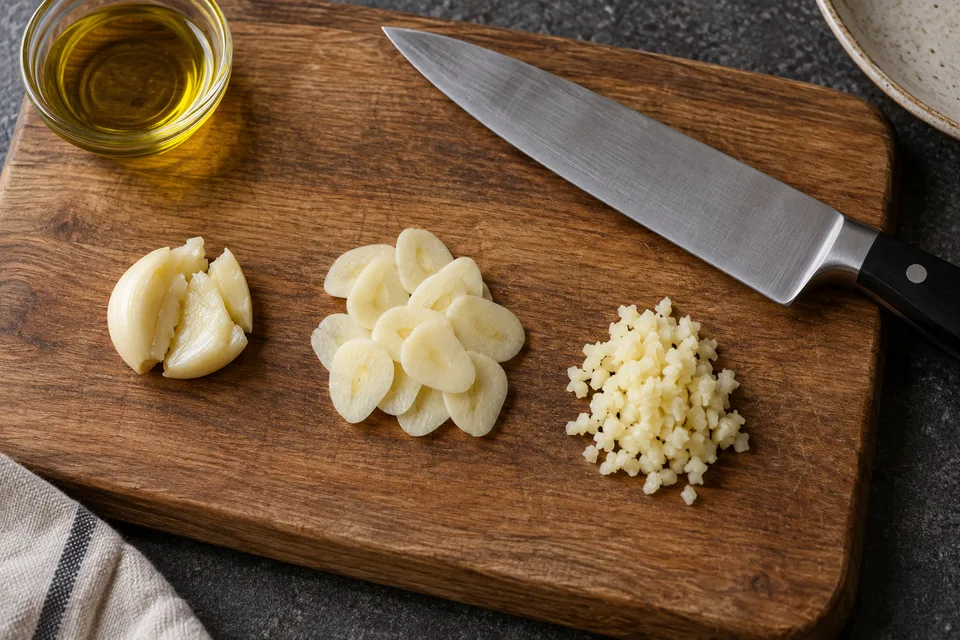
Aglio e olio has only garlic, oil, chili, and pasta water in it — which is exactly why the cut changes everything, from how much aroma comes out to how fast it burns. As the editors see it, the cut is really a decision about what gets dissolved into the oil. We compare crushed, sliced, and minced across four chefs’ published recipes and transcripts.
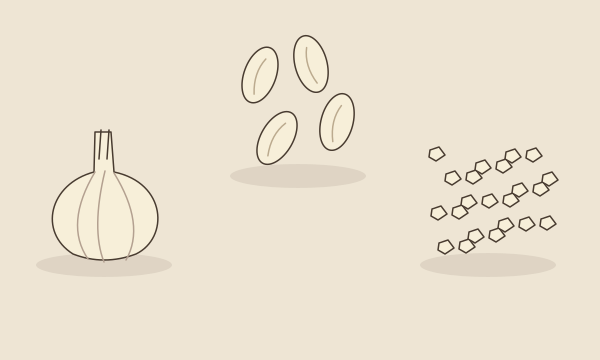
- Whole or crushedLess exposed surface releases aroma more slowly.
- Thin slicesMore edges infuse oil faster and color sooner.
- Fine minceMaximum surface gives strong aroma and little burn margin.
Cut size trades aromatic speed for heat tolerance.
More cut surface means more aroma — and a faster burn
Cutting or crushing garlic triggers an enzymatic reaction that produces allicin, the compound behind its aroma. The wider the cut surface, the more of it is generally said to form, though we haven’t verified that claim on this site. Mincing exposes the most surface area, which also means it burns fastest in the oil. A crushed clove or one left nearly whole, by contrast, resists burning as long as it stays submerged in oil, giving you room to cook it slowly (we haven’t verified on this site how much the aroma’s onset differs by cut). Slicing sits in between.
In other words, how much aroma comes out and how much room you have before it burns are linked, and which of the two a chef prioritizes is where the approaches diverge.
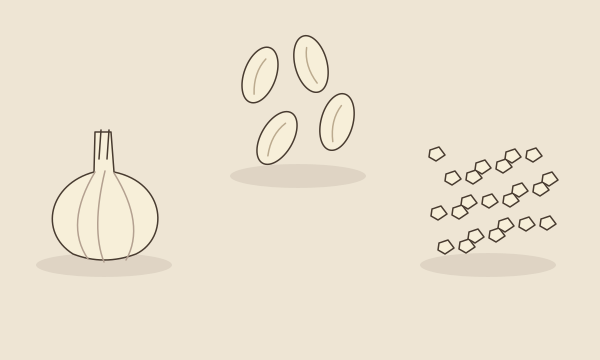
- Whole or crushedA removable clove gives a gentler infusion.
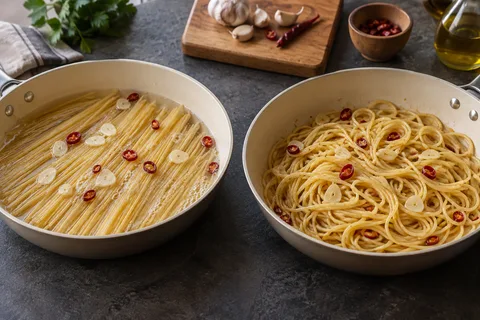
- SlicedVisible pieces balance aroma with manageable browning.
- MincedFine garlic disperses strongly through the sauce.
The chefs place garlic intensity through the knife cut.
Four chefs, three different cuts
Tsutomu Ochiai starts three crushed garlic cloves in 50 cc of extra-virgin olive oil (a workable-batch amount; the pasta itself is 70 g per serving) from cold, over high heat, tilting the pan to pool the oil and float the garlic off the bottom to keep it from burning. Once the oil starts to bubble, he drops to low heat and cooks until “a skewer slides through easily,” moving the aroma into the oil — a doneness cue managed by feel (Cuisine Kingdom article; based on an article from issue 288 of the magazine Cuisine Kingdom). Because a crushed clove has relatively little surface area, it holds up well even under this longer cook. He describes garlic here as something you enjoy “not for its flavor but for its richness and aroma,” noting that in Italy people rarely eat the clove itself.
Read the full explanation
Fabio puts 2 tbsp of olive oil and one whole chili over high heat, and once the chili starts sizzling, adds one clove of garlic and swirls the pan to turn it into garlic chips (the page is the editors’ write-up of the video rather than a word-for-word transcript and never states the cut; we’re inferring something close to sliced from the description of chip-like results. howtocook.jp write-up; unconfirmed). This is a short, high-heat approach — cook until golden — with the chili charred black for a smokier, aroma-forward result. Slices expose more surface than a crushed clove, so they color quickly even over high heat, which suits a design built around a fast burst of aroma.
Ryuji minces two cloves of garlic, adds them to 1 tbsp of olive oil before the burner is even on, then turns the heat to high. Once it starts to sputter, he tilts the pan to pool the oil and drops to low heat to cook it through slowly (ingredients from bazurecipe.com; method from the etemarublog.com transcript). Mincing exposes the most cut surface and is normally the cut most prone to burning, but the method starts from cold oil and drops to low heat the moment bubbles appear, which the editors read as a design that ends up resisting burning (the purpose his source gives is drawing out aroma; it says nothing about preventing scorching). Even with the same mince, the outcome shifts depending on how the heat is managed.
Tomomi Ogura’s transcript describes thinly sliced garlic, one clove, cooked with chili over medium-low heat for about 7 minutes (TubeRecipe transcript; transcript-based, unconfirmed). That’s a much longer aroma-infusion window than Fabio’s slice, making for an instructive contrast. Even the same “sliced” cut produces different results depending on the combination of heat level and time.
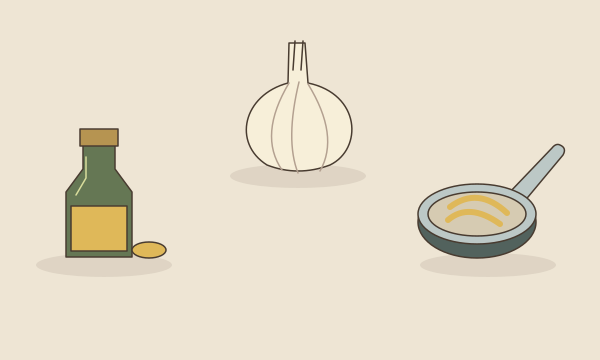
- Ochiai: floatPool the oil to keep the garlic from burning.
- Ryuji: pool oilThe source calls it aroma extraction; anti-scorching is an editorial reading.
- Fabio: swirlKeep the chips moving; even heating is the editors’ interpretation.
These three move garlic away from prolonged pan contact; Ogura’s transcript gives no such step.
Different cuts, the same move against burning
Lining up Ochiai’s, Ryuji’s, and Fabio’s steps side by side, the cuts differ but a common move for avoiding burnt garlic runs through all three. Ochiai states outright that he tilts the pan to pool the oil and floats the garlic to keep it from burning. Ryuji likewise tilts the pan to pool the oil, but his source gives the purpose as drawing out aroma, so whether it is the same anti-scorching move is the editors’ reading. Fabio swirls the pan as he makes the chips (to even out the heat, as the editors read it). What they share is never letting the garlic sit against the hot pan surface — whether by floating it in pooled oil or by keeping the pan in motion. Ogura’s medium-low, seven-minute approach, however, includes no such step in the transcript.
Read the full explanation
If you want to try this at home, start by reproducing one chef’s approach exactly as described. That means Ryuji’s cold oil plus high-to-low heat, Fabio’s short high-heat burst, Ogura’s medium-low seven minutes, or Ochiai’s crushed clove started in room-temperature oil and taken from high to low heat.
Once you’ve made the dish with one chef’s heat pattern, it’s easier to compare by changing only the cut and repeating. How each chef handles the chili also varies — Ochiai removes the seeds and roughly chops it, while Fabio chars a whole pod black (based on the editors’ write-up of the video; unconfirmed). Fabio’s steps come from an editors’ write-up and Ogura’s from a transcript; both remain unconfirmed. Ochiai’s are based on a published magazine article.
Pressing play loads YouTube’s embedded player.Open on YouTube

- Fine cut riskSmall pieces darken quickly because every edge is exposed.
- Cold-oil controlA slow temperature climb buys time before browning.
Cold oil can widen the margin; other schools use different heat patterns.
Summary: even mincing can be tamed with cold oil
How you cut the garlic is the first fork in the road that decides the balance between aroma and burn risk. A crushed clove or one left nearly whole suits slow cooking, while mincing exposes more surface area and demands active steps to keep it off the hot pan floor (we haven’t verified on this site how much the aroma’s intensity itself actually differs). Slicing sits in between, and its result shifts with how heat and time are combined. Start by copying one chef’s cut and heat pattern exactly, then change only the cut to feel the difference in how easily it burns. To compare the aroma differences side by side in one dish, the peperoncino chef comparison and the peperoncino comparison page are useful next reads, and the knife guide covers the tool itself.


 Ingredients
 Reads
Reads