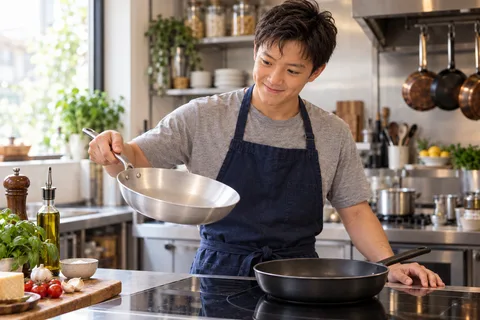
The Thinner the Pan, the Faster It Reacts — And Cools
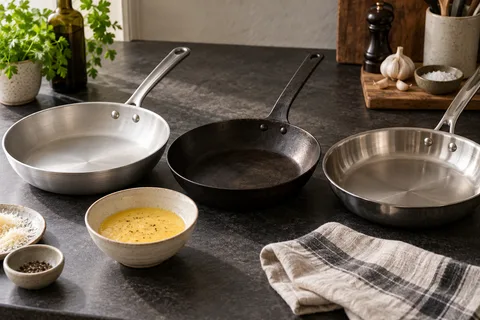
What pro tool lists actually share isn't the material — it's how fast the heat rises and falls. A millimeter of thickness changes how easy carbonara's emulsion is to catch.
Explore 19 articles tagged “emulsion”.
19 articlesWhat pro tool lists actually share isn't the material — it's how fast the heat rises and falls. A millimeter of thickness changes how easy carbonara's emulsion is to catch.
The box time appears to assume pasta eaten straight from the pot, though we could not find a manufacturer stating that outright. Skip the subtraction before a pan toss, and it turns soft.
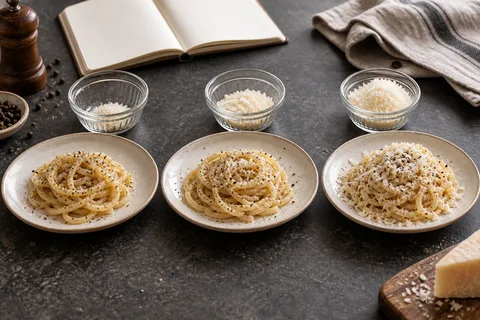
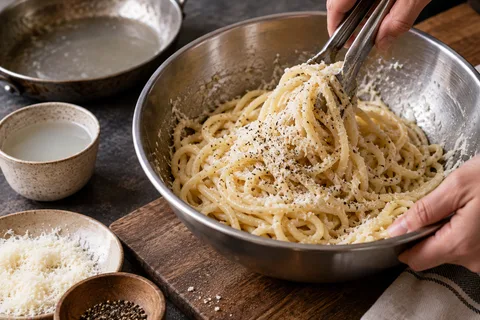
Cacio e pepe comes down to cheese and black pepper, yet almost every failure has one cause — a pan that's too hot when the cheese goes in. Eight chefs split into three schools for that moment.
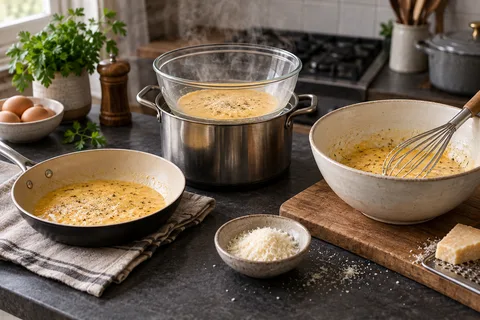
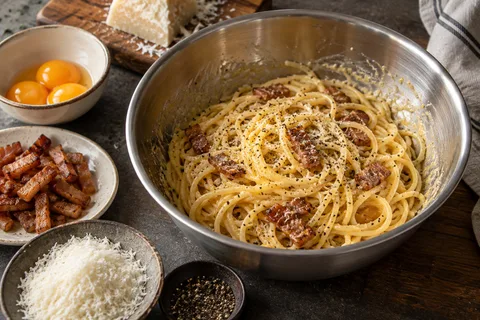
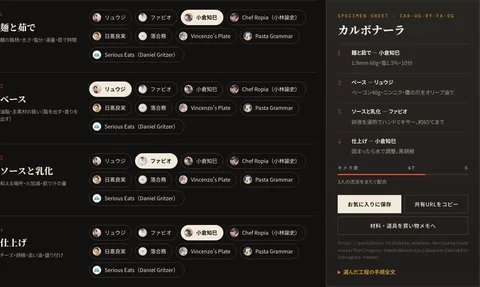
Carbonara splits over one question — where the egg comes up to temperature. Direct heat, bain-marie, or residual heat: five chefs, plus the tip line in Fabio's transcript about hot water and eggs.
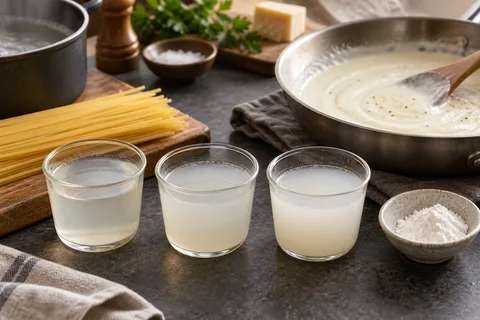
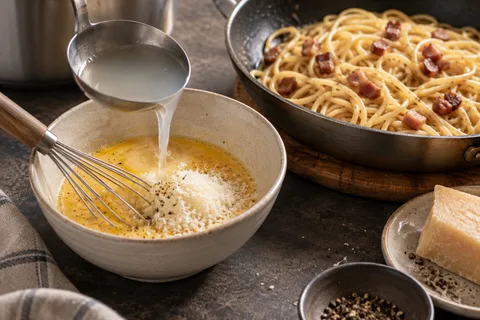
Chef Ropia's carbonara never touches cream — egg and cheese alone create the emulsion. In his book, he thins the egg mixture with cooled pasta water first, which he says keeps it from going lumpy.
In a carbonara egg mixture, the white starts to set first and the yolk second. That order is why whole-egg and yolks-only recipes come off the heat at different moments.
Emulsifying pasta sauce isn't about mixing harder. It happens only when starch, a safe temperature, and nonstop agitation all line up. Four schools split the work differently.
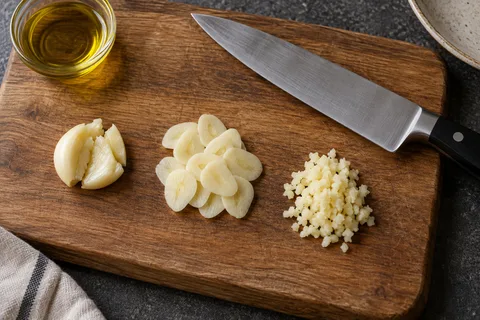
How you cut garlic trades off aroma against burn risk. Mincing should burn fastest, yet Ryuji starts it in cold oil — reading that as burn-proofing is the editors' inference, not his source's.
In the Recipe Builder, a chimera score of 100 doesn't predict failure — it just means no reference video exists for that mix. What each step changes and how sharing and saving work.
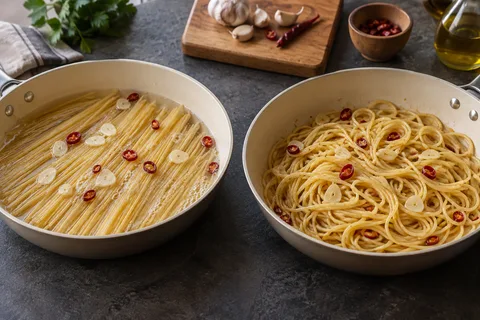
Ryuji's ultimate aglio e olio lists olive oil on two separate lines — one tablespoon each, the same oil. The split appears to come down to whether the oil hits heat.
Three channels all calling themselves traditionalist put 25g, 37.5g, and 50g of cheese per 100g of pasta into cacio e pepe — the middle one is half Pecorino, half Parmigiano.
Ogura's fava bean carbonara, Fabio's rich carbonara and Gritzer's carbonara all pull the egg off direct heat.
A 2025 physics study found sauce stability turns on starch as a share of cheese mass: under 1% splits, 2-3% is ideal, over 4% stiffens. Kenji cuts the water; the paper's own fix is powdered starch.
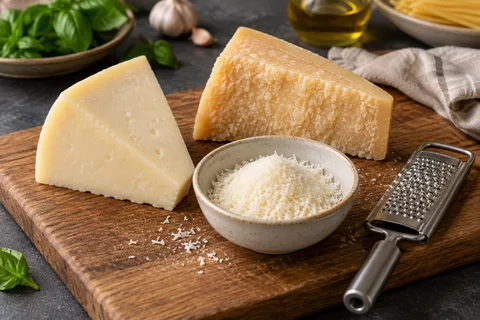
Pecorino is salty sheep's-milk cheese; Parmigiano is milder cow's-milk. Some recipes leave the water unsalted so Pecorino carries the salt; others salt it heavily instead. Pick the cheese first.
Ryuji's peperoncino skips emulsification: he simmers dried pasta directly in water and bouillon. Tomomi Ogura adds pasta water with ten seconds left on the boil. Six chefs compared.
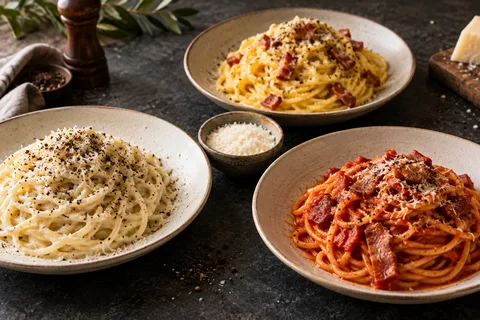
Cacio e pepe's grated cheese runs 17g to 50g per 100g of pasta, and Fabio adds 50g of cream cheese on top. Rome's three classics split along the same three axes: cheese, pork fat, emulsion.
Moving pasta from pot to pan comes down to two tools. That how much pasta water rides along changes the finish is the editors' read, not a relationship our sources tested.
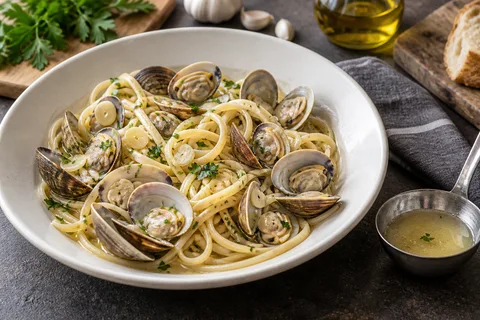
Ryuji's vongole bianco includes a half-teaspoon of kombu tea. Seven takes split on one real question — does the pasta drink clam liquor straight, or get tossed with a pasta-water emulsion?
Fabio's carbonara takes the egg mixture to around 65°C, and the transcript gives two cues: the temperature and the hand blender getting harder to turn. Ogura, Ryuji, and Fabio diverge on one dish.
 Chef profiles
 Reads
Reads
 Ingredients