
 Reads
ReadsIn his own write-up, Ryuji writes flatly: “I ignored the authentic method completely and made aglio e olio, and it turned out to be the finest plate of pasta of my life” — calling it “heretical, and yet supreme.” Kyomu pasta (literally “void pasta” — a dish stripped down to nothing) isn’t the product of cutting corners. It’s a deliberate swap: the reproducibility problems of emulsification and water-ratio math get replaced with one-pan cooking and umami seasoning. Line up “Ultimate Aglio e Olio” (2020) against his “Cacio e Pepe” (2023), and you can watch that swap happen in real time.

- Traditional routeBoil separately, then bind pasta water and oil by agitation.
- Kyomu routeSimmer dry pasta in one pan until the liquid thickens itself.
One-pan reduction routes around a separate emulsion step.
Emulsification, the one real hurdle, gets thrown out whole
Aglio e olio as made in Italian homes and trattorias has one real technical hurdle: emulsification. You infuse oil with garlic, add pasta water, and agitate the pan until the oil and water bind into a single sauce. In Tsutomu Ochiai’s published recipe (Cuisine Kingdom), you add 3 to 4 tablespoons of pasta water, shake the pan, and once it turns glossy and slightly thickened, add the parsley. Ochiai has no personal YouTube channel, so what follows should be read as the wording of that published recipe, not a video.
Read the full explanation
“Kyomu” is Ryuji’s own naming series: his site carries a “kyomu recipe” tag, with entries like kyomu porridge and kyomu misokin lined up under it (source). We couldn’t trace the term back to its first use.
Pressing play loads YouTube’s embedded player.Open on YouTube
Ryuji’s “Ultimate Aglio e Olio” skips that hurdle entirely. There’s no separate pot for boiling the pasta — it’s a one-pan build with 350cc of water and bouillon granules, where the dried noodles simmer down in a small amount of water until they thicken on their own, rather than chasing an emulsion (see the transcript for exact quantities). In his own write-up, Ryuji says flatly: “I ignored the authentic method completely and made aglio e olio, and it turned out to be the finest plate of pasta of my life” — calling it “heretical, and yet supreme.” That instinct — to route around the technical difficulty of emulsification rather than master it — leads directly to kyomu pasta.

- Roman referencePecorino, pepper, and pasta water define the core.
- Kyomu versionGarlic, butter, and generic grated cheese reshape the dish.
The shared name hides a different ingredient design.
The cacio e pepe version adds garlic and butter — neither traditional
The 2023 “Cacio e Pepe” video pushes the same design further. It’s a one-pan build: 100g of 1.4mm noodles simmered down in 340cc of water, finished with butter and grated cheese (see the transcript for exact quantities). Traditional Roman cacio e pepe is finished with nothing but Pecorino Romano, black pepper, and pasta water — this version adds garlic and butter, and swaps in generic grated cheese (no type specified) instead of Pecorino. The video title itself uses the phrase “insanely good no-topping one-pan kyomu pasta” (per the transcript).
Pressing play loads YouTube’s embedded player.Open on YouTube
As the editors read it, “kyomu” here isn’t a self-deprecating admission of laziness — it’s a design principle: cut steps while still landing the flavor. The technical variables of the authentic version — emulsification, water-ratio math, the exact grind of the cheese — get replaced with bouillon or MSG, seasonings that arrive with concentrated umami already built in, shifting reproducibility toward the home cook.

- Reproduce processPreserve the restaurant or home technique itself.
- Reproduce outcomeUse seasoning and one-pan cooking for fast reliable flavor.
The disagreement starts with two definitions of fidelity.
The real MSG debate is about what’s being reproduced
At the center of this design swap are umami seasoning and flavor seasoning — MSG (Ajinomoto) is the former; granulated bouillon and shiro-dashi are the latter, products that blend umami compounds with stock or dashi flavor, sugars, and salt. Ryuji’s recipes are built by remaking the same dish over and over across years, each version presented as the current definitive one (see our chef page for more on this pattern). Home-oriented flavor design built around umami seasoning is a direct extension of that approach. By contrast, Fabio’s aglio e olio and cacio e pepe (source), and Ochiai’s aglio e olio, use neither umami nor flavor seasoning at all (Fabio does use fish sauce or shiro-dashi in some vongole versions, so it isn’t that he rejects home-style seasoning outright). Fabio is reported in the site’s write-up to give a figure for his pasta water salt — 30g per 2 L (about 2 quarts), or 1.5% (we haven’t yet cross-checked this against the video itself). Ochiai instead judges doneness by feel, cooking the garlic until a skewer slides through it easily (his version doesn’t specify a salt or water quantity).
Read the full explanation
Which of these two approaches is the “correct” pasta isn’t just a matter of taste — it’s a disagreement about what’s actually being reproduced. A version like Ochiai’s, that follows a restaurant’s own procedure, is trying to reproduce the process itself, whether in a professional kitchen or an Italian home (Fabio, for his part, translates professional technique for the home cook — he never rejects one-pan cooking outright). Ryuji’s approach is trying to reproduce something different: a plate that’s fast, reliably repeatable, and satisfying. In the editors’ view, this isn’t a debate that resolves — it’s two schools with different goals that happen to share the same dish names, “aglio e olio” and “cacio e pepe.” We’re also setting aside the health question around MSG entirely here; this article sticks to flavor design.
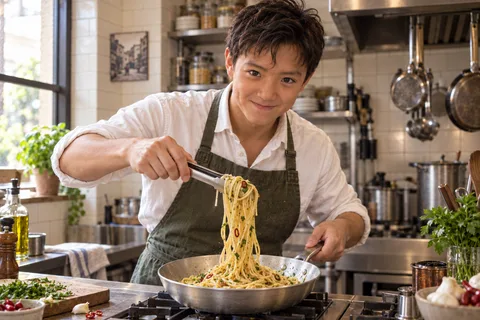
Both of Ryuji’s dishes being one-pan builds comes down to the same logic as skipping emulsification. There’s no separate pot to boil pasta in and no draining step — everything finishes in a single skillet, cutting down on both dishes and steps. A nonstick pan is a natural fit for this design, since it resists scorching during the step where the water simmers down.

- Remove extra potCook noodles and sauce in one vessel.
- Replace emulsion workLet reduction and released starch thicken the liquid.
- Add concentrated umamiBouillon or MSG supplies depth with fewer steps.
Kyomu pasta exchanges process fidelity for repeatability.
Summary
Kyomu pasta isn’t about removing ingredients — it’s a design that swaps out the technical hurdle of emulsification and the reproducibility problem of water-and-salt math for one-pan cooking plus umami seasoning. Comparing the transcripts of Ryuji’s “Ultimate Aglio e Olio” and “Cacio e Pepe” shows that swap sharpening between 2020 and 2023. This isn’t an article about which approach is “correct” relative to the authentic procedure — but reading it alongside the aglio e olio chef comparison and the cacio e pepe chef comparison, where the emulsion is built carefully, makes the difference in design philosophy easier to see. Ryuji’s full body of work is covered on his chef page, and the fault line between home-style and authentic approaches gets a deeper look in this article.



 Ingredients