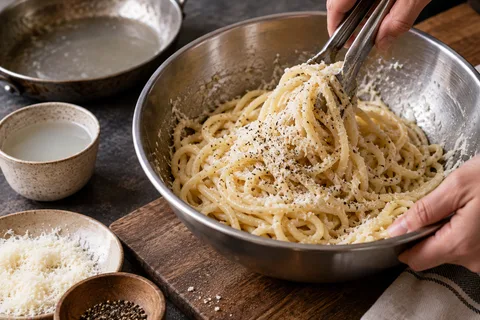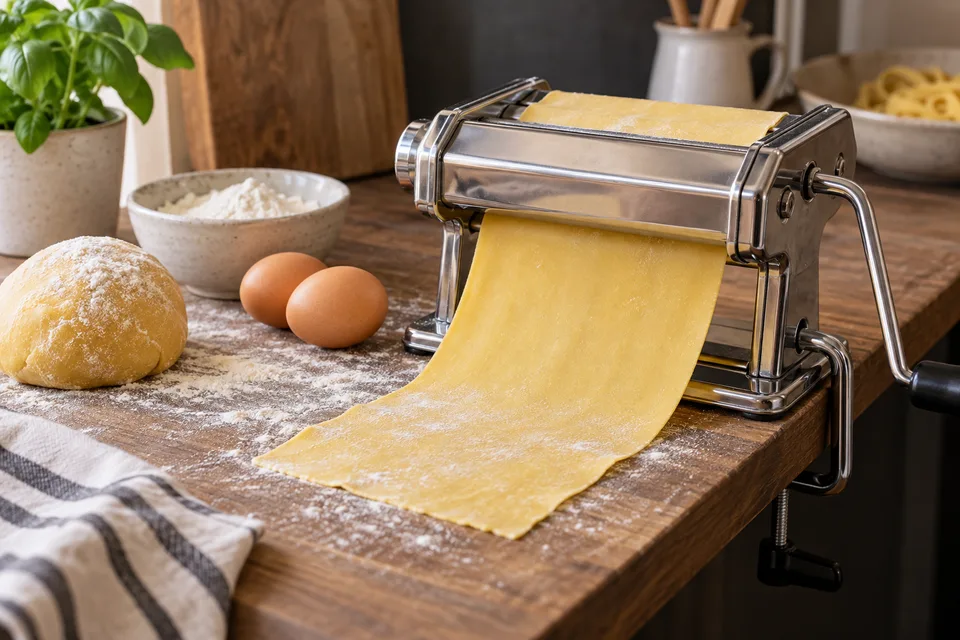
If you’re going to roll fresh pasta at home, the first decision is the pasta machine. The short answer: a manual model is plenty for home use, and you can hold off on going electric until you’re rolling dough often. Starting with a dish that pairs well with a thick, flat noodle — like bolognese — is a good way in, since even a rough first attempt won’t show up as much in the texture, making it forgiving practice material.

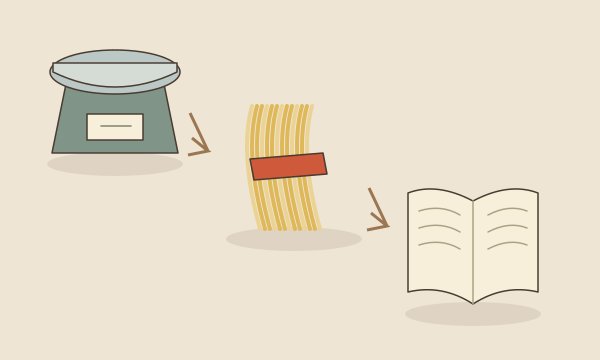
- Industrial extrusionPressure, die, and drying create a repeatable dried strand.
- Home rollingThe cook controls flour blend, thickness, and fresh texture.
A roller transfers texture control from factory to cook.
What changes when you swap the industrial die for a home roller
Dried pasta is made by extruding durum semolina dough through a die under high pressure, then drying it slowly, which gives it a consistently firm bite. The surface texture depends on the die material: bronze dies (De Cecco, Garofalo, and others) leave the surface rough, while Teflon dies (Barilla and others) produce a smooth finish (drying temperatures also vary by product). Fresh pasta swaps that industrial process for a home roller, so you decide the flour blend and the dough thickness yourself — which means any mistakes show up directly in the texture. A sauce with a lot of moisture in the ingredients, like bolognese, clings better to a flat fresh noodle than to a thin dried one, which is a straightforward reason to pick up a pasta machine in the first place.
Pressing play loads YouTube’s embedded player.Open on YouTube

- Ogura gear listNames a machine and flours without a fresh-dough blend.
- Fabio recipePublishes 00 flour, egg, salt, oil, and rolling thickness.
Only Fabio supplies a dough that can be copied as written.
Only one of the two chefs actually publishes a ratio
Tomomi Ogura, chef-owner of Regalo in Sangubashi, lists a pasta machine (the Imperia R-220) in his note roundup of favorite gear, along with durum semolina and French-style medium-strength flour (Lys d’Or) as separate entries. In that note, though, the semolina is introduced for frying — “nicely gritty for fritto” — and the Lys d’Or as a French bread flour, so neither is presented as part of a fresh pasta dough. The note is a link roundup of the equipment and ingredients he uses, and it doesn’t disclose any blend ratio between the two flours.
Read the full explanation
Fabio’s bolognese video write-up (howtocook.jp), on the other hand, gives a specific dough: 100g of 00 flour combined with 2 egg yolks, a little egg white, 2g of salt, and 10cc of extra-virgin olive oil. This hasn’t been independently re-checked against the video itself. The write-up also gives a thickness setting — roll the dough to 1.5mm on the machine, then fold it in thirds and cut it by hand. Blend and boiling details are covered separately on our bolognese chef comparison page. This blend likely handles more smoothly than a semolina-only dough because of the added egg yolk, though the video itself never states that reasoning outright.
Both chefs’ dough blends reflect their own school of technique, and neither is more “correct” than the other — the flour ratio is a variable you’ll tune against your own dough once you own the machine.
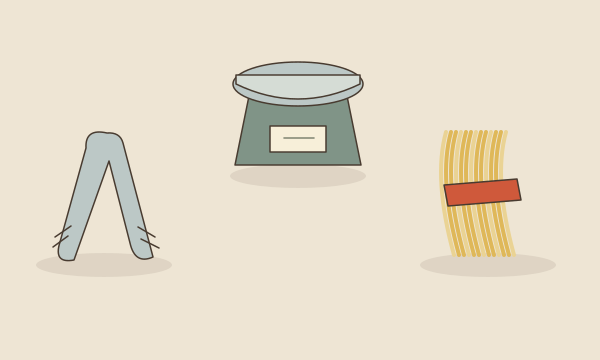
- Manual crankAffordable for small batches, but one hand turns the roller.
- Electric motorFrees both hands for dough at a higher purchase cost.
- Cutters and widthIncluded attachments decide which noodles emerge ready-cut.
Buy for batch frequency and the shapes you will actually make.
Manual or electric, and whether the width and attachments cover you
Home pasta machines fall broadly into manual and electric types.
- Manual: The Imperia and Marcato Atlas 150 are the well-known names, and you feed dough through by turning a hand crank. This is plenty while you’re only making small batches at a time
- Electric: A motor turns the rollers, freeing one hand to feed the dough while the other shapes it. These cost more than manual machines and are worth considering once you’re rolling dough regularly
- Roller width: Many home models run around 150mm wide. That’s enough width for wider noodles like tagliatelle or fettuccine
- Attachments: The cutters that come bundled vary by model. Flat-noodle and thin-noodle cutters usually ship with the machine itself, while attachments for filled pasta or spaghetti are sometimes sold separately. If you already know what width of noodle you want to cut, check the product page to confirm whether that cutter is included before you buy
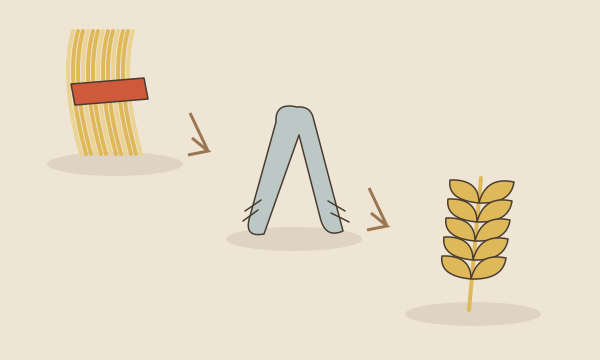
- Center the doughAn off-center sheet stretches diagonally through the rollers.
- Repeat the settingRotate and pass again until thickness becomes even.
- Dust and spreadKeep sheets separate so they do not dry or stick.
Even feeding matters before chasing the thinnest setting.
Beginners trip on feed position, not thickness
Right after buying a pasta machine, the two easiest things to get wrong are keeping the thickness even and timing the drying. Feed the dough in off-center from the roller and it tends to stretch at an angle, so for the first few passes, run the dough through the same setting two or three times, rotating it between passes, to even out the thickness. Rolled dough dries out and cracks quickly once it hits the air, so it’s safer to keep it dusted with flour and spread out — not stacked — right up until you cut it. In the editors’ view, prioritizing evenness over thinness for the first pass or two cuts down on uneven cooking later.
- Copy Fabio’s doughStart from the only published complete ratio in the comparison.
- Roll to the guideUse the stated thickness as the first machine target.
- Adjust next batchChange hydration only after observing your own dough.
A documented baseline shortens the first round of guessing.
The shortcut is the one ratio that’s actually written down
There’s no problem starting with a manual pasta machine. Which flour to use varies by chef: Tomomi Ogura lists durum semolina and French-style medium-strength flour among his favorites on note, while Fabio uses 00 flour. That said, Ogura’s note names the flour brands but introduces the semolina for fritto and the Lys d’Or as a French bread flour, and it gives no fresh pasta blend ratio, so the only dough blend you can actually replicate as written is Fabio’s — the one with a surviving transcript (100g 00 flour, 2 egg yolks plus a little egg white, 2g salt, 10cc extra-virgin olive oil). Treat that as your starting template, then adjust the ratio based on how your own dough handles. Check the bolognese chef comparison page alongside it to confirm what sauce consistency actually pairs with a flat noodle — it’ll help you judge how well the sauce clings from your very first plate. For flour choices, see the durum semolina and Lys d’Or pages; for the machine itself, see the pasta machine page. Tomomi Ogura’s broader approach to cooking is covered on the Tomomi Ogura page (the pasta broken down there mostly uses 1.5–1.9mm dried noodles, as in the bolognese and carbonara entries, though some episodes use short shapes like the fusilli in his Napolitan). The fresh pasta dough itself is compared chef by chef on the bolognese chef comparison page.



 Ingredients