 Reads
ReadsPressing play loads YouTube’s embedded player.Open on YouTube
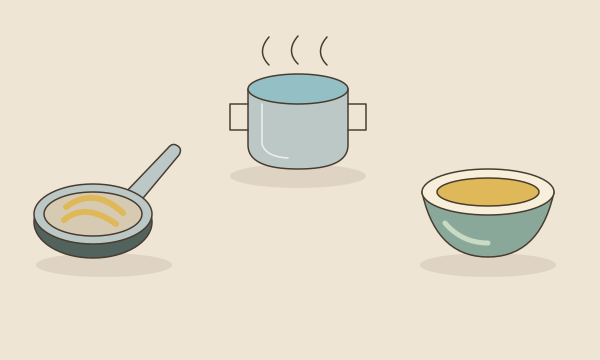
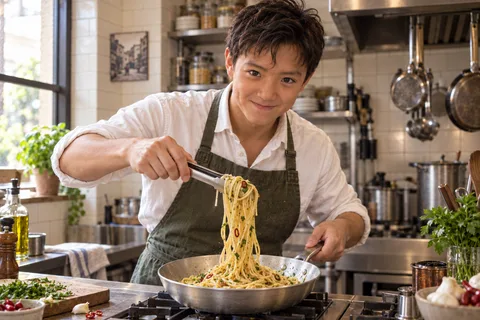
- Ryuji direct heatA cooled pan returns to low heat with constant stirring.
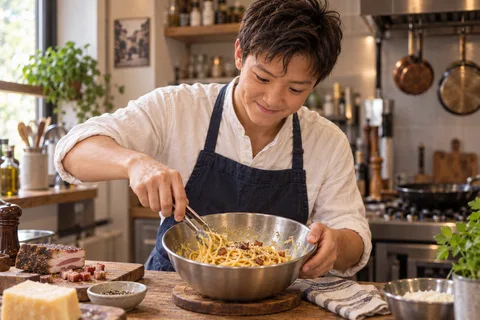
- Fabio bain-marieA hand blender works the egg over buffered water heat.
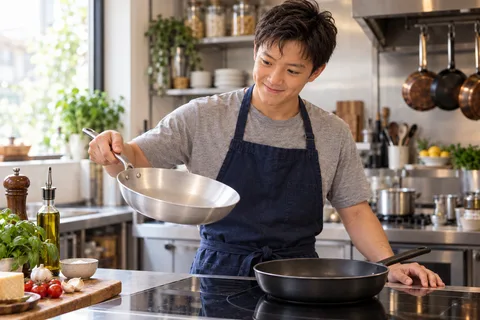
- Ogura residual heatThe egg enters only after the pan leaves the flame.
Carbonara schools differ mainly in the heat path.
Same dish, different place for the heat to meet the egg
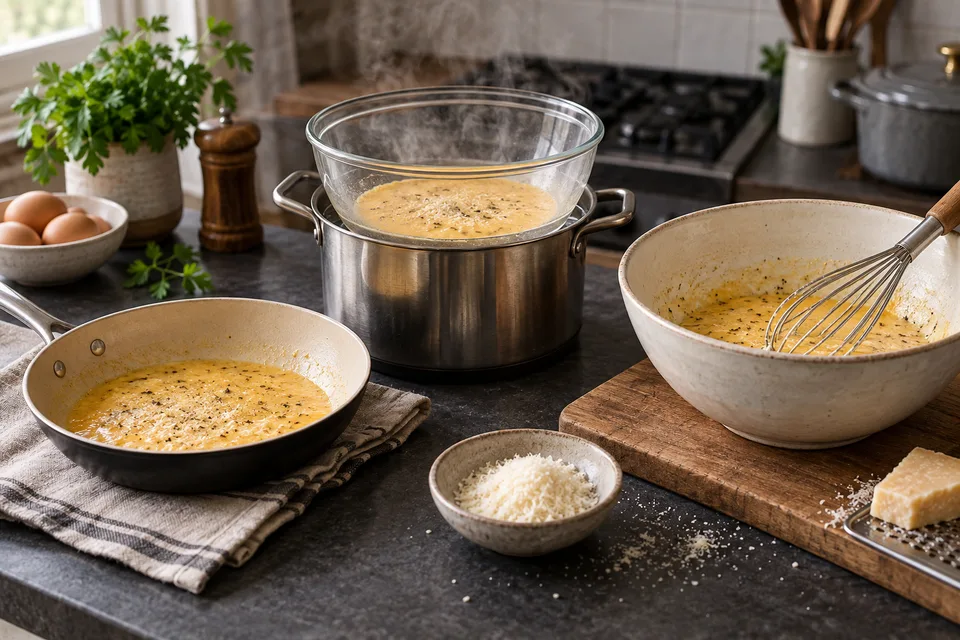
The gap between these three chefs isn’t a matter of skill — as the editors read it, it comes from who each one is picturing on the other end of the recipe. The fork in the road is where the egg mixture meets heat. Ryuji lets the pan he sautéed the aromatics in cool down first, then sets it back over low direct heat, pours in the egg mixture, and stirs constantly. Fabio sets a bowl of egg mixture over a bain-marie and whisks it with a hand blender up to around 65°C, according to the transcript site (this has not been cross-checked against the full video). Tomomi Ogura — in his “Fava Bean Carbonara” episode, built around a seasonal ingredient — does the opposite: he takes the pan off the heat entirely before adding the egg mixture and pasta, and never puts the egg mixture over direct heat at all. It’s the same step of turning egg and cheese silky, but whether the heat source is direct flame, a bain-marie, or residual heat changes what tools you need and what you have to watch for.

- Ryuji one panCooling, low flame, and a spatula minimize equipment.
- Fabio tool stackBain-marie and machine agitation make heat more explicit.
One simplifies the setup; the other instruments the process.
Ryuji works with one pan at home; Fabio manages temperature with equipment
Ryuji’s version uses 1 whole egg and 30 g of grated cheese, in a two-stage move: cool the pan, then stir constantly over low heat. The tools are just an everyday pan and a rubber spatula — the transcript doesn’t mention a thermometer anywhere. Instead of relying on a feel for heat level, this reads as a design that avoids adding any extra equipment.
Read the full explanation
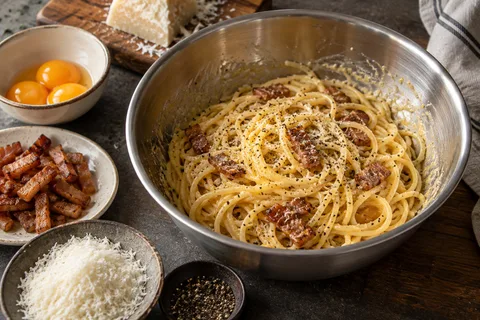
Fabio’s version combines 3 egg yolks with Grana Padano, Pecorino Romano, and rendered guanciale fat, sets the whole bowl over a bain-marie, and brings it up to around 65°C while whisking with a hand blender, according to the transcript site (this has not been cross-checked against the full video). Rather than going by feel, this method controls how fast the temperature climbs using the bain-marie and the hand blender. The transcript never uses the word “thermometer,” but it gives two cues: a temperature — “finish it over the bain-marie until the inside reaches about 65°C” — and a physical one, “once it gets harder to turn, that’s your sign it has thickened.” It can’t be read as saying he works without a thermometer. This is a school that reads doneness through both the temperature and how the equipment responds.
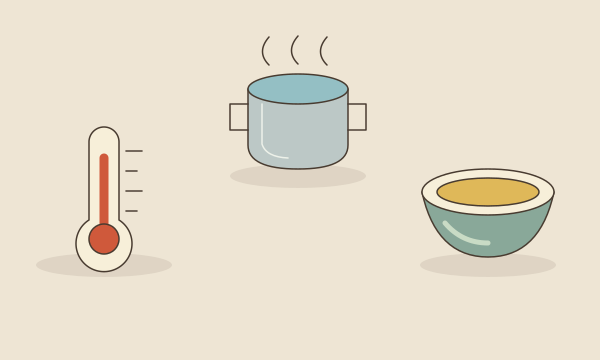
- Direct pan bottomA hot spot can cross the setting range first.
- Bain-marieWater spreads heat and slows local overheating.
- Cooling vesselResidual heat weakens continuously after mixing starts.
Heat delivery changes how fast egg reaches coagulation.
The temperature at which egg actually sets
Egg yolk is fully set at 65–70°C and egg white near 80°C (Chemical Society of Japan, Kagaku Daisuki Club), while the white is generally said to begin reacting at a lower temperature (the widely circulated figure of around 58°C for when egg white starts to set is one this site has not been able to confirm against a primary source). All of these shift with the individual egg, the rate of heating, and dilution; see the egg coagulation article. Pour an egg mixture directly over a flame and the bottom of the pan alone tends to cross that setting temperature first, which is why constant stirring to spread the heat is essential. A bain-marie transfers heat through water, so it’s less prone to a single overheated hot spot the way a pan bottom is; folding pasta in off the heat is an even harder environment for the egg to set in, since the pan itself keeps losing heat the whole time. Seen this way, all three chefs’ choices of heat source read as different answers to the same underlying problem: how to avoid crossing that setting temperature too fast.
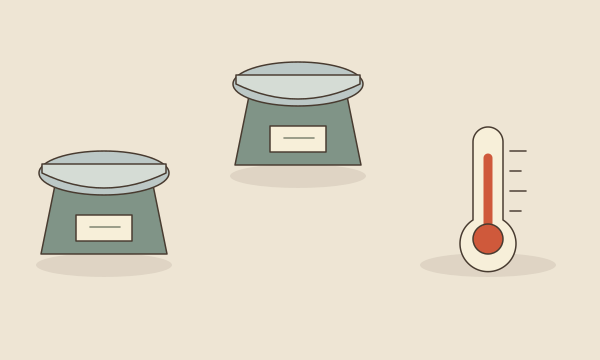
- Ogura ratiosIngredient relationships scale a professional framework down.
- Ryuji quantitiesFixed egg size and grams target repeatable home cooking.
- Fabio cuesTemperature and blender resistance teach equipment-based control.
Recipe form reflects the cook each chef is teaching.
Ogura works in ratios, Ryuji works in quantities — who is each recipe for?
In his “Fava Bean Carbonara” video, Tomomi Ogura specifies Parmigiano Reggiano by ratio — “the same weight as the egg yolk” — against 1 egg yolk, plus a small amount of heavy cream (this is a seasonal variation distinct from his plain “Spaghetti Carbonara,” vol. 8). The center of gravity here sits less on exact quantities and more on holding a fixed ratio between ingredients. The table of contents of his book, Minimalist Best-Ever Pasta From a One-Star Italian Kitchen (KADOKAWA), includes a section on pasta’s “five major elements,” “supporting elements,” and “aromatic elements” — a framework that appears to be why the ratios stay fixed even when a restaurant dish is scaled down to a home portion.
Read the full explanation
As the editors read it, the difference among these three chefs isn’t a matter of skill — it’s a difference in who each one is trying to reach. Ryuji’s version prioritizes being reproducible in a home kitchen with no special equipment, and dials in the quantities carefully for repeatability — specifying an L-size egg, for instance. Fabio’s version is aimed at viewers standing in a Japanese kitchen, showing them that the right equipment can get you close to an authentic Italian result without having to rely on a feel for direct flame. Tomomi Ogura’s version, meanwhile, is addressed to aspiring professionals — fittingly, given that his channel is literally named “Tomomi Ogura’s Italian Chef Training Course.” He takes the ingredient ratios honed in a professional kitchen and scales them down to a 60 g home portion that a home cook’s equipment can handle. The form of the egg and the cheese differ, and so do the methods — but the heart of the divergence is where the heat is placed.

- Pick the heat pathChoose direct, buffered, or residual heat first.
- Use its cueFollow quantities, ratios, or equipment feedback consistently.
- Compare one changeSwap only the emulsification step on the next attempt.
Chef differences become useful when tested one variable at a time.
Summary
The differences among these three chefs come down to two things: where the egg mixture meets heat (direct flame, bain-marie, or residual heat), and what standard each one uses to judge doneness (feel, an equipment reading, or a fixed ratio). None of them is the “correct” answer. Start by following one school exactly as shown in its video, then swap out just that school’s emulsification step for another’s — the fork in the road becomes obvious the moment you feel it happen. For a fuller side-by-side of the steps, see the carbonara comparison page; to actually swap out steps yourself, see how to use the recipe builder. To read up on each chef’s full school of thought, see the pages for Ryuji, Fabio, and Tomomi Ogura.