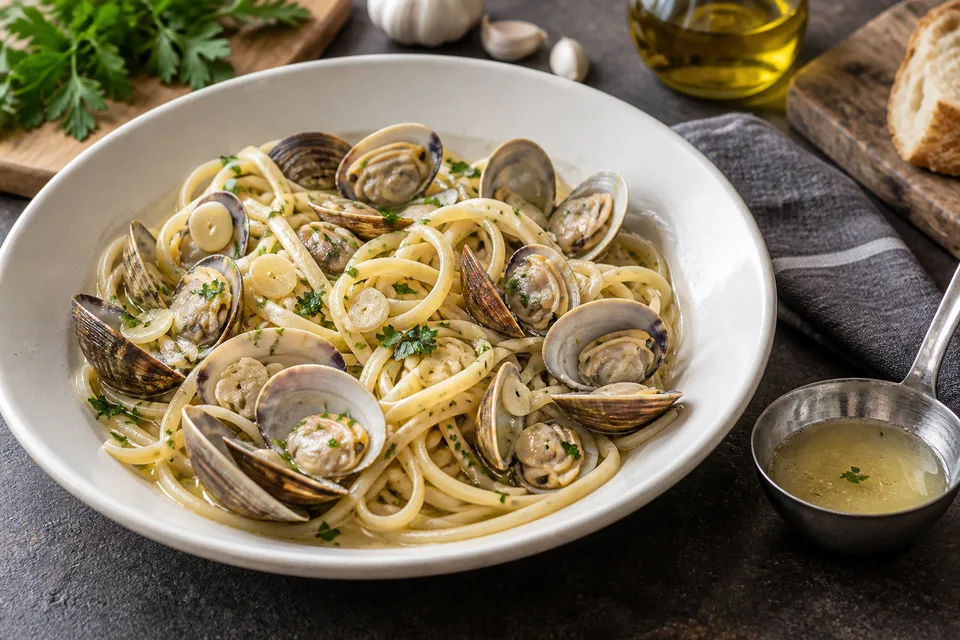
Pressing play loads YouTube’s embedded player.Open on YouTube
Ryuji’s vongole bianco calls for half a teaspoon of kombu tea — an Italian dish finished with a Japanese dashi trick. The real dividing line in vongole, though, is whether the pasta drinks the clam liquor or gets tossed with an emulsion built from pasta water. The first splits again into a one-pan version, where the noodles cook in the clam liquor, and a separately boiled version where the drained noodles absorb the clam liquor alone; the second boils the pasta separately and finishes it with the steaming liquid plus added hot water over high heat. When the clams open matters differently in each school, too. This article lines up seven schools on three points: when the clams open, how the sauce emulsifies, and how much salt goes in (the comparison page adds Fabio, who this article doesn’t cover, for eight in all).

- Pull pan at first crackResidual heat finishes shells after the burner stops.
- Remove one by oneEach clam leaves as it opens and returns at the end.
- Keep all liquorThe steaming liquid becomes the pasta’s cooking sauce.
Clam timing and clam liquor are separate decisions.
Three ways of handling the clams (off the heat as they crack / out as they open / use every drop)
Handling the clams splits into three types: pull the pan off the heat the moment the shells start to open, take the clams out as they open and return them at the end, or use every drop of the steaming liquid. The first two are about when to stop the cooking; the third is about what happens to the liquid — so not all seven schools land in exactly one of them.
Read the full explanation
Not Another Cooking Show treats the first crack of a shell as the “pull it off the heat now” signal: “opening is your cue to take it off the heat immediately — it’ll fully open about 10 seconds after it starts.” Ryuji’s transcript says clams should come out “as each one opens, to keep them from shrinking and toughening up,” and he removes the meat from the shell for every clam except five or six large ones he leaves whole.
Yoshimi Hidaka also takes the clams out once they open and returns them at the end. He steams 240 g of clams, shells on, in 70 ml of white wine — the Kurashiru recipe reads “add the clams and white wine, turn the heat to high, cover, cook until the clams open, and take them out” — then returns them “while a little liquid still remains” and tosses the pasta over high heat with the steaming liquid plus extra hot water. The use-every-drop school is Vincenzo’s Plate, who steams 300 g of clams (a 1:1 ratio with 100 g of pasta) in a glass of white wine, and even addresses clams that stay shut: “if it doesn’t open in the middle, it’s not edible.”
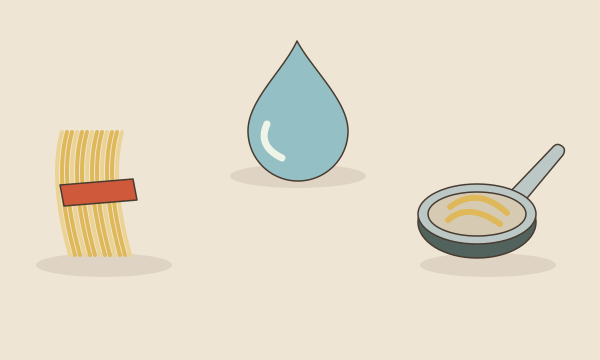
- Cook pasta in brothReleased starch stays directly in the clam liquid.
- Concentrated pasta waterA small boil supplies stronger starch for the finish.
- Reduce clam liquorEvaporation thickens the liquid before oil or butter joins.
Vongole body comes from starch, reduction, or both.
Emulsion by starch, or by reduction
Two families anchor the emulsification method — let the pasta’s own starch do the work, or reduce the clam liquor down — and a third is layered on top of them: building the emulsion with fat (oil or butter) at the finish.
Read the full explanation
Ryuji skips boiling the pasta separately, cooking 1.4 mm noodles directly in a mixture of 320 ml of water and 50 ml of sake. The transcript reads, “boiling the pasta in the clam broth releases the pasta’s flour, and it emulsifies right there in the pan” (a third-party transcript, not yet cross-checked against the video itself). The 10 g of butter is an add-on “for richness and aroma,” and a half-teaspoon of kombu tea layers umami on at the end. Not Another Cooking Show boils the pasta itself in a small pot, or in less water, to concentrate the starch in the pasta water: “I find it’s nearly impossible to get the pasta water starchy enough in a big pot,” though the recipe also notes “either way works.”
Yoshimi Hidaka tosses the pasta over high heat while adding the steaming liquid and extra hot water (the original recipe lists only “hot water (for adjusting)” and never specifies pasta water), while Vincenzo’s Plate adds no pasta water at all — the drained noodles absorb only the clam liquor. Tomomi Ogura adds the clams, takes the pan off the heat, adds water, covers, and returns it to high heat; once open, the shells come off and the liquid reduces over low heat, the boiled pasta is tossed in over medium-high, and the dish is finished by emulsifying with basil, Italian parsley, and olive oil.
Separately, Tsutomu Ochiai’s official recipe from NHK’s Today’s Cooking reduces the steaming liquid from 500 g of clams down to three-quarters of its volume, adds 10 g of butter, and shakes the pan until it clouds white and emulsifies. This hasn’t yet been cross-checked against the broadcast itself, so treat the figures as approximate. Serious Eats makes fine adjustments, adding pasta water “one tablespoon at a time” to walk back an over-reduced sauce, and the butter is optional in the original recipe.
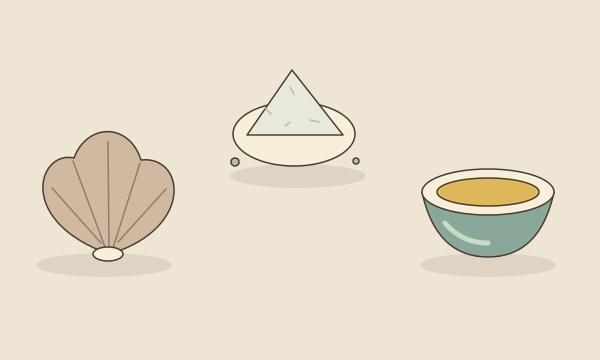
- Clam-led seasoningUse little boiling salt and taste the liquor first.
- Firm pasta brineSalt the noodles strongly, then control reduction carefully.
- Added umami saltRyuji layers kombu tea and a final pinch instead.
The schools allocate salt to different parts of the dish.
Trusting the clams for salt, or salting hard
The schools split between going light on boiling salt because the clams themselves carry salt, and salting the water hard regardless.
Vincenzo’s Plate keeps it minimal: “just a pinch of rock salt, don’t overdo it — the clams already carry the sea’s salt.” Serious Eats spells it out with a conversion, “three tablespoons per 12 cups of water,” which works out to about 1%, and Tsutomu Ochiai uses 20-25 g of salt per 2 L of boiling water (a bit over 1%). Tomomi Ogura, by contrast, salts higher at 1.5%, explaining that “boiling the pasta slightly firm and tossing it with the sauce concentrates the flavor.” Ryuji’s cooking liquid uses only a fifth of a teaspoon of salt, leaving the seasoning to the kombu tea and a final pinch of salt.
If you want to match the salt to your own pot’s water volume, multiply water by the percentage you want: 1% of 1 L of water is 10 g of salt.
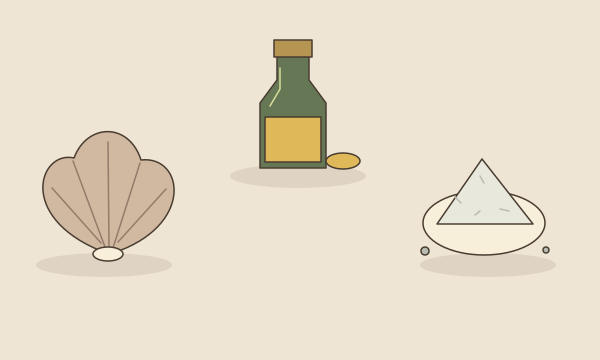
- Tough clamsStop heat or remove each clam as soon as it opens.
- Oily sauceUse concentrated starch or add pasta water gradually.
- OversaltingChoose either clam-led or brine-led seasoning.
Texture, emulsion, and salt each need their own safeguard.
Common failure points and how each school avoids them
Clams turn tough from overcooking. Not Another Cooking Show pulls the pan off the heat the moment the shells start to open, and Ryuji removes each clam as soon as it opens.
A sauce that won’t emulsify and turns oily usually means the pasta water’s starch is too thin, or the ratio of oil to water has gotten out of balance. Not Another Cooking Show boils the pasta in a small pot to concentrate the starch, and Serious Eats adjusts by adding pasta water one tablespoon at a time. Tsutomu Ochiai emulsifies with butter instead.
Oversalting comes from the clams’ own salt stacking on top of the boiling salt. Either go light on the boiling salt the way Vincenzo’s Plate does, or salt the boiling water hard the way Tomomi Ogura does — pick one lane rather than mixing both.
- Choose clam timingDecide when opened shells leave the heat.
- Choose cooking liquidFinish in broth, pasta water, or reduced liquor.
- Set salt around itSeason only after accounting for the clams.
The liquid plan should determine the clam and salt plan.
Summary
Once you decide whether the pasta cooks directly in the clam liquor or gets boiled separately and finished with a hard toss, how each school handles opening the clams and setting the salt tends to fall into place. The full step-by-step breakdown — these seven plus Fabio, eight in all — is laid out on the vongole comparison page, and how to use the recipe builder covers picking a chef for each step and assembling your own plate.