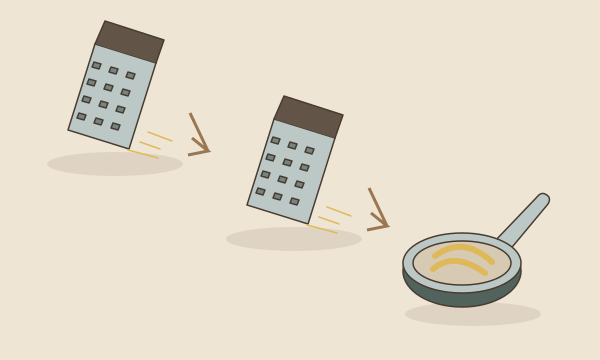
- Start wholeWhole pepper preserves aroma until the dish is made.
- Crack or grindChoose particle size before it meets the sauce.
- Place the pepperToast early or grind at the finish for different effects.
Pepper must be processed and timed, unlike a ready sauce.
Cacio e pepe’s “pepe” comes with an extra step
Cacio e pepe schools split into a camp that scatters pepper only at the finish, and a camp that toasts it first to build aroma. The difference isn’t really about origin — it comes down to three things: grind, toasting, and when the pepper goes in. Cheese technique is covered in detail on the cacio e pepe comparison page.
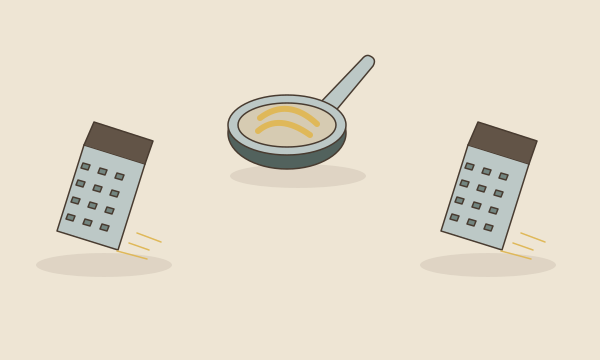
- Freshly ground rawKeeps a bright bite and volatile top notes.
- Dry toastedHeat changes the aroma before pepper enters the sauce.
- Toast then finishSome cooks layer warmed depth with a final fresh grind.
Heat timing gives one pepper two aromatic roles.
Raw pepper versus toasted pepper
Ryuji’s school is simple: crack whole black peppercorns during prep, then scatter them at the finish. There’s no toasting step — he cracks the peppercorns in the prep stage and scatters them over the pasta once it’s plated.
Read the full explanation
Pressing play loads YouTube’s embedded player.Open on YouTube
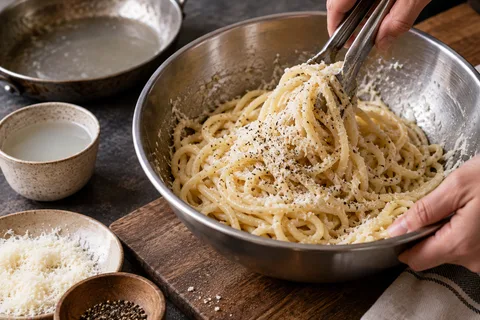
Chef Ropia goes the other way, putting pepper front and center from the start. Once the pan surface is warm, he lowers the heat and dry-toasts whole black peppercorns with no fat, grinds them in a mill, returns them to the pan, and only then brings in the pasta water and noodles. In the video he states the ingredients are just three: black pepper, grated cheese, and pasta.
Pasta Grammar takes the toasting further, roasting peppercorns over medium-high heat for about 4 minutes, then taking the pan off the heat, coarsely grinding the pepper in a mortar, and returning it to the pan. Claudio Gargioli of Armando al Pantheon, the storied Rome restaurant featured by Italia Squisita, roasts whole cubeb pepper (pepe nero cubebe) in a small pan. His tell for doneness: the peppercorns turning translucent, a sign that oil is starting to render out. He cools them on absorbent paper before pounding them in a mortar — and notably doesn’t grind everything to powder, leaving some peppercorns whole.
Serious Eats’ J. Kenji López-Alt spells the step out in the recipe: heat 1 teaspoon of coarsely ground black pepper in olive oil over medium-low heat for about a minute, pulling it off the heat once the pepper starts to sizzle faintly — a step the article describes as “toasting black pepper in a little olive oil and butter” (“Toasting pepper in oil,” as it puts it elsewhere; what this site calls an “oil bloom”). The video that matches this recipe article is “Food Lab Basics: POV Cacio e Pepe” on his own channel, whose description points straight at it — “Here’s a published version of the recipe” — with a link that now redirects to this recipe page. The amounts below come from the recipe page.
Between grind style (coarsely cracked, pounded, or left partly whole) and whether heat is applied at all (raw, dry-toasted, or bloomed in oil), that’s at least four distinct schools built from these two variables alone. Few chefs spell out exactly when in the process they grind. Within what this site’s breakdown data can confirm: Ryuji cracks his peppercorns and scatters them at the finish, while Pasta Grammar and Claudio Gargioli toast their peppercorns first and then pound them in a mortar. The only school that explicitly calls for a mill in its own steps is Chef Ropia’s (he grinds the dry-toasted peppercorns in a mill and returns them to the pan); Pasta Grammar and Claudio Gargioli use a mortar, and Ryuji chops his during prep.

- Fine-only millSmall particles disappear evenly through the sauce.
- Wide coarse settingLarge fragments stay visible and tactile in cacio e pepe.
- Whole-pepper optionA removable top makes loading and cleaning practical.
For pepper-led pasta, grind range matters more than looks.
Many mills can’t grind coarse enough
To reproduce these differences at home, start with a mill that can be set to a coarse grind. Some mills have a narrow adjustment range and can’t be set coarse enough at all, so before buying, check whether the product description actually states the particle size at its coarsest setting. A mill with a wide adjustment range can get you both the coarseness Ryuji uses for cracking peppercorns to scatter at the finish, and the coarseness Pasta Grammar uses for grinding toasted peppercorns. Chef Ropia dry-toasts his black pepper whole and then grinds it in a mill before returning it to the pan — he uses both dry-toasting and a mill.
Read the full explanation
The peppercorns themselves also shape the result. Tellicherry isn’t a variety — it’s a grade name for peppercorns sorted by size, and grading standards vary by vendor. The general wisdom is that buying whole peppercorns and grinding them right before use preserves more aroma. Origin and grading differences are covered in Black Pepper Origins and Grinding for Cacio e Pepe.
If you don’t own a mill, a mortar and pestle, or peppercorns crushed in a bag with a rolling pin, both work as substitutes. For a process like Pasta Grammar’s or Italia Squisita’s — toasting peppercorns first, then pounding them — some would argue a mortar actually gives you better control over particle size than a mill would.
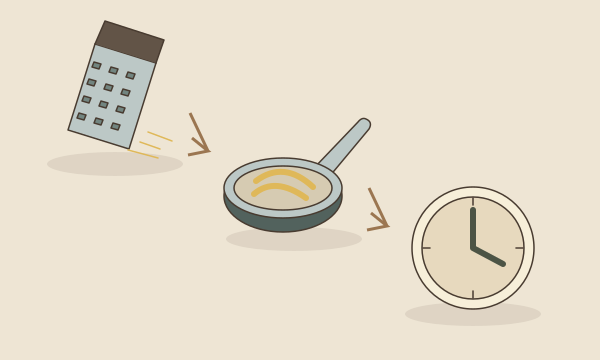
- Choose a coarse-capable millMake sure the adjustment reaches visible fragments.
- Decide on toastWarm the pepper if deeper aroma suits the method.
- Grind near serviceKeep the final pepper layer as fresh as possible.
Mill range and timing shape the pepper more than branding.
Summary
Black pepper in cacio e pepe ranges from a supporting role scattered at the finish to a lead ingredient toasted first to build aroma. A reasonable starting point is Ryuji’s style — cracking whole peppercorns and scattering them at the finish, as shown in his video — and if a mill is all you have, set it coarse as a substitute. From there, try dry-toasting or coarse-pounding in a mortar once you’re comfortable, since that’s where the differences become easiest to taste. For the full step-by-step branching, see the cacio e pepe breakdown page; for more on choosing the pepper itself, see Black Pepper Origins and Grinding for Cacio e Pepe.


 Ingredients