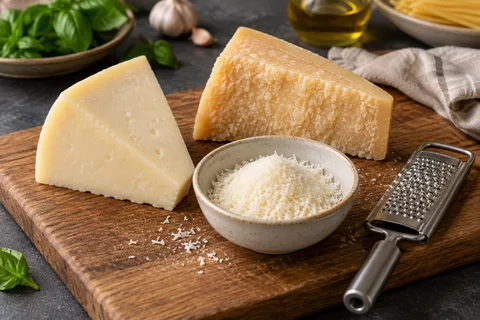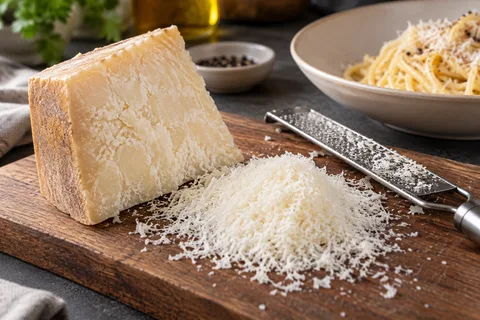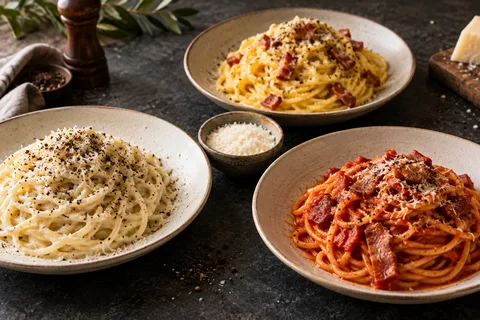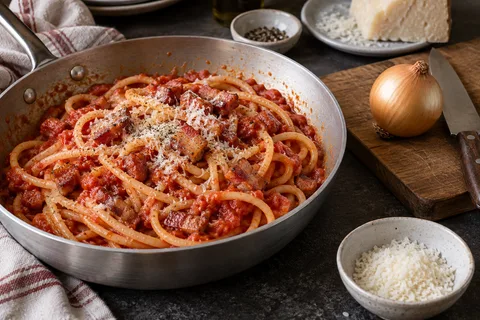
The traditional Roman and Amatrice schools skip onion and garlic. Of six chefs here, only Ryuji and Yoshimi Hidaka add them — the other four build on pork fat, tomato, and cheese, with wine or chili.
International chef
Italia Squisita
Italia Squisita
Comparative media featuring top chefs Operates as a media outlet rather than an individual, inviting a well-known chef each episode to compare and explain technique. Often cited as a primary source for the four classic Roman pastas.
Italia Squisita · ~1.39M subscribers (as of 2026-09-05)
Watch
Plays through the official embed
Fettuccine AlfredoFettuccine Alfredo: la ricetta originale del Ristorante Alfredo alla Scrofa
AmatricianaPasta all'amatriciana: originale vs. gourmet - Gabriele Perilli e Angelo Troiani
Cacio e pepeCacio e pepe: originale vs. gourmet - Claudio Gargioli e Cristina Bowerman
La Genovese napoletanaPasta alla Genovese: la ricetta di Antonio Sorrentino e Carmela Abbate
Ragù napoletanoRagù alla napoletana: ricetta di Antonio Sorrentino
Tajarin al tartufo biancoTagliolini al tartufo ricetta di Enrico Crippa - Piazza Duomo***
What defines this chef’s technique
- A recurring format where multiple top chefs make the same dish for direct technique comparison
- Repeatedly references Luciano Monosilio (called "the king of carbonara") for his emulsification and low-temperature cooking
- For cacio e pepe, contrasts the traditionalist Gargioli with the reconstructionist Bowerman
Cook from this chef’s recipes
6 dishes
Gear and ingredients referenced by Italia Squisita
Add them all to your shopping list
No gear confirmed from sources yet. We add items as they show up in videos.
Articles about Italia Squisita
The box time appears to assume pasta eaten straight from the pot, though we could not find a manufacturer stating that outright. Skip the subtraction before a pan toss, and it turns soft.
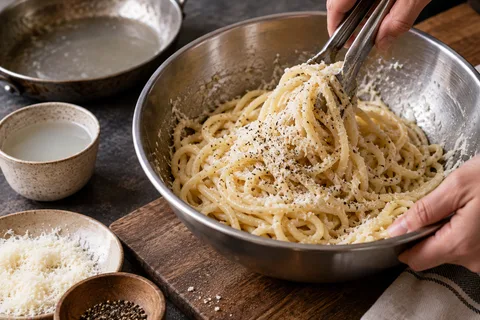
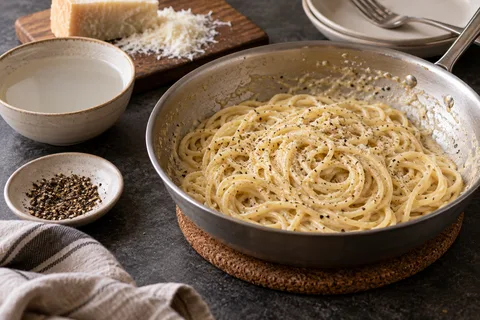
Cacio e pepe comes down to cheese and black pepper, yet almost every failure has one cause — a pan that's too hot when the cheese goes in. Eight chefs split into three schools for that moment.
Italia Squisita's original cacio e pepe gives no water volume or salt amount — just "enough salt" and water used "sparingly." Its amatriciana browns guanciale in a dry, blazing-hot pan instead.
Vincenzo's Plate allows pancetta or salami as a substitute in amatriciana but names bacon specifically as the one to avoid. Here's how guanciale differs, how chefs treat it, and how to buy it online.
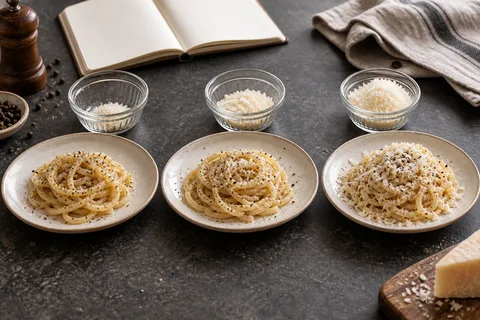
Three channels all calling themselves traditionalist put 25g, 37.5g, and 50g of cheese per 100g of pasta into cacio e pepe — the middle one is half Pecorino, half Parmigiano.
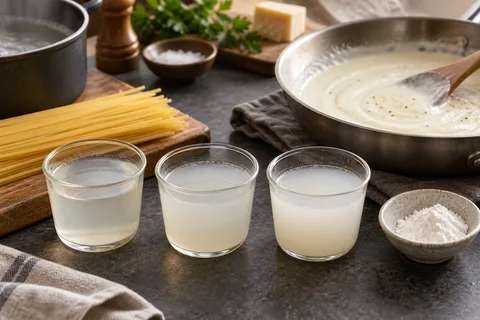
A 2025 physics study found sauce stability turns on starch as a share of cheese mass: under 1% splits, 2-3% is ideal, over 4% stiffens. Kenji cuts the water; the paper's own fix is powdered starch.
Pecorino is salty sheep's-milk cheese; Parmigiano is milder cow's-milk. Some recipes leave the water unsalted so Pecorino carries the salt; others salt it heavily instead. Pick the cheese first.
One Roman amatriciana uses 20g of Pecorino Romano DOP per 100g of pasta — the highest ratio we could confirm for the dish. Buying it as a wedge, in our view, keeps more of the aroma.
Ryuji scatters raw cracked peppercorns at the finish; Pasta Grammar roasts them 4 minutes, then pounds them in a mortar. Grind and heat alone split cacio e pepe pepper into at least four schools.
Cacio e pepe's grated cheese runs 17g to 50g per 100g of pasta, and Fabio adds 50g of cream cheese on top. Rome's three classics split along the same three axes: cheese, pork fat, emulsion.