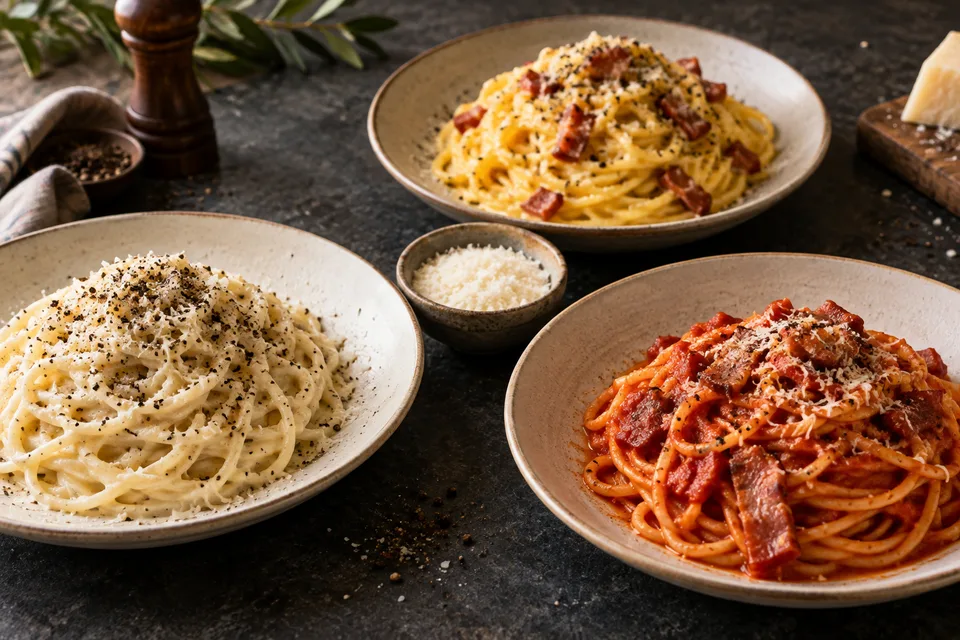
Cacio e pepe’s grated cheese (Pecorino Romano or Parmigiano Reggiano) runs from 17g to 50g per 100g of pasta. That’s how wide the gap gets between schools cooking the same Roman dish. Fabio’s version adds 50 g of cream cheese on top of that, which makes it the heaviest of all in total cheese. And yet structurally, carbonara, cacio e pepe, and amatriciana are the same dish. Cheese and black pepper (cacio e pepe, carbonara), or tomato and guanciale (amatriciana), anchor an emulsion started by fat, starch, or egg, and that sauce gets worked into the noodles either over direct heat, in a bain-marie, with residual heat, or off the heat. Here they are side by side, to sort out what’s shared and where they actually diverge.
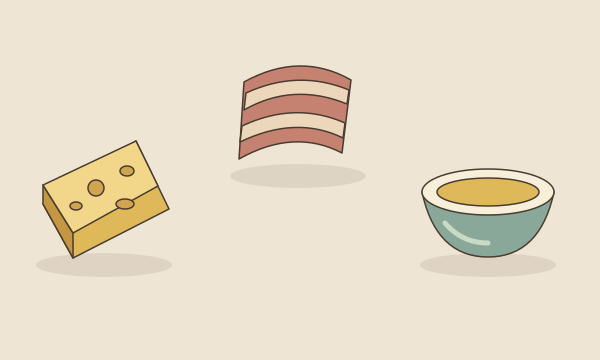
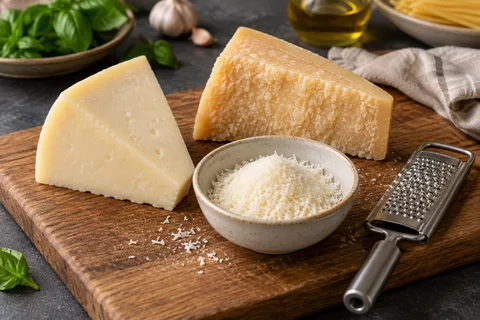
- PecorinoA hard salty cheese links the Roman sauces.
- Pork fatGuanciale links carbonara and amatriciana, but not cacio.
- Emulsion starterEgg, starch, or tomato starts the body of each sauce.
Cheese, pork fat, and emulsion starter map the three dishes.
The structure that runs through all three
The traditional Roman schools build their sauces from cheese, fat, and pasta water alone, with no heavy cream. There are exceptions worth flagging: Tomomi Ogura adds a small amount of heavy cream in his fava-bean version, and Fabio takes the pan off the heat, adds 50 g of cream cheese, and lets residual heat melt it before the Pecorino goes in for his cacio e pepe (see the Fabio cacio e pepe write-up; his own explanation of why this resists separating hasn’t been confirmed in the post text) — both are alternate routes to a stable emulsion. As the editors read it, this region’s “big four pastas” (some groupings count gricia as a fourth; this article sticks to the three whose ingredients overlap most — the gricia breakdown is on the gricia comparison page) become easier to map once you treat them as a product of three variables.
Read the full explanation
- Cheese type and amount: Cheese carries cacio e pepe as the main event, and counting grated cheese alone the amount swings widely — roughly 17 to 50 g per 100 g of pasta, depending on whether the school uses Pecorino alone, blends in Parmigiano, or adds butter or cream cheese. The 17 g floor is Fabio’s version, which uses a separate 50 g of cream cheese on top, making it the heaviest version in total cheese; the 50 g ceiling is the 125 g of Pecorino to 250 g of pasta in Vincenzo’s Plate’s 2026 revision, though the body text on the same page also says 150 g to 250 g of pasta, which would be 60 g per 100 g. Amatriciana ranges from schools that dust cheese on lightly at the end to the Italia Squisita Perilli version, which mantecas 100 g of Pecorino into 500 g of pasta (20 g per 100 g). Carbonara varies the most because the cheese gets folded into egg yolk, spreading from about 10 to 30 g per 100 g of pasta — Vincenzo’s Plate states a hard floor of 30 g, while Serious Eats lands around 11 g
- Pork fat: This is the axis carbonara and amatriciana share. Whether you reach for guanciale, pancetta, or bacon changes how much fat renders out and how salty the dish reads. Cacio e pepe has no pork in it at all
- What starts the emulsion: Egg (carbonara), starch from the pasta water (cacio e pepe), or tomato and wine (amatriciana) — whichever one a school builds the sauce around directly shapes the character of the dish
Pressing play loads YouTube’s embedded player.Open on YouTube
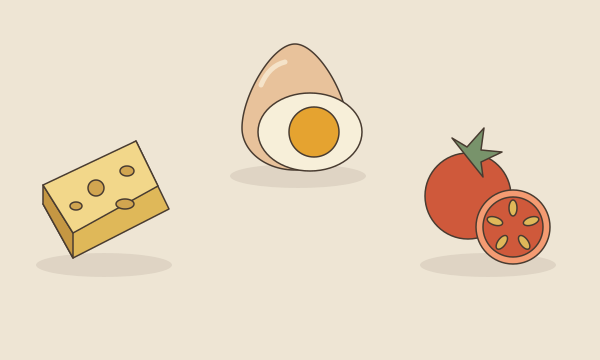
- Cacio e pepeCheese and pepper are the entire sauce.
- CarbonaraCheese seasons and thickens an egg-led emulsion.
- AmatricianaPecorino finishes a tomato-and-pork sauce.
The same cheese shifts from base to support to finish.
Cheese and pepper play different roles in each dish
Cacio e pepe’s constraint — Pecorino and black pepper, nothing else — turns the technique for melting the cheese into the whole point of the dish. The original Armando al Pantheon version that Italia Squisita profiles uses 150 g of Pecorino with no added fat, and mantecas it always off the heat (sempre a fuoco spento). Vincenzo’s Plate’s 2026 version, by contrast, cooks the pasta unsalted in a reduced amount of water, builds a Pecorino paste in a separate bowl with pasta water, then tosses it in a saucepan set over the pasta pot, using the steam’s indirect heat (though the same page’s write-up also says the paste goes into the pan before it’s set on top of the pot, so the source itself disagrees on the order of steps). Both agree on one thing — never put the cheese directly over a flame — which lines up with the general cooking-science point that Parmigiano and Pecorino separate easily at high heat.
Read the full explanation
In carbonara, the cheese goes in early, mixed into the egg base. Tomomi Ogura, in his fava-bean version, matches one egg yolk with an equal weight of Parmigiano and folds it together in a pan that’s already off the heat (no video of a plain version has been confirmed; see the TubeRecipe transcript). Vincenzo’s Plate specifies 3 egg yolks and 1 whole egg with 90 g of Pecorino (a floor of at least 30 g per 100 g of pasta), and sets the pan directly over the pot to build heat through steam so the egg doesn’t overcook.
In amatriciana, cheese most often shows up as a finishing move, and schools split between putting a number on it and just saying “a generous amount.” Pasta Grammar takes the pan off the heat and stirs in a generous amount of Pecorino; Vincenzo’s Plate doesn’t list it in the ingredients at all, but the plating instructions call for “a generous amount of pecorino cheese” — neither puts a number on it. Just tracking how each school handles cheese shows how much the role shifts — from lead ingredient to a finishing touch that sharpens the edges.
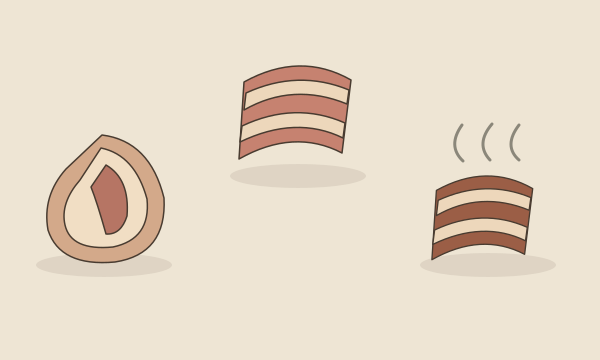
- GuancialeCured jowl supplies the reference fat and crisp lean.
- PancettaUnsmoked belly is the closer structural substitute.
- BaconSmoked belly adds an aroma outside the reference profile.
The pork swap changes both fat yield and flavor identity.
Pork fat: reading the three through guanciale
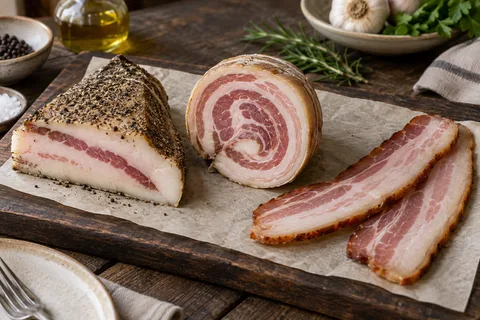
Pork fat is the axis carbonara and amatriciana share. Guanciale is cured pork jowl — higher in fat than pancetta (cured pork belly) and without the smoke that bacon carries — and the choice of cut and heat changes how heavy the finished sauce feels. (Saltiness varies a lot by brand, so it’s hard to generalize.)
Read the full explanation
Vincenzo’s Plate’s amatriciana renders 150 g of guanciale (75 g per serving) slowly over low-to-medium heat with no added oil, and is blunt about substitutes: “Pancetta, salami — not bacon!” Italia Squisita’s Perilli version uses the same guanciale but takes the opposite approach, searing it hard and fast with no oil — so “low and slow” and “hard and fast for color” both stand as legitimate traditional methods. On the Japanese side, Yoshimi Hidaka starts pancetta from cold and cooks it up, and — using pancetta rather than guanciale and adding both onion and garlic — sits at some distance from the traditional Roman line (breakdown data only partially confirmed; see the English write-up of Hidaka’s version. Ryuji’s version, built on bacon and granulated bouillon, sits further out still).
The differences between guanciale, pancetta, and bacon ripple through the whole dish as differences in how the fat renders (saltiness varies too much by brand to generalize). A fuller comparison is in Guanciale vs. Pancetta vs. Bacon.

- Carbonara eggEgg proteins thicken fat and water into a sauce.
- Cacio starchStarchy water helps Pecorino and fat stay dispersed.
- Amatriciana tomatoTomato pulp and liquid carry rendered pork fat.
Each dish starts body from a different binder.
What starts the emulsion: egg, starch, tomato
The biggest difference between the three dishes is what triggers the sauce to thicken. Carbonara relies on the egg’s coagulation temperature; cacio e pepe relies on starch concentration in the pasta water. Amatriciana draws on moisture from the tomatoes plus pasta water, and splits into two camps: the Perilli version, Pasta Grammar, and Yoshimi Hidaka all take the pan off the heat before stirring in Pecorino to finish it, while Vincenzo’s Plate saves the cheese for a topping instead. (White wine varies too — from a glass in Vincenzo’s Plate to a tablespoon in Italia Squisita’s Perilli version, while Ryuji’s version skips it and Fabio’s ingredient list doesn’t mention it, based on a partial reading of the video description.) These three triggers are independent phenomena, but they all come back to the same question: where does the heat actually get built. Carbonara’s split between direct heat, bain-marie, and residual heat is covered in Working Backward From Egg Coagulation in Carbonara; the general principles behind emulsification itself are in What Emulsification Actually Is.
For a fuller breakdown of each school, see the carbonara comparison page, the cacio e pepe comparison page, and the amatriciana comparison page. If you want to pick a chef for each step and build your own version of the dish, each page’s recipe builder can do that.
- Scrambled carbonaraReduce or buffer heat before egg sets.
- Clumped cacioCool the pan and add finely grated cheese gradually.
- Salty amatricianaBalance guanciale, Pecorino, and pasta water together.
Each Roman sauce fails at its defining binder.
Common mistakes and how each school avoids them
- Cheese clumps: Putting cheese directly over a flame makes it separate easily, which is why Italia Squisita and Vincenzo’s Plate both manteca off the heat or with indirect steam. Adding the pasta water gradually helps.
- Egg overcooks (carbonara): The standard fix is to pull the pan off direct heat and finish with residual warmth or a bain-marie. Tomomi Ogura uses a pan that’s already off the heat; Vincenzo’s Plate uses steam to keep the egg from setting too fast.
- Guanciale burns, or the fat doesn’t render: Vincenzo’s Plate goes low-to-medium and slow; Italia Squisita’s Perilli version sears hard and fast for color. These are opposite strategies — picking based on whether you’re after rendered fat or a seared, aromatic edge is the shortest route to fewer failures.
- Shared pantryPecorino, pepper, pasta, and guanciale recur.
- Different binderEgg, starch, or tomato changes the sauce architecture.
- Different heat riskEach binder needs its own temperature control.
Common ingredients do not imply one universal method.
Summary
Carbonara, cacio e pepe, and amatriciana use different ingredients, but they split along the same three axes: how much cheese goes in, how the pork fat is handled, and what triggers the emulsion. Read side by side, Roman cooking looks less like three separate dishes and more like one system competing to control temperature and quantity precisely with a short ingredient list. A good way in is to make one dish exactly as a source specifies, then make a second dish and watch how the same three axes — cheese quantity, pork fat, what starts the emulsion — shift.



 Ingredients