 Ingredients
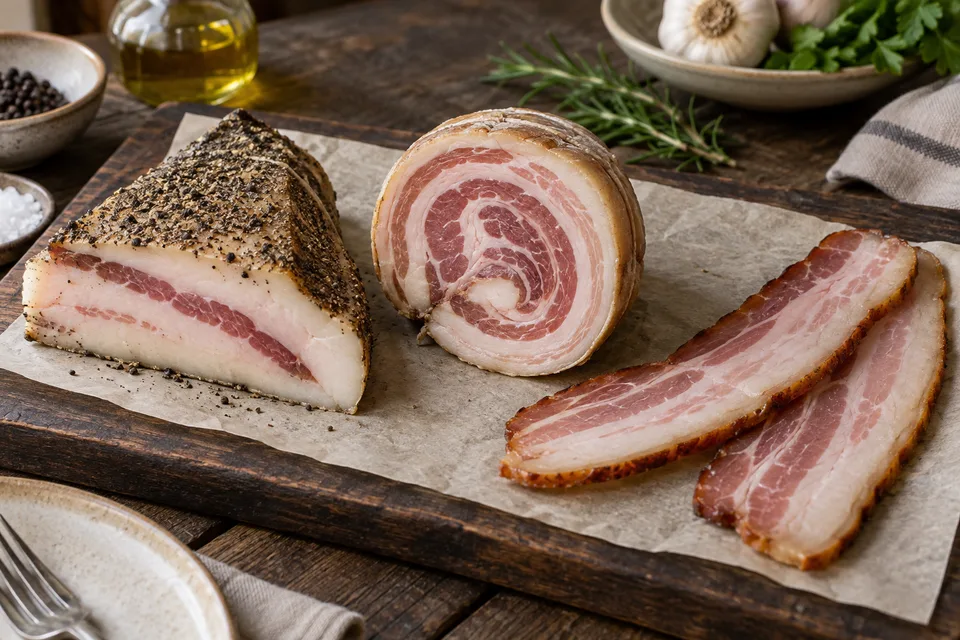
Same word, “cured pork,” but guanciale, pancetta, and bacon render fat in completely different ways. Guanciale (cured pork jowl) has the highest fat ratio; pancetta (cured pork belly) has thinner, more even layers of lean and fat; bacon adds smoke and is the easiest of the three to find. Want the authentic technique exactly? Guanciale. Want to dial back the fat? Pancetta. Want extra aroma? Bacon. Saltiness alone varies too much by product to generalize.
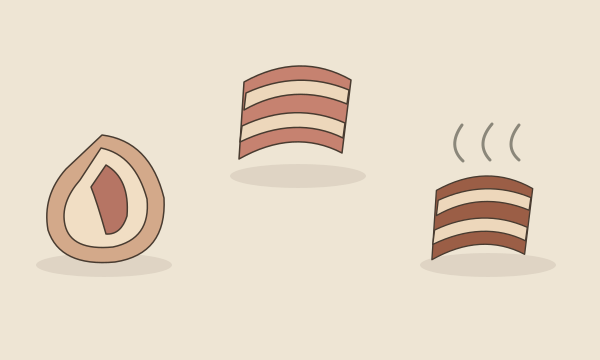
- GuancialeJowl brings the most rendered fat and no smoke.
- PancettaBelly offers more even layers and is usually unsmoked.
- BaconSmoked belly adds an aroma absent from the Roman cut.
Fat structure and smoke separate the three choices.
Fat ratio and smoke split three cuts of the same pig
Guanciale is made by salt-curing pork jowl (the cheek-to-jaw area) and then drying and aging it without smoking. Its fat ratio is high, and when it’s cooked, it splits into crisp lean bits and a large pool of rendered fat. Pancetta is cured pork belly and, like guanciale, is generally not smoked (smoked versions do exist, so check the label when you buy), but its layers of lean and fat are thinner and more uniform. Bacon is pork belly that’s been cured and then smoked; it’s the easiest of the three to find at a Japanese supermarket, but the smoke flavor carries into the sauce.
Serious Eats (Daniel Gritzer) lines the three up on an “authenticity scale,” explaining that moving from smoked bacon to pancetta to guanciale gets you progressively closer to authentic carbonara (source). Pasta Grammar takes a similar line: pancetta or bacon can stand in, though the site notes that in Italy neither is “considered the real thing” — and publishes the recipe anyway.

- Lean ratioSerious Eats uses the low end relative to pasta weight.
- Rich ratioVincenzo’s carbonara reaches the high end of the comparison.
- Cut and renderSlices, cubes, and heat change how that amount eats.
The ingredient name alone says little about sauce richness.
Same guanciale, yet the amount used swings from 19g to 67g
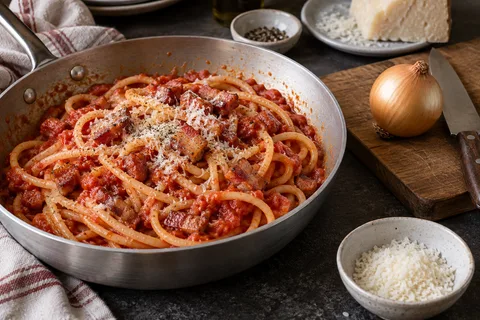
According to the write-up, Fabio’s carbonara recreates the recipe of the chef known as the “king of carbonara,” Luciano, using 45 g of guanciale per serving against 70 g of dry pasta (about 64 g per 100 g of pasta), cut into “large cubes so you can really taste it,” then slow-cooked until crisp to render out the fat. For amatriciana, his video description states plainly that the classic version from Lazio, Rome, uses neither onion nor olive oil. A separate X post from 2022, about a different, earlier video, describes not discarding the rendered fat of guanciale or pancetta and combining it with the tomato sauce as “the secret to making a properly rich, local-style pasta.”
Read the full explanation
Vincenzo’s Plate uses 150 g of guanciale for 2 servings against 250 g of dry pasta in amatriciana (60 g per 100 g of pasta), and is explicit about substitutions: “Pancetta, Salami – not bacon!” A distinctive feature of his method is cooking it slowly over low-to-medium heat and being careful not to trim away too much of the fat.
Pasta Grammar’s carbonara trims the tough outer casing off 125 g of guanciale against 340 g of dry pasta (about 37 g per 100 g of pasta), cuts it into roughly 1.3 cm cubes, and sautés it over medium heat for 4–6 minutes until deeply colored and crisp. For amatriciana, they trim 100 g of guanciale (after removing the casing) against 160 g of dry pasta (about 63 g per 100 g of pasta), cut into larger chunks, and cook it over medium heat for 5–6 minutes — a different cut for each dish.
Serious Eats’ carbonara (Daniel Gritzer) uses 85 g of guanciale against 450 g of dry pasta for 4 servings (about 19 g per 100 g of pasta), the smallest ratio among the recipes compared here. The largest is Vincenzo’s Plate’s carbonara: 200 g of guanciale against 300 g of dry pasta for 3 servings (about 67 g per 100 g of pasta), thinly sliced and cooked over medium-low heat until golden, then removed.
As an example of a chef who puts pancetta front and center, Yoshimi Hidaka, owner-chef of Ristorante ACQUA PAZZA in Minami-Aoyama, puts one minced clove of garlic into the olive oil for amatriciana (2 servings, 160 g of dry pasta), adds 70–80 g of pancetta (about 44–50 g per 100 g of pasta) cold, and keeps the garlic at the edge of the pan so it does not burn while the pancetta cooks slowly until crisp and the fat renders. (The Japanese write-up says the same thing — add the pancetta cold and cook it until crisp to draw the fat out — and the English one words it as “cook from cold.” What is cold is the pancetta; the garlic is handled at the edge of the pan so it doesn’t burn. The source gives no heat level for the pan itself.)
Pressing play loads YouTube’s embedded player.Open on YouTube
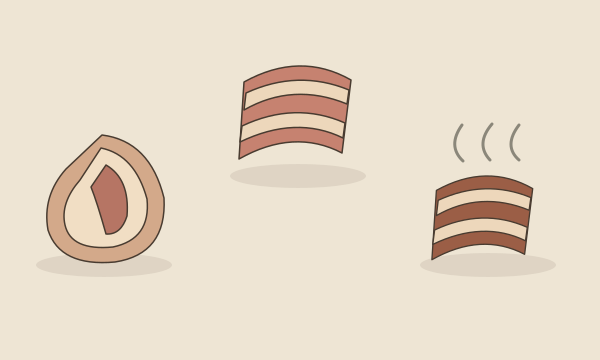
- Maximum rendered fatChoose guanciale when the pork fat builds the sauce.
- Milder cured porkChoose pancetta to reduce fat while avoiding smoke.
- Easy smoky optionChoose bacon when access matters and smoke is welcome.
Pick the cured pork by the result you value most.
Choosing between fat, flavor, and availability
- Want more rendered fat, or want to stay close to the authentic flavor? Go with guanciale. The cut and the heat level vary by chef (cubed, sliced, or chunked; medium or low-to-medium heat), but they all agree on one thing: don’t discard the rendered fat — it goes into the sauce
- Want to hold back the fat but still get cured-pork flavor? Go with pancetta. Yoshimi Hidaka cooks his slowly until crisp to render the fat (the source gives no heat level)
- Prioritizing availability, or want smoke as an accent? Go with bacon. That said, some chefs — Vincenzo’s Plate among them — explicitly rule out bacon as a substitute, so if you’re after an authentic flavor, it’s safer to avoid it
How salty these products run varies a lot by brand, and in our editors’ experience salt content can differ by batch too. Taste a piece before you cook, then dial the boiling water’s salt up or down as a percentage to balance it against the salt already in the pork.
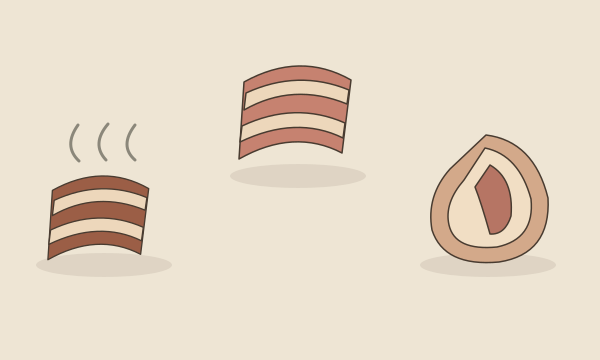
- BaconMost available, but smoke moves furthest from Roman flavor.
- PancettaUnsmoked belly moves closer to the traditional profile.
- GuancialeCured jowl is the reference cut for the Roman dishes.
The authenticity scale moves from smoke toward cured jowl.
Summary: bacon, pancetta, guanciale — in that order of authenticity
Guanciale, pancetta, and bacon are all “cured pork,” but the cut and whether they’re smoked create a clear split in how much fat renders out. For the step where you want to reproduce the authentic technique exactly, slow-cook guanciale to render its fat (the cut and heat level vary by chef); as an example of pancetta taking the lead role, Yoshimi Hidaka cooks it slowly to render the fat (the source gives no heat level). For the actual quantities and heat levels each chef uses, check the carbonara comparison page and the amatriciana comparison page, plus the amatriciana chef comparison article. Gear details are on the guanciale and pancetta pages.