
Drop a coarsely grated chunk of cheese into hot pasta water and it tends to resist melting and seize into a dense little ball (the sources don’t explain the mechanism — this is the editors’ reading). Shave the same cheese into a snow-like powder with a Microplane-style zester and that clumping barely happens. The more a dish melts Parmigiano or Pecorino straight into a liquid, the more the shred itself decides how it turns out.
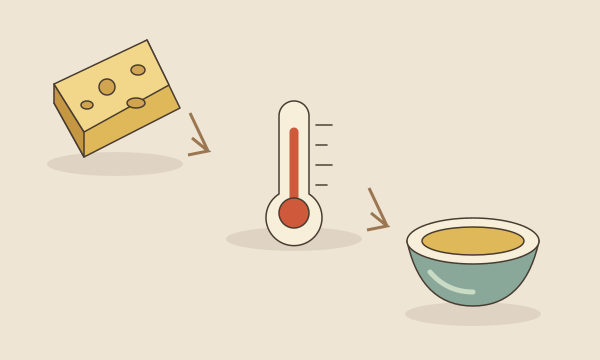
- Large shredsCoarse pieces need more time and heat to dissolve.
- Uneven meltingOuter cheese tightens while inner pieces stay solid.
- Visible clumpsProtein gathers before it disperses through the water.
Fine particles melt before the sauce overheats.
Why coarse cheese turns into clumps
Cheese with more surface area melts faster and blends more evenly into pasta water or an egg mixture. Pasta Grammar names pan temperature as by far the biggest factor behind clumping, and treats shred size as a precondition — if the cheese is already clumpy before it goes in, you’re set up to fail. That a coarsely grated chunk melts from the outside in while the inside seizes into a dense little ball is the editors’ own reading; the source says nothing about melting unevenly from outside to inside. A Microplane-style zester has very fine blades, so it shaves Parmigiano and Pecorino into a powder that’s much less prone to clumping in the first place.
Read the full explanation
Pasta Grammar’s cacio e pepe recipe explicitly calls for grating the Pecorino and Parmigiano into a “super-fine” shred and adding it in small increments, with an added warning that dumping a large amount of cheese into a pan that’s too hot will always seize it (source). The same recipe also calls for taking the pan off the heat and letting it cool for three minutes before adding the cheese — which suggests fine grating, small additions, and pan temperature work together as a set, not as three separate tricks. Here’s Pasta Grammar’s cacio e pepe video:
Pressing play loads YouTube’s embedded player.Open on YouTube

- Microplane usersOgura and Pasta Grammar explicitly favor very fine grating.
- Tool unspecifiedOther chefs state cheese texture without naming a grater.
A fine result may be documented even when the tool is not.
Who reaches for one — and who doesn’t
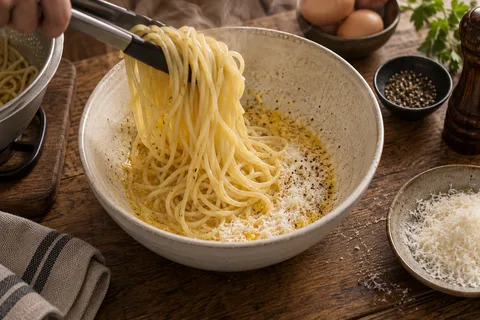
Tomomi Ogura’s own note posts confirm the use of a Microplane-style zester grater. In his cacio e pepe, the finishing step is grating 15g of Parmigiano Reggiano over the dish. In his carbonara (the fava bean version, vol. 26), 1 egg yolk is mixed with an equal weight of Parmigiano in a bowl first, then tossed with the pasta off the heat — that appears to be the build (a plain version is published as vol. 8, but the fava bean version is the only one whose quantities can be followed in a transcript). The same note post also lists a 4-sided box grater as the tool for “when you want to grate cheese coarsely,” so he does appear to pick his grater by shred size.
Read the full explanation
For Ryuji, a third-party gear roundup lists a Microplane-style grater, but its use hasn’t been confirmed in any of his own videos (unverified). What is confirmed in his videos is that he uses store-bought grated cheese (kona-chīzu, the Japanese shelf-stable powdered parmesan-style cheese) rather than grating his own — 30g in his carbonara, 2 tablespoons in his cacio e pepe. For his recipes, it’s hard to say that how the cheese is grated is a meaningful fork in the process.
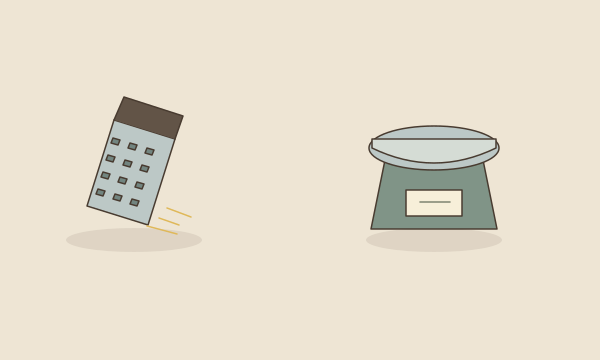
- Particle sizeFiner cheese disperses faster into the emulsion.
- Fluffy volumeA fine grate occupies more space for the same weight.
Judge the tool by texture, but measure cheese by weight.
Two things actually matter: fineness and volume
There are two main things to weigh when picking a cheese grater.
- Fineness of the shred: On dishes like cacio e pepe or carbonara, where the cheese has to melt into pasta water or egg to emulsify, a finer shred means less uneven melting. If you’re just grating cheese over a finished plate, coarseness is more a matter of taste
- How much you can grate at once: A Microplane-style grater has a narrow blade surface, so grating a large batch at once likely takes longer (the editors’ estimate). It’s built for grating one portion’s worth (roughly 15–30g of Parmigiano and Pecorino combined) right before use. If you want to grate a large batch ahead of time, a tool that can switch between coarse and fine, like a 4-sided box grater, will get you through it faster

- Fine raspLook for small sharp teeth that make powdery strands.
- Box grater fine sideA common substitute works if its smallest holes are sharp.
- Pre-grated cheeseConvenient particles may be drier or less uniform.
The substitute succeeds when it reproduces a fine particle.
No Microplane? Here’s what comes close
Without a Microplane on hand, the fine side of a 4-sided box grater will stand in for it up to a point. That said, its blade geometry differs from a Microplane’s, and depending on how much pressure you apply, the shred can come out less even (the editors’ view). A food processor’s fine shredding disc produces strands rather than powder, so for melting cheese into a liquid the shred is a different animal. In the editors’ view, the benefit of a finer, more even shred is easiest to notice on dishes that are prone to failing in the first place, like cacio e pepe.
Grated cheese absorbs moisture and clumps easily, so the general rule is to grate right before you use it. If you do grate ahead of time, keep it in a sealed container in the fridge and use it up as soon as you can.
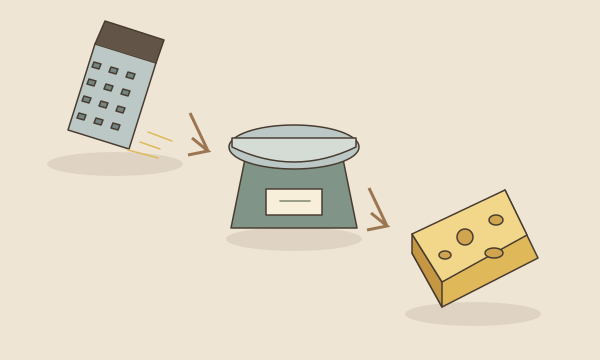
- Grate very fineCreate particles that disperse with limited heat.
- Weigh the cheeseAvoid volume errors caused by a fluffy grate.
- Add off heatProtect the fine cheese from seizing in a hot pan.
Fineness helps only when quantity and heat are controlled.
Summary
Which grater to use comes down to what you’re using it for. Pasta Grammar’s cacio e pepe instructions pair a super-fine shred with small, incremental additions. On the other hand, when cheese is just grated over a finished dish as a garnish — as in Tomomi Ogura’s cacio e pepe — the fineness of the shred has no direct bearing on uneven melting (his carbonara is a different story, since the cheese gets mixed into the egg there). If you want to grate a large batch at once, or switch between coarse and fine, a 4-sided box grater is worth considering as well. For the actual quantities and steps involved, see the cacio e pepe comparison page, the carbonara comparison page, and the article on grated cheese particle size.


 Ingredients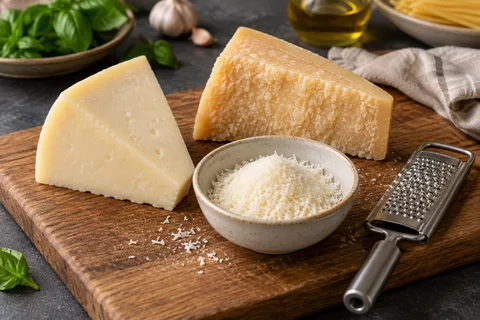
 Chef profiles