 Chef profiles
Pasta Grammar’s pasta comes down to two moves: for carbonara, the pasta water is salted lightly (about half the usual amount, as the official recipe states), and emulsification runs entirely on the residual heat of the pasta itself, with no pan over the flame. Run by Eva, from Calabria, and her American husband Harper Alexander, the channel makes a point of distinguishing regional home cooking from the standard Roman method.

- Regional breadthThe channel explores many local Italian home dishes.
- Roman boundariesCarbonara and cacio e pepe receive firmer authenticity rules.
Their flexibility narrows around the Roman classics.
Generous with regional cooking, strict about Roman tradition
Pasta Grammar’s style is best described as a “regional and historical commentary” school — one that traces the origins and regional differences of pasta dishes back to written sources and family memory. It treats Calabrian home cooking as primary-source material, while also taking a traditionalist stance on Roman classics, noting that substituting pancetta or bacon for guanciale “wouldn’t be considered authentic in Italy.” On the cacio e pepe recipe page, the channel explicitly rejects modern techniques like blenders or xanthan gum, restating a simple principle: this should be a dish anyone can make without overthinking it (source). They also have an episode on the origins of carbonara, though the content of that video itself is unverified (source).
- Salt water lightlyGuanciale and Pecorino supply much of the final seasoning.
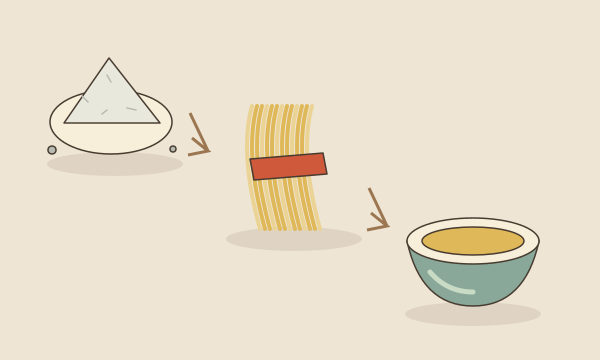
- Use pasta heatHot noodles warm the egg mixture in the bowl.
- Keep off flameNo pan returns to direct heat during emulsification.
Lower salt and residual heat work as one carbonara method.
Technique: less salt, and emulsifying without the stove
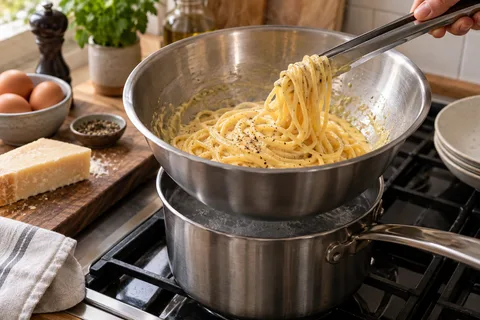
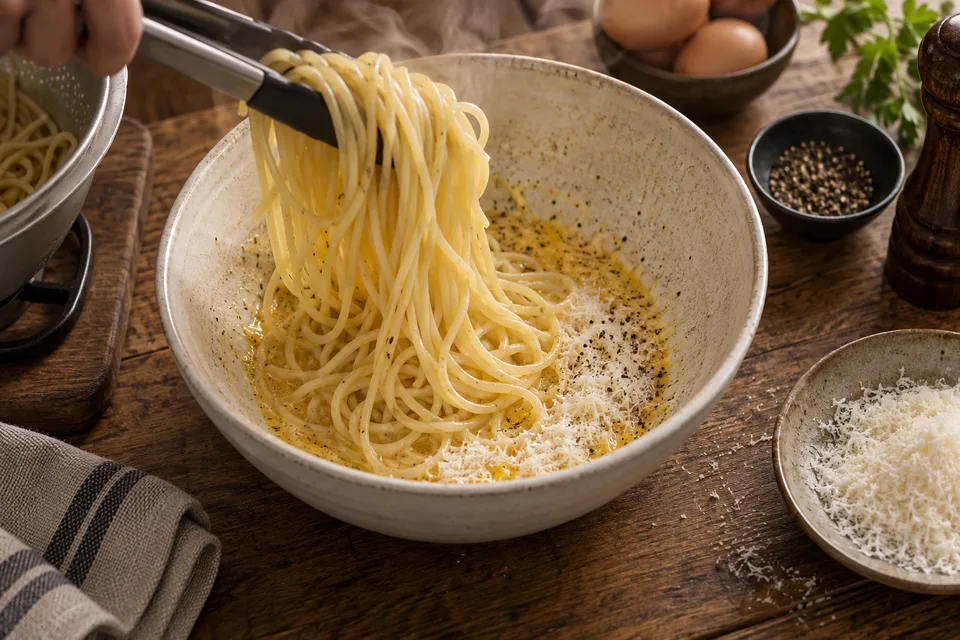
What stands out in the official carbonara recipe (the video counterpart to this recipe is unverified, source) is how sparingly the pasta water is salted. The guanciale and Pecorino already bring plenty of salt, and the recipe states outright that the salt is cut to about half the usual amount — the opposite direction from many chefs, who salt more aggressively. For emulsification, 340 g of pasta (with 125 g of guanciale) meets a bowl already mixed with 4 egg yolks and 55 g of Pecorino; the al dente pasta goes straight in with tongs, and vigorous mixing lets the pasta’s own heat cook the eggs. No pan ever goes back over the flame. The recipe cites the long-standing idea that “the heat of the pasta pasteurizes the eggs,” and explicitly offers a bain-marie option — setting a heatproof bowl over the simmering pasta water — for anyone uneasy about that.
Read the full explanation
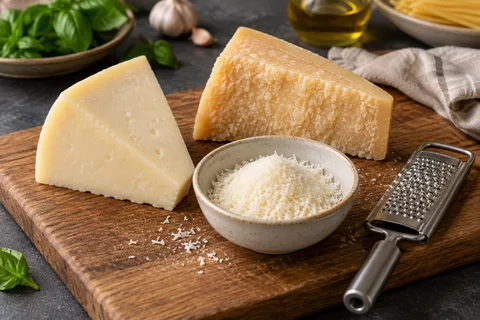
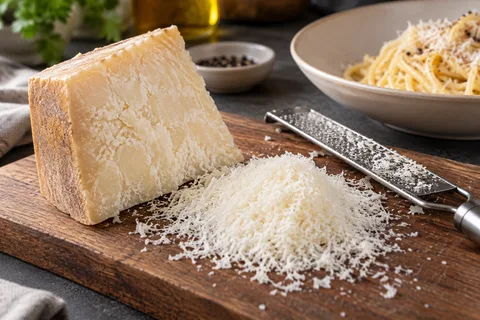
Cacio e pepe (confirmed via both the video and the official recipe, source), by contrast, is defined by a specific cooldown: take the pan off the heat, let it rest three minutes, then add the cheese gradually. The cheese ratio — 30 g Pecorino Romano and 30 g Parmigiano Reggiano, split evenly — is a clear departure from schools that use 100% Pecorino. The official recipe also calls for the cheese to be “very finely grated,” making the fineness of the grate a precondition for the whole method. The official recipe recommends a microplane grater by name, adding that “In Italy cheeses are ALWAYS grated extremely fine.”
Pressing play loads YouTube’s embedded player.Open on YouTube

- Pasta GrammarUses about half its usual boiling salt for carbonara.
- More salted schoolsOther methods season the pasta water at standard or higher levels.
Their salt choice compensates for salty pork and cheese.
Cutting the salt puts them in the minority
The two choices — less salt, no stove — stand out clearly when set against other approaches on the carbonara comparison page. Most schools salt the water at a standard or heavier level, so Pasta Grammar’s roughly-halved approach is a minority position. The cacio e pepe “off the heat for three minutes” cooldown likewise stands out as one particular way to prevent the cheese from clumping when compared with other emulsification methods on the cacio e pepe comparison page. For another school broadcasting from outside Italy, Vincenzo’s Plate’s pasta also makes a useful point of comparison.

- CarbonaraLess salt and pasta heat alone form the sauce.
- Cacio e pepeA three-minute cooldown precedes gradual cheese addition.
Both Roman dishes keep cheese away from direct heat.
Summary
Pasta Grammar combines respect for regional home cooking with a traditionalist streak about what counts as “authentic.” Carbonara uses less salt and emulsifies on pasta heat alone; cacio e pepe rests off the heat for three minutes before the cheese goes in gradually. Cacio e pepe is documented in both a video and the official recipe page, while carbonara is documented only on the official recipe page (no matching video for the carbonara steps has been identified). Start by following the official method as written, then adjust it to your own kitchen — starting with something like a guide to choosing a cheese grater.


 Ingredients