 Chef profiles
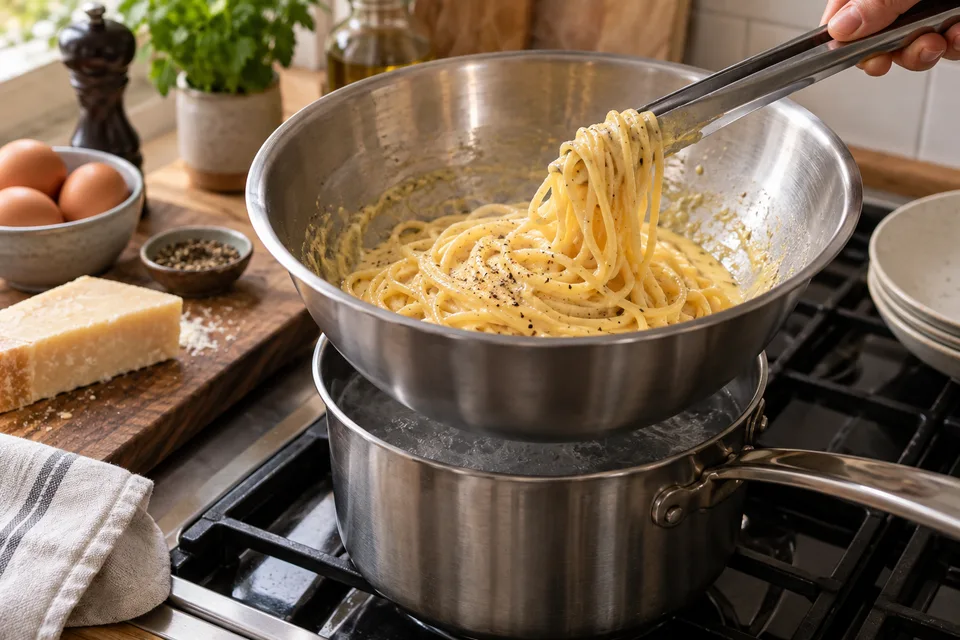
Vincenzo’s Plate never finishes carbonara or cacio e pepe over direct heat. Vincenzo Prosperi, an Italian-born chef now based in Sydney (about 1.65 million subscribers as of 2026-09-05), sets the pan above the pasta pot and lets the rising steam do the emulsifying.
For carbonara, he holds cream-free sauce up as the authentic standard; for cacio e pepe, his 2026 recipe drops salt entirely. In the editors’ view, being an Italian living abroad is part of what drives him to keep drawing the line between the authentic method and how home cooks make do.
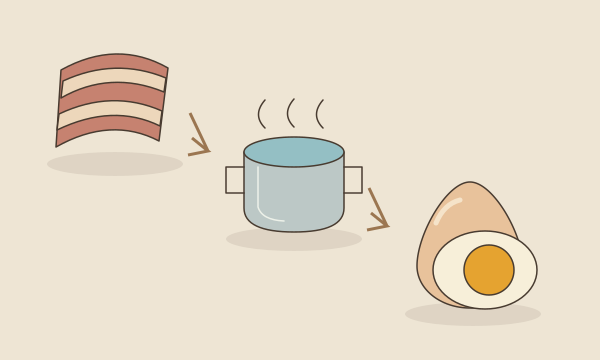
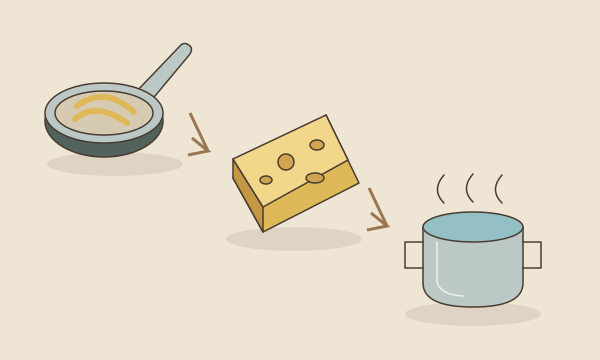
- Toss pasta in fatRendered guanciale coats the hot noodles first.
- Set pan over potRising steam replaces the open flame.
- Fold in egg creamResidual and steam heat thicken the sauce gently.
The egg cooks above the pasta pot, never on the burner.
The egg never touches direct heat
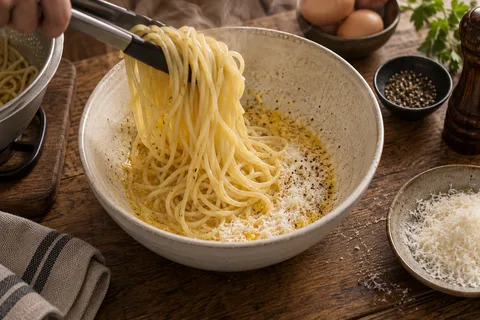
According to the Spaghetti alla Carbonara Recipe, the noodle is 300 g of thick round spaghetti — his own favorite is spaghettoni quadrato, and a thick spaghetti like bucatini works too. He is actually in favor of fresh pasta; the one type he says isn’t really worth using is egg-enriched fresh pasta, which he calls too heavy and hard to digest. Three egg yolks and one whole egg get mixed with black pepper, then 90 g of Pecorino Romano is worked in gradually until the mixture turns into a thick cream.
Read the full explanation
The dividing line is how the sauce is warmed through. The egg-and-Pecorino sauce goes into the pasta, which has already been tossed with the rendered guanciale fat, and the whole pan sits directly above the pot holding the cooking water while everything is combined. The official recipe describes it as a technique he came across during a stay in Rome, and the defining feature is that the egg only ever cooks off the residual heat of steam, never over direct heat. For the finish, the official recipe states a ratio rule — at least 30 g of Pecorino per 100 g of pasta — and presses the point that you shouldn’t go below it. The official recipe also calls for a generous finish of freshly cracked black pepper.
Pressing play loads YouTube’s embedded player.Open on YouTube
He even suggests using the leftover three egg whites for amaretti, which is part of his broader stance against wasting eggs.
- Toast the pepperWarm black pepper first, then remove the saucepan from heat.
- Make cheese pastePecorino and pepper loosen gradually with pasta water.
- Cook and finish over steamLess water concentrates starch before the steam-heated finish.
The 2026 method relies on Pecorino salt and starchy water.
The 2026 cacio e pepe drops salt entirely
Cacio e Pepe Pasta is notable for running both an older recipe and a 2026 version side by side. The older recipe called for a tablespoon of rock salt, but the 2026 version leaves salt out entirely, relying instead on the saltiness of the Pecorino. He also cuts back the water, explicitly aiming to raise the starch concentration of the pasta water. This “boil in less water in a pan to concentrate the starch” logic tracks closely with the conclusion J. Kenji López-Alt reached at Serious Eats by pan-boiling the pasta (see our cacio e pepe chef comparison for more).
Read the full explanation
The method: toast black pepper in a saucepan for about 2 minutes, then take it off the heat. In a separate bowl, combine 125 g of Pecorino Romano with the black pepper, then add pasta water gradually to build a thick paste. The pasta is cooked in the saucepan together with pasta water, and then the saucepan is set over the pot that still holds the boiling water, warming through in the steam while the Pecorino cream is folded in and tossed. Just as with the carbonara, the emulsion here stays off direct heat and finishes entirely in steam.
The article also states, in essence, that “physics research on cacio e pepe published in 2025 confirmed that a higher starch concentration in the pasta water makes the sauce more stable,” citing it as supporting evidence (unverified). It’s also worth noting the same page still carries two Pecorino quantities for two servings — 150 g in the Tips section and 125 g on the 2026 recipe card — but the page’s own FAQ states that the 2026 version updated the quantities to 250 g pasta and 125 g pecorino, so 125 g is the current figure. The 150 g in the Tips section appears to be a leftover from the older write-up.

- Pasta brandsThe guide ranks products through an Italian-authenticity lens.
- Cheese identityParmigiano and Parmesan receive the same provenance scrutiny.
- Aluminum cookwareThe listed pans fit the steam-heated finishing setup.
Ingredient and equipment choices follow the same standard.
The “authentic standard” extends to brand picks, too
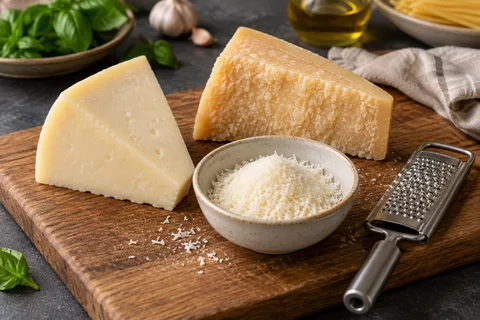
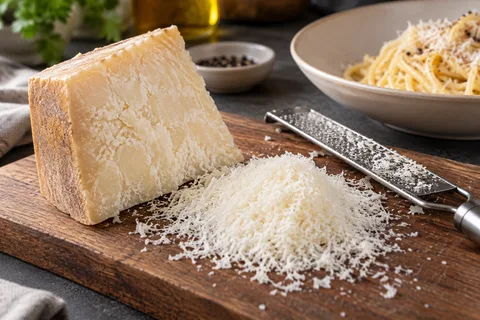
Vincenzo’s Plate also publishes an original Ranking Italian Pasta Brands article that compares De Cecco, Barilla, Garofalo, Rummo, Voiello, Di Martino, and La Molisana from an authentic-Italian point of view. He covers Parmigiano the same way, in Decoding Parmigiano Reggiano and Parmesan Cheese and a blind Parmesan taste test — the same “authentic standard” framing extends all the way down to ingredient selection. As for equipment, the official recipes spell it out in their equipment lists: an aluminum pan for the carbonara, and a large pot plus an aluminum saucepan for the cacio e pepe. In the editors’ view, since the method depends on steam-heating from below, the pan also has to be sized to sit over the mouth of the pot.
The tools and ingredients Vincenzo’s Plate uses are collected here.

- CarbonaraSteam protects egg from direct pan-bottom heat.
- Cacio e pepeSteam protects Pecorino cream from seizing.
One heat route solves two different protein sauces.
Summary: steam, never a flame
Vincenzo’s Plate’s school is consistent across both dishes: set a second pan or saucepan over the pasta pot and emulsify with rising steam rather than direct heat, a design meant to avoid the common failure of scrambling the egg or seizing the cheese over an open flame. That said, the cacio e pepe page still leaves the older 150 g figure in its Tips section, so 125 g — the 2026 version — is the Pecorino quantity to go with. Check the carbonara comparison page and the carbonara chef comparison article to see how other schools differ.


 Ingredients