 Chef profiles
- Guest chefEach recipe reflects the invited cook rather than one host.
- Regional dishThe pairing ties technique to a local tradition.
- Editorial channelItalia Squisita frames the contrast across episodes.
Read each episode as a chef-region pairing.
Italia Squisita isn’t about whose school it is — it’s about who gets paired with whom
Italia Squisita isn’t a single chef’s channel. It’s an Italian food media outlet that invites a well-known chef each episode to make the same dish, then compares technique. For cacio e pepe, it pairs the “originale” (original) version from Claudio Gargioli of the storied Roman trattoria Armando al Pantheon against a “gourmet” (reimagined) version from Cristina Bowerman. Amatriciana follows the same format, pairing Gabriele Perilli’s original version with Angelo Troiani’s reimagined one. This site breaks down the two original versions. In the editors’ view, this pairing format — showing the same dish through direct contrast — is exactly why Italia Squisita gets treated as a primary reference for the four classic Roman pastas.
Pressing play loads YouTube’s embedded player.Open on YouTube

- Measured ingredientsPasta, pork, tomato, and cheese receive exact quantities.
- Judged water and saltThe cook leaves these two variables to context and feel.
Precision stops where pot conditions and seasoning vary.
Only the water and salt go unnumbered: “enough salt” and “go easy on the water”
Gargioli’s version is notable for how many steps are described in feel rather than numbers. The coarse salt is “to taste” (q.b.), and the water is described only as “avara” (stingy — meaning sparing), with no figures given for water volume or salt concentration. This narration style appears common across traditional Roman recipes.
Read the full explanation
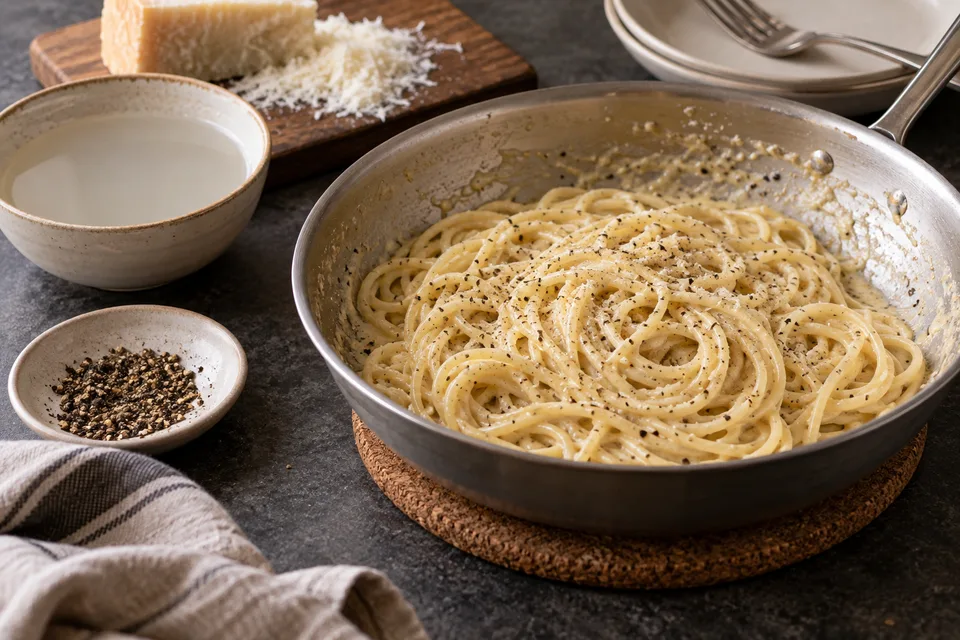
The pepper is one tablespoon of pepe nero cubebe (cubeb pepper); the method calls for toasting it whole in a small pan (the ingredient list, however, specifies it “coarsely ground” — the source contradicts itself on this point). Once the “pearls” of the peppercorns start to turn translucent, that signals the oil is coming out; they’re cooled on absorbent paper, then coarsely crushed in a mortar. Notably, not all of it is ground to powder — some whole pieces are left in.
The emulsification starts with the sauce pan already off the heat. Grated Pecorino (150 g) is worked with a small amount of pasta water, the crushed pepper is added, and the al dente pasta is folded in, with the pan carefully kept off direct heat the entire time for the mantecatura (emulsifying by tossing). Italia Squisita’s recipe text notes: “everything stays liquid, but never wet — that’s the hardest part to get right.” The Pecorino ratio is 150 g for 600 g of spaghetti (25 g per 100 g of pasta), with no fat added at all — a mid-range amount among the cacio e pepe schools compared on this site.
If you want to convert the “sparing” water amount to your own pot size, work the numbers out from the percentage first, then scale them down toward this original version’s restraint. To compare against other chefs’ amounts, see the cacio e pepe comparison page.
- Guanciale aloneIts own fat replaces added oil in the pan.
- Hard searHigh heat browns the guanciale quickly in its own fat.
- Wine deglazeA small splash lifts the browned residue before tomato.
The traditional version builds its base from pork fat.
No oil, full blast: the original amatriciana
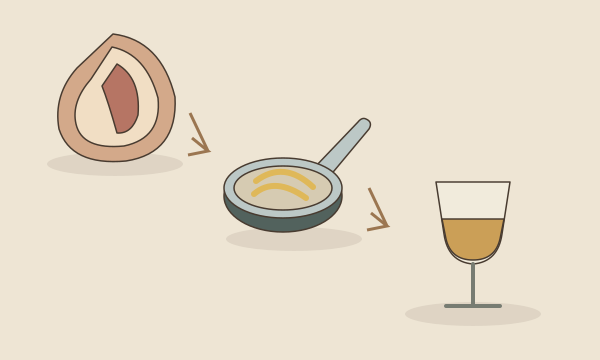
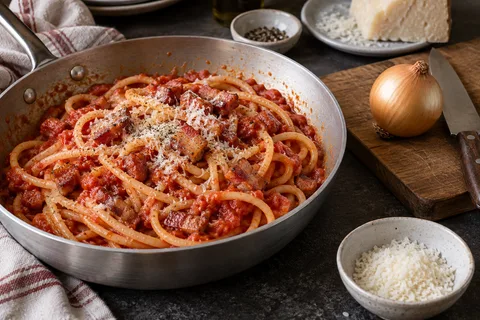
Neither onion nor garlic appears anywhere in Perilli’s recipe — a textbook example of the traditional Roman school (the source never argues for leaving them out; this is read off the ingredient list). The guanciale (150 g) is cut into long strips (the first few slices from the block are discarded), then cooked with no added oil over high heat (fuoco vivo) until deeply browned — the opposite direction from schools that render the fat slowly over low heat.
Read the full explanation
Just one tablespoon of white wine is used to deglaze, then 400 g of whole peeled tomatoes go in, seasoned with salt, with one whole dried chili added at the end; the sauce simmers “piano piano” (slowly). By comparison, Pasta Grammar’s version uses 60 ml of white wine for 160 g of pasta. Normalized per 100 g of pasta, that’s about 3 ml for Perilli’s version versus about 37 ml for Pasta Grammar’s — an order of magnitude apart.
To finish, 500 g of spaghetti is drained 1 minute under the package time and goes straight into the sauce pan. With the heat off, 100 g of Pecorino is folded in over a few minutes of mantecatura. At 20 g per 100 g of pasta, this is among the cheesiest of the amatriciana versions broken down on this site.
Rendering guanciale fat splits into a high-heat school and a slow-render school depending on the chef. To see how others differ, check the amatriciana comparison page.

- Follow the pairingAttribute the method to the featured regional chef.
- Keep the variablesExact quantities coexist with judged salt and water.
- Protect the methodIn amatriciana, guanciale fat starts the sauce alone.
The channel documents distinct chefs within tradition.
Summary
Italia Squisita’s cacio e pepe and amatriciana share one thing in common: both finish with a mantecatura done entirely off the heat. What marks these as the “originale” versions is the cubeb pepper and constant off-heat emulsification for cacio e pepe, and the oil-free high-heat guanciale with just one tablespoon of wine for amatriciana. Since so many of the cacio e pepe steps aren’t given as numbers, start by reproducing the “originale” narration as written to get a feel for it, then mix it with other schools using the recipe builder.




 Ingredients