 Reads
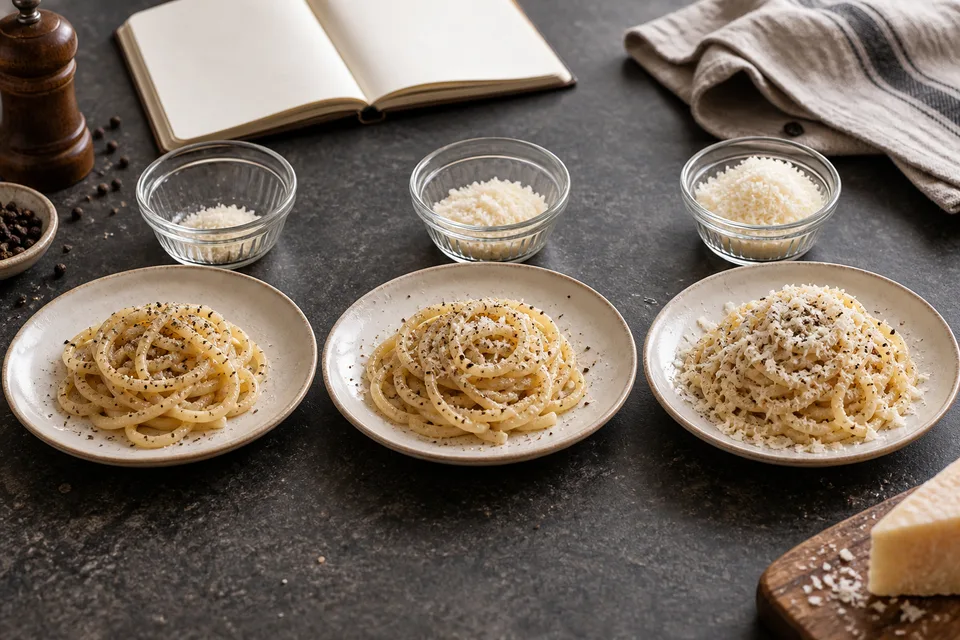
ReadsThree channels that all call themselves traditionalist put wildly different amounts of cheese into the same cacio e pepe — 25g, 37.5g, and 50g per 100g of pasta (the middle figure is a half-and-half blend, 18.75g of Pecorino plus 18.75g of Parmigiano). Overseas pasta YouTube covers the same Roman dishes, but the channels are not all after the same thing. In the editors’ reading, they sort into three broad schools: a traditionalist school that competes on fidelity to the original, a food-science school that uses experiments to show why something works, and a translator school that adapts restaurant technique for the home cook. Line up the same cacio e pepe across all three, and the difference shows up directly in how each one builds the emulsion.

- Lower cheese ratioOne traditionalist method keeps the dairy load restrained.
- Higher cheese ratioAnother uses roughly twice as much for the same pasta scale.
A shared authenticity label does not standardize quantities.
Even inside “traditionalist,” the cheese swings by 2x
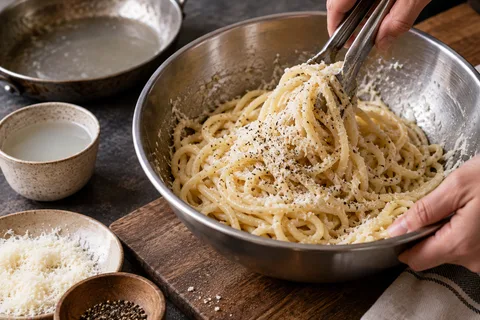
Italia Squisita is not a solo channel but a media outlet that invites a well-known chef each episode to compare technique. For cacio e pepe, it runs an episode titled “originale vs. gourmet,” pitting traditionalist Claudio Gargioli against reconstructionist Cristina Bowerman. Gargioli’s method, for 600 g of pasta, melts 150 g of Pecorino (25 g per 100 g of pasta) and pasta water into a pan taken off the heat, adds pepper, and then always tosses the pasta with the pan off the flame — the technique known as mantecare. The Italian recipe page describes the hardest part as “keeping everything liquid, yet never wet.”
Read the full explanation
Pressing play loads YouTube’s embedded player.Open on YouTube
Pasta Grammar is a husband-and-wife channel run by Eva, from Calabria, Italy, and Harper, from the US, and its core is comparing regional variations. Its cacio e pepe episode, titled “Stop Overthinking,” keeps the steps minimal: boil the pasta hard, take it off the heat and let it cool for three minutes, then sprinkle in 60 g of combined Pecorino and Parmigiano (30 g each, for 160 g of pasta, two servings — 37.5 g of cheese per 100 g of pasta, or 18.75 g of Pecorino on its own) a little at a time. The recipe article states plainly that “a large amount of cheese dropped into a pan that’s too hot will always clump” — among the traditionalists, this channel puts its weight on temperature management that is hard to get wrong at home.
Vincenzo’s Plate is run from Sydney by an Italian-born host, and its explanations turn on “how a real Italian makes it.” It publishes both an original and a 2026 version of cacio e pepe; the 2026 version uses less pasta water, skips salt to raise the starch concentration, then works 125 g of Pecorino (for 250 g of pasta, 50 g per 100 g) into a thick paste with black pepper in a separate bowl before melting it in a saucepan set on top of the pasta pot, using the rising steam (the same page’s tips section also gives an alternative 150 g of Pecorino for 250 g of pasta, and its FAQ puts the 2026 version at 125 g). Rather than reproducing the traditional technique as is, this channel revises its own steps while still claiming an authentic-Italian standard — a different branch from Gargioli or Pasta Grammar within the same traditionalist school.
- POV cookingKenji films the process from the cook’s point of view.
- Keep the failed stepUnsuccessful moments remain in the edit instead of vanishing.
- Explain the departureHis cacio e pepe openly identifies butter as nontraditional.
Visible process and admitted departures build the argument.
The food-science school leaves the failed take in the edit
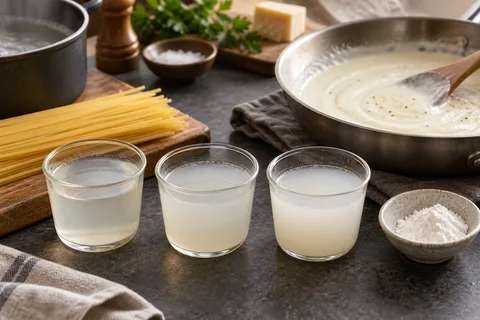
J. Kenji López-Alt is the former Managing Culinary Director at Serious Eats and is still its Chief Culinary Advisor, as well as a two-time James Beard Award-winning columnist. His filming style is first-person POV, and he keeps failed steps in the edit rather than cutting them. His cacio e pepe recipe article skips the big pot, boiling 225 g of pasta in just enough water to cover it in a 12-inch skillet to concentrate the starch in the cooking water, then moves 2-3 tbsp of that water into a separate pan of pepper oil and butter and works in 55 g of Pecorino (24.4 g per 100 g of pasta) grated extra-fine on a microplane. The video that matches this recipe is Food Lab Basics: POV Cacio e Pepe, whose description links straight to this recipe article; the amounts here follow the recipe article. Within that scope, it looks like a different design from the classic Roman method. In that same video’s description, he notes that adding a small amount of butter to cacio e pepe departs from tradition. The same description also says this is one of those dishes you don’t need to measure — his repeatability rests less on exact amounts than on the process, namely pasta water and vigorous stirring to emulsify.

- Italian sourceA regional recipe supplies the starting structure.
- Home-kitchen translationIngredients and equipment shift for another audience.
- Explanation layerThe creator teaches why the adaptation still works.
The value lies in adapting technique across kitchens.
Translators sell the translation, not the original itself
Stephen Cusato of Not Another Cooking Show states on his own site that his carbonara studies the technique of Roman chef Luciano Monosilio and reworks it for the home cook. His cacio e pepe video is titled around “how they do it in Rome” and centers on the process of emulsifying the cheese (we have not broken down the steps, so the details remain unverified). The emphasis here sits less on showing the original itself and more on translating it and delivering it.

- TraditionalistsStart from regional legitimacy but disagree on ratios.
- Food scienceBuild authority through visible tests and revisions.
- TranslatorsBuild authority by making techniques travel.
Channel type predicts the promise, not one fixed recipe.
Summary
Across the same cacio e pepe, the traditionalists compete on matching the original, the food-science school on repeatability, and the translators on how easy the dish is to make at home. None of the three is simply “correct” — they are just different yardsticks. Watching only one channel can leave you thinking “this is how it’s really done in Italy,” but reading the cacio e pepe chef comparison and the science of emulsification alongside this piece makes it clearer which fork in the road each school is actually committed to. The Italia Squisita profile and the Kenji López-Alt profile are also good entry points for tracing these differences across each channel’s full video list.

 Ingredients