 Chef profiles
- Video guidanceKenji emphasizes adjustment and observation while cooking.
- Published recipeSerious Eats supplies measured quantities for repetition.
Loose spoken advice and precise written recipes serve different uses.
Don’t measure precisely, he says. Then the site prints grams.
J. Kenji López-Alt is the former Managing Culinary Director at Serious Eats and is still its Chief Culinary Advisor, as well as a two-time James Beard Award-winning New York Times columnist. His videos are shot first-person POV and drive relentlessly at the question of why something works, keeping failed steps in the edit rather than cutting them out. He states outright that measurements don’t need to be precise, yet his Serious Eats articles carry a “Why It Works” section that lays out the reasoning point by point.
Serious Eats itself refers to the US food media outlet where López-Alt once worked. The current carbonara recipe on the site is written by Editorial Director Daniel Gritzer, a different author from López-Alt. In the editors’ view, reading the two side by side — one person and one outlet — shows how personal habits and editorial house style diverge even within a shared “food-science” method.
Pressing play loads YouTube’s embedded player.Open on YouTube
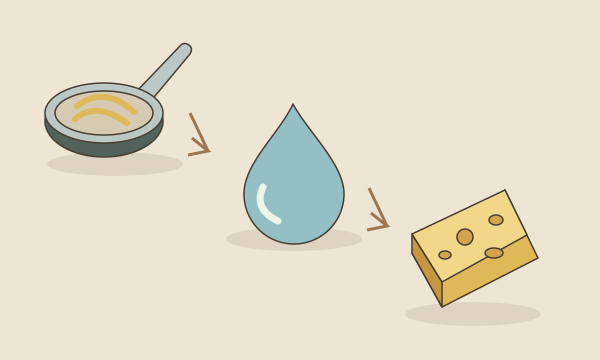
- Shallow skillet boilLess water becomes starchy more quickly around the pasta.
- Reserve concentrated waterThe liquid carries more binding starch into the sauce.
- Add cheese off heatGentler finishing protects the emulsion from clumping.
The skillet changes the starch concentration before cheese.
Cacio e pepe: Kenji’s skillet with less water
For cacio e pepe, a recipe article written by López-Alt himself survives on Serious Eats (no matching official video has been confirmed; the video embedded above is a first-person Food Lab Basics video covering the same dish, and the amounts below come from the article). He boils 225 g of spaghetti not in a large pot but in a 12-inch skillet with just enough water to cover the noodles, a setup designed to concentrate the starch in the cooking water. He salts it with only a pinch and pulls the pasta about 1 minute under package time.
Read the full explanation
The pepper is bloomed in 3 tbsp of olive oil over medium-low heat for about 1 minute, then the skillet comes off the heat to cool; 2–3 tbsp of the pasta water goes in, 30 g of unsalted butter is stirred in after it, and the noodles go straight from the pot into the skillet with tongs. 55 g of Pecorino Romano, grated as finely as possible with a Microplane, is added and mixed with a fork until fully melted. Finishing in a separate skillet rather than the boiling pot, he explains, prevents the cheese from clumping from the residual heat of the cooking pot (the figures above come from the archived June 27, 2024 update cited). This direction of “less water, more concentrated starch” also overlaps with the 2026 revised version from Vincenzo’s Plate, a different school (less water, no salt). That said, Vincenzo keeps a large pot and simply reduces the water — he doesn’t boil in a skillet the way Kenji does. What the two share is the direction of less water and more concentrated starch, plus skipping the salt; for toasting the black pepper and melting the cheese, Vincenzo uses a saucepan (an aluminum one). Its school classification, “authentic Italian standard,” also sits in a separate category from Kenji’s food-science testing school.

- Kenji videoResidual pasta heat and active tossing cook the egg sauce.
- Gritzer recipeA bowl over hot water supplies controlled backup heat.
The same publication presents two different egg-heat routes.
Carbonara: Kenji on video, Serious Eats via Gritzer’s double-boiler
Carbonara is where the two paths split. López-Alt’s own video, “How to Make Classic Pasta Carbonara,” has been confirmed to exist, but the exact amounts and temperatures it walks through haven’t been transcribed for this piece, so this article doesn’t dig into that level of detail. What is confirmed about his personal technique is a policy of whisking vigorously while adding the cheese to emulsify it and prevent clumping, plus a broadcasting style that covers Roman pastas systematically as part of his Food Lab Basics series.
Read the full explanation
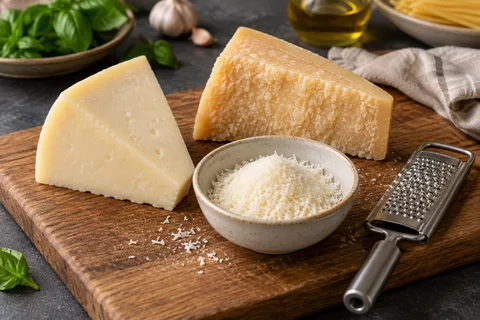
The current official Serious Eats recipe, on the other hand, is written by Daniel Gritzer and uses a bain-marie (a heatproof metal bowl set over the pasta pot, its bottom kept clear of the water), a design the recipe itself describes as leaving no room for failure. Two whole eggs plus 6 egg yolks (for 4 servings) are whisked in the bowl, and Pecorino and Parmigiano are blended 50:50. The recipe spells out that Pecorino alone would be too assertive — a point also covered in our article on choosing cheese. Guanciale is diced and rendered crisp, the pasta is tossed in the fat, then combined with the egg mixture and pasta water and stirred with tongs inside the bowl set over the pot to build the sauce — the double-boiler method (see the official recipe for exact amounts and timing). Because the pasta water is meant to go into the sauce, the Notes warn to go light on salt in the boiling water.
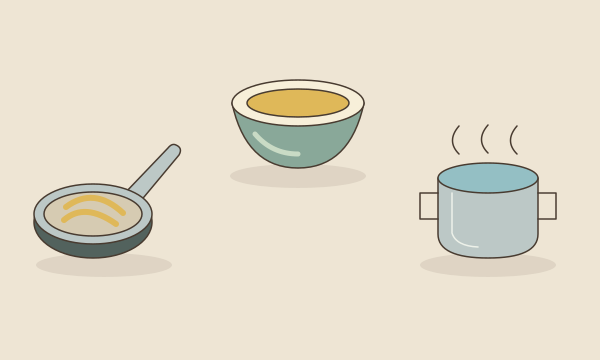
- SkilletShallow water concentrates starch during boiling.
- Mixing bowlMoving off the burner limits stored pan heat.
- Double boilerSteam adds heat without direct flame contact.
Equipment determines whether heat concentrates or softens.
Splitting how the heat lands, through equipment
What the two have in common is a refusal to lean on feel-based language (“until it’s creamy,” “watch it closely”) in favor of temperature, time, and weight. The cacio e pepe skillet method is engineered to concentrate starch in the pasta water, while clumping from residual heat is handled by a separate step — finishing in a skillet apart from the boiling pot. The carbonara bain-marie, meanwhile, sets a metal bowl over the pasta pot to take the edge off the heat by one step and slowly bring the egg mixture up just short of setting. Both share the idea of “splitting how heat lands using equipment,” but the target differs: starch concentration in the first case, controlling egg coagulation in the second. Emulsification itself is general kitchen science that applies across schools — egg yolk is said to start setting at around 65°C (see our article organizing schools by egg coagulation temperature; the roughly 58°C often cited for egg white is a widely circulated rule of thumb whose primary source we have not confirmed) — and where in that band each chef stops is what separates the schools.
Read the full explanation
There are differences too. López-Alt’s own video leaves amounts flexible, stating plainly that precise measuring isn’t necessary, while the current Serious Eats article specifies down to the gram and milliliter, even writing in equipment conditions like a “Large, metal heatproof mixing bowl (large enough to nest on top of the pasta pot without the bottom touching the boiling water).” It looks like the temperature gap between first-person personal content and an editorially vetted outlet recipe. This gap also echoes the hand-mixer emulsification method from Fabio covered in our comparison of tool-driven emulsification schools.
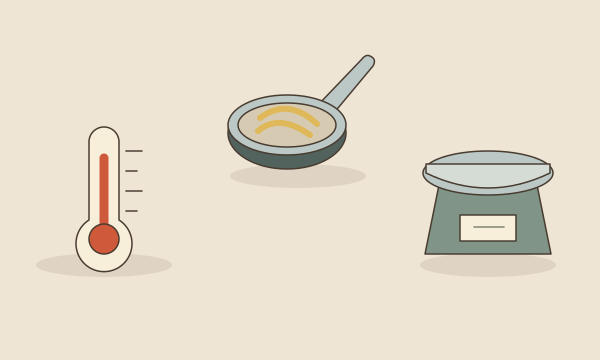
- Observe and adjustTreat texture as feedback rather than blind timing.
- Use the setupSkillet or double boiler changes the physical conditions.
- Keep measurementsPrinted grams make the experiment reproducible.
Kenji pairs measured recipes with adaptive technique.
Summary
J. Kenji López-Alt is a first-person science communicator who leaves room in his amounts, while Serious Eats (currently under Daniel Gritzer) is an editorially locked-down recipe specified down to the gram — two different roles within the same “food-science testing” school. What they share is a design that controls the heat reaching the cheese or egg mixture through equipment. Kenji finishes in a skillet separate from the boiling pot to avoid clumping; Gritzer softens the heat by one step in a bowl set over the pasta pot to keep the egg mixture just short of setting. If you want to dig further into the carbonara temperature range itself, see our article organizing schools by egg coagulation temperature; if you’d rather compare the actual steps side by side, try our chef-by-chef carbonara comparison page.



 Ingredients